3 Days in Tokyo: A Luxury Weekend Itinerary
A 3-day Tokyo itinerary built around neighborhoods, rituals, restaurants, and hotels that make the city feel unforgettable.
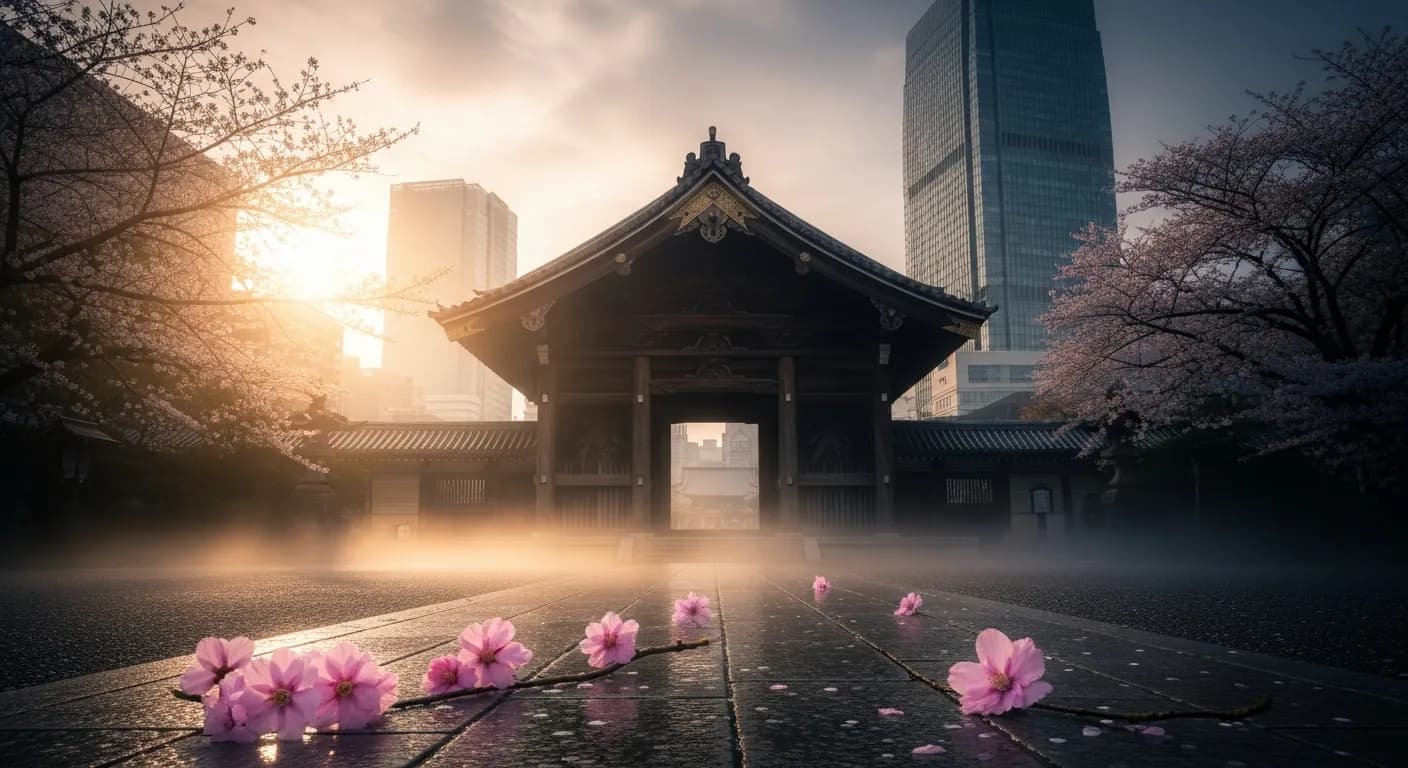
There is a particular kind of silence that exists only inside a plane descending into Haneda at 4 AM. The cabin lights are still dimmed, most passengers are folded into restless sleep, and through the oval window Tokyo reveals itself — a sprawling constellation of white and amber light pressed against the dark curve of Tokyo Bay. I pressed my forehead to the cold glass and thought: this city has been awake the entire time I was crossing the Pacific.
If you can, fly into Haneda. It sits just fourteen kilometers from central Tokyo, and the difference between landing here versus Narita — sixty kilometers out, buried in Chiba Prefecture — is the difference between stepping into the city and commuting to it. From Haneda, the Keikyu Line deposits you at Shinagawa Station in fifteen minutes for roughly ¥510 to ¥610 (about $3.50 to $4). From Narita, you’re looking at the Narita Express: ¥3,070, fifty-three minutes, and the creeping feeling that Tokyo is playing hard to get.
Before you leave the airport, do one thing. Load a Suica card onto your Apple Wallet, or buy the physical card at any station kiosk for a ¥500 deposit. This little rectangle of digital magic works on every train, every bus, every convenience store register, and every vending machine in the city. It is, without exaggeration, the single most useful thing you’ll carry in Tokyo. The second most useful thing is cash — and I mean actual paper bills. Load ¥10,000 to ¥20,000 into your wallet before you leave the airport. Many of the best places in Tokyo — the tiny sushi counters, the shrine offering boxes, the market stalls where breakfast is born at dawn — don’t take cards. They don’t want your cards. They want the crisp rustle of yen, and honestly, there’s something beautiful about a city that still believes in the tangible.
One more thing, and I cannot stress this enough: do not tip. Not your server, not your taxi driver, not the concierge who just rearranged the impossible to get you a reservation. In Japan, exceptional service is the baseline, not a transaction. Leaving money on the table isn’t generous here — it’s confusing at best, insulting at worst.
Who this 3-day Tokyo itinerary is for
This is for readers who want a first Tokyo trip that feels considered rather than frantic. Choose your base from my guide to the best luxury hotels in Tokyo, keep my Tokyo hidden gems guide nearby for detours, and read the Aman Tokyo review if that hotel is on your shortlist.
Day One: The City Before It Wakes
Your first morning starts in darkness. Set an alarm you’ll hate, leave the hotel while the lobby is still empty, and take the subway to Tsukiji. The ¥200 fare buys you entry to a world that most visitors sleep through entirely.
Tsukiji Outer Market comes alive around 5 AM — over four hundred stalls compressed into narrow alleys where the air is thick with charcoal smoke and the sweet-salt scent of grilling seafood. This is free to explore, which feels almost criminal given what it offers. I wandered for an hour before I could bring myself to commit to breakfast, passing vendors fanning binchotan coals beneath rows of scallops, watching a woman press tamagoyaki — those impossibly fluffy layered egg omelets — into perfect golden rectangles on a copper pan. She handed me one still warm for ¥200. I ate it standing in the alley and it was, without question, one of the ten best things I’ve ever tasted.
Eventually you’ll find your way to a sushi counter. Daiwa Sushi and Sushi Dai are the legendary ones — eight to ten seats each, chefs whose hands move with the kind of muscular grace that only comes from decades of repetition. The omakase starts around ¥4,000 (roughly $26), and the wait can stretch to two hours. I’ll tell you what I tell everyone: the wait is part of it. Stand in line. Watch the alley wake up around you. Talk to the Australian couple ahead of you who’ve been here since 4:30. When you finally sit down and the first piece of tuna touches your tongue — deep ruby, cool, tasting like the ocean distilled to its purest expression — you will understand why people fly across the world for a counter with eight seats.
By mid-morning, the spell of the market will release you, and that’s when you head to Asakusa. Senso-ji Temple is free, ancient, and best experienced before nine o’clock, when the tour buses begin to circle. Walk through the Thunder Gate — Kaminarimon, with its massive red lantern — and down Nakamise-dori, a hundred and fifty meters of traditional stalls selling rice crackers, silk fans, and wooden combs that have been made the same way for generations. At this hour, the shopkeepers are still arranging their displays, and the temple grounds are hushed. Incense smoke curls through morning light. Elderly women in kimono move between wooden structures like visitors from a more graceful century. This is the Tokyo that existed long before the neon, and it’s still breathing.
Afternoon belongs to Shibuya. I know you’ve seen the crossing in photographs — that aerial shot of a thousand tiny figures surging across white-striped asphalt from five different directions. What the photos don’t capture is the sound: the collective shuffle of three thousand people per crossing at peak hours, the jingles from the Don Quijote across the street, the train announcements layered over each other like an urban symphony. Don’t just watch it from above. Descend into it. Let yourself be carried by the current.
But then — and this is the part most people skip — take the elevator up. Shibuya Sky sits two hundred and twenty-nine meters above the crossing, an open-air rooftop observation deck that costs ¥2,000 and is worth ten times that at sunset. I arrived at golden hour and watched the city transform below me: the daytime gray giving way to an electric tapestry of white headlights and red taillights, office windows flickering on one by one, the crossing shrinking to a pulsing organism of light far below. The wind at that height carries the faint suggestion of the Pacific.
Dinner is at Omoide Yokocho — Memory Lane — a tangle of sixty-odd tiny stalls tucked beside Shinjuku Station’s west exit. The alley is barely wide enough for two people to pass. Smoke from yakitori grills hangs in the air like weather. I wedged myself onto a stool at a counter where the chef was threading chicken hearts onto bamboo skewers with surgical precision. Yakitori starts at ¥100 per skewer — roughly sixty-five cents — and a cold Asahi runs about ¥400. I ordered too much of everything, talked to a salary man who practiced his English between beers, and stumbled back to the station around eleven with smoke in my hair and the deep satisfaction of a day that started in a fish market at dawn and ended in a yakitori alley at night.
A word about those last trains: they stop running around midnight. If you lose track of time — and you will, in a place like Memory Lane — budget ¥3,000 to ¥5,000 for a taxi back to your hotel. Or just stay out until the first trains resume at five. Tokyo is one of the few cities where both options feel perfectly reasonable.
Day Two: Forest, Fashion, and the Bars That Seat Six
Meiji Shrine asks nothing of you but your presence. There is no admission fee. There is no guided tour. You simply walk through the massive torii gate and into seventy hectares of forest that somehow exist in the dead center of Shibuya — one of the most densely built neighborhoods on Earth. I arrived before eight, and the only sounds were gravel underfoot and birdsong filtering through a canopy so dense it blocked the sky entirely. The shrine itself is austere and immaculate. I watched a young couple in wedding attire — she in white silk, he in black hakama — cross the courtyard in perfect, practiced steps. Nobody applauded. Nobody needed to.
From the shrine, walk south along Omotesando — sometimes called Tokyo’s Champs-Elysees, though I think it’s more interesting than that. The boulevard is lined with architectural landmarks that happen to sell clothing: the Prada building by Herzog & de Meuron, its faceted glass surface catching light like a diamond; Tod’s wrapped in intersecting concrete ribbons; Dior’s translucent skin glowing faintly even in daylight. You don’t need to buy anything. Window shopping here is a free architecture tour that would cost you forty euros in any European city.
The boulevard spills you naturally into Harajuku, and Takeshita Street is exactly the sensory overload you’ve been promised. Crepes stuffed with strawberries and whipped cream for ¥400 to ¥600. Vintage band tees mixed with cutting-edge streetwear. The sweet-smoke scent of freshly pressed imagawayaki. It’s loud and joyful and unapologetically young, and after the morning’s serenity at Meiji Shrine, the contrast feels intentional — as if Tokyo is reminding you that reverence and exuberance are not opposites here.
By early afternoon, escape the crowds. Take the Keio Inokashira Line two stops to Shimokitazawa — a neighborhood that feels like Tokyo’s answer to Brooklyn, if Brooklyn had better coffee and more interesting secondhand stores. Flamingo is the vintage shop everyone whispers about: curated racks of denim, leather, and silk priced between ¥3,000 and ¥8,000. I found a 1970s suede jacket for ¥5,000 — about $32 — and wore it for the rest of the trip. Around the corner, Bear Pond Espresso serves what might be the best shot in Tokyo from a narrow counter with a hand-lettered sign that reads “No Photos.” I respected it. You should too. Some things are meant to be experienced only once, in the moment, without a screen between you and the cup.
Evening. Golden Gai. This is the one you’ve heard about, and it deserves every syllable of its reputation. Tucked behind Shinjuku Station, Golden Gai is a labyrinth of over two hundred bars crammed into six narrow alleys. Most seat six to ten people. Some seat four. The cover charges range from ¥500 to ¥2,000, and they exist not to gouge you but to keep the bars intimate — these are living rooms, not nightclubs. I found a bar on the second floor of a building so narrow I had to turn sideways on the stairs. The bartender was a retired jazz musician who poured whisky with the concentration of a surgeon and played Coltrane on a speaker smaller than my fist. There were five of us in that room — me, the bartender, a French photographer, and a Japanese couple celebrating something they wouldn’t explain. By the second drink, we were all friends. By the third, we were family. That’s Golden Gai.
On the trains home — and remember, they stop at midnight — observe the unspoken rules. No phone calls. No eating on local trains (the shinkansen is different, but you won’t need the bullet train for this trip). Speak softly. The Japanese word you need most is sumimasen — it means excuse me, sorry, and thank you, depending on context and inflection, and you will use it a hundred times a day.
Day Three: The Art of the Elegant Goodbye
Your final morning deserves a different tempo. Ginza wakes slowly compared to the rest of Tokyo — the boutiques don’t open until ten or eleven — so use the early hours to walk. The district’s wide boulevards and clean geometry feel almost European after two days of Tokyo’s beautiful chaos. At Ginza Six, take the elevator to the rooftop garden. It’s free, it’s immaculate, and at nine in the morning you’ll have it nearly to yourself — a private terrace suspended above a city of fourteen million.
For lunch, find Uogashi Nihon-Ichi, a standing sushi counter where the etiquette is simple: point, eat, repeat. Pieces run ¥150 to ¥400 each — roughly a dollar to $2.60 — and you eat them standing at a narrow counter with no reservations, no pretense, and no wasted motion. I had six pieces of the day’s selection, paid about ¥1,800 for what would cost forty dollars anywhere in Manhattan, bowed to the chef, and walked out into the Ginza sunshine feeling unreasonably happy.
The afternoon belongs to teamLab Borderless, now housed in the Azabudai Hills complex. Book this two weeks ahead — I mean it, the tickets sell out — and expect to pay ¥3,800 to ¥4,800 depending on timing. What you get for that price is difficult to describe. You walk through rooms where digital waterfalls cascade down invisible walls, where flowers bloom and die across every surface in accelerated seasons, where the boundary between the art and the viewer dissolves until you’re not sure which one you are. I spent two hours inside. I could have spent five. It is, without qualification, one of the most extraordinary art experiences I’ve ever had, and I say that as someone who’s stood in the Sistine Chapel and wept.
Late afternoon: Kagurazaka. This former geisha district is one of Tokyo’s best-kept secrets — cobblestone alleys too narrow for cars, traditional wooden facades hiding French-Japanese fusion restaurants that exist because, improbably, this neighborhood became a haven for French expats decades ago. The collision of cultures produced something genuinely new: a place where you can eat a yuzu tart made by a pastry chef trained in Lyon, then walk thirty seconds to a centuries-old shrine where priests are sweeping the courtyard with straw brooms.
For your final night, you have a choice, and it says something about who you are. The Park Hyatt‘s New York Bar sits fifty-two stories above Shinjuku. The ¥3,300 cover includes live jazz and a view that turns Tokyo into an infinite circuit board of light — it’s the bar from Lost in Translation, and it earns every frame of that film. Or, if heights and hotel bars aren’t your language, try the Roppongi Hills observation deck for a different angle on the same luminous farewell.
I chose the Park Hyatt. I sat alone at a corner table with a glass of Japanese whisky and watched the city pulse below me — trains threading through neighborhoods like veins of light, the distant red spike of Tokyo Tower, headlights tracing the expressway in slow rivers of white and gold. The jazz trio played something by Bill Evans. The whisky tasted like smoke and honey and the particular sweetness of an ending you didn’t want.
What Tokyo Costs, and What It’s Worth
Here’s what I’ve learned across multiple trips: Tokyo is exactly as expensive as you want it to be. A mid-range day — a clean, compact hotel, trains to everywhere, three excellent meals — runs $150 to $300. A luxury day — a suite at the Park Hyatt, omakase dinners, rooftop cocktails — can climb to $500, $1,000, $1,500. But the extraordinary thing about this city is that some of its finest experiences cost almost nothing. Meiji Shrine is free. Senso-ji is free. The architectural promenade along Omotesando is free. And the convenience stores — 7-Eleven, Lawson, FamilyMart — serve meals for ¥500 to ¥800 that are genuinely, startlingly good. I’m talking about egg salad sandwiches with the crusts cut off that taste like someone’s grandmother made them with love. Onigiri wrapped in sheets of crisp nori that snap when you bite through. Tokyo’s convenience stores are not a concession to budget travel; they are a legitimate culinary experience, and anyone who tells you otherwise hasn’t been paying attention.
Come in late March through May, when the cherry blossoms turn the city into a pink-and-white fever dream and temperatures hover between fifteen and twenty-two degrees. Or come in October and November, when the maple leaves burn red and gold and the air has that particular autumn crispness that makes everything feel more vivid. Avoid Golden Week in late April and early May, when the entire country travels at once, and skip Obon in mid-August, when Tokyo empties out and the heat is genuinely punishing.
Three days is not enough for Tokyo. I knew that before I came, and I know it more deeply now. But three days is enough to understand something essential about this city — that it holds its contradictions not as tension but as harmony. The ancient and the electric. The silent and the roaring. The ¥100 yakitori skewer and the ¥3,300 cocktail fifty-two stories up. Tokyo doesn’t ask you to choose between them. It asks you to hold them all at once, the way it does, with grace and without apology. And when you board your flight home — back through Haneda, back across the Pacific, back to wherever your ordinary life is waiting — you carry that understanding with you like a Suica card loaded with something more valuable than yen.
Worth reading next
More stories worth your time.

Where to Stay in Tokyo: A Luxury Neighborhood Guide
An honest guide to where to stay in Tokyo, with the neighborhoods, hotel styles, and tradeoffs that matter before you book.

The Winter Alps: Where Luxury Means Wood Fires, Not Gold Leaf
Four Alpine towns, four different ideas of what winter luxury means. From Zermatt's car-free quiet to Courchevel's fur-coat chaos, a guide to the Alps for people who care about the fire in the lobby.

Where to Eat in Tokyo: A Guide for People Who Take Food Personally
Two weeks in Tokyo, eating three meals a day plus snacks, convenience store runs at midnight, and one life-altering omakase. A neighborhood-by-neighborhood guide for people who consider food a personality trait.
About Kaira
Explore With Kaira is built for readers who want the atmosphere of a luxury travel magazine without the emptiness of sponsored copy.
About Kaira