Aman Tokyo Review: Is It Worth It?
An honest Aman Tokyo review covering what the hotel gets right, where the money goes, and whether it still deserves its reputation.
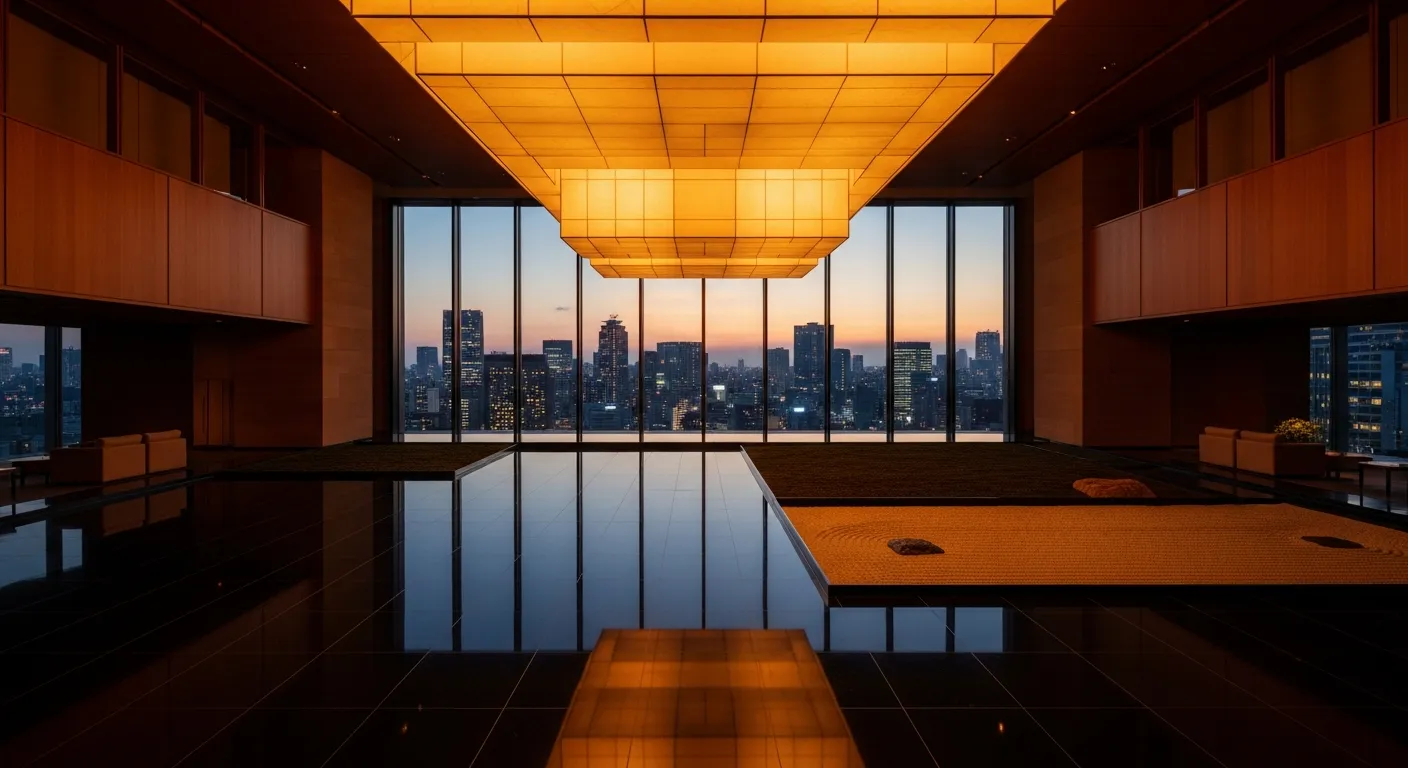
The elevator opens on the 33rd floor and the city disappears. Not gradually — completely. One moment you’re in the lobby of an Otemachi office tower, surrounded by salarymen and the particular hum of Tokyo’s financial district. The next, you’re standing inside a lantern.
That’s the only word for it. The washi paper ceiling rises six stories above you, 30 meters of handmade paper stretched through a shoji frame that glows with whatever light the sky is offering. Morning turns it pale gold. Overcast days make it silver. At dusk, when the programmed lighting activates and the paper warms to amber, you understand what Kerry Hill was doing when he designed this space — he was building a transition. Not between floors, but between worlds.
Below the lantern, a zen garden of still water and raked stone. Somewhere, a woman in kimono plays koto. The Imperial Palace gardens stretch beyond the floor-to-ceiling glass, and on clear winter mornings, Mount Fuji floats on the horizon like a rumor someone’s trying to confirm.
I’ve stayed at Aman Tokyo three times now. The first, in 2019, I left believing it was the finest hotel in Tokyo. The second, in 2024, I left wondering. The third, last month, I left knowing exactly what it is: a genuinely extraordinary hotel that’s no longer the only one.
Who this Aman Tokyo review is for
This is for travelers wondering whether Aman Tokyo is still worth the price in a city that now has more serious luxury competition. If you are comparing options, start with my guide to the best luxury hotels in Tokyo, then map the rest of the stay with my 3-day Tokyo itinerary and these Tokyo hidden gems.
The Arrival
There is no grand porte-cochère. No sweeping driveway. You enter through a discreet ground-floor entrance on the side of Otemachi Tower — Mizuho Bank’s headquarters, a corporate skyscraper that gives no indication that one of the world’s most celebrated hotels occupies its upper floors. A staff member in black guides you to a private elevator. You rise 33 floors in silence. The doors open.
And then the lantern. Every time, it works. I’ve read reviews from people who’ve stayed here a dozen times, and they all say the same thing: stepping into that lobby still feels like arriving somewhere new. The scale is part of it — the atrium is 40 meters long and 11 wide, proportions that register as ceremonial before your conscious mind catches up. But it’s the quality of light that holds you. Washi paper diffuses everything. There are no hard shadows in this lobby. The world has been filtered through something handmade, and it shows.
Check-in happens at a low desk, seated, with tea. Your shoes come off at the room door — slippers replace them, and the hotel is serious about this. It’s not a gesture. It’s a threshold.
The Room
Even the entry-level suite at Aman Tokyo is 71 square meters — 764 square feet, which makes it the largest base-category room in any Tokyo luxury hotel. The Mandarin Oriental starts at 50. The Peninsula at roughly the same. Aman gives you an apartment.
The design is Kerry Hill’s particular genius: Japanese materials, modernist restraint, and an understanding that the view is the decoration. Dark sen wood panels the walls. Shoji screens slide between the sleeping area and bathroom, opening or closing the space at will. The bed sits on a raised platform, the living area steps down slightly — a split-level layout that creates the feeling of distinct rooms without a single wall.
The stone furo soaking tub is positioned at the window. You lie in volcanic granite, water to your chin, and watch the Imperial Palace gardens darken as the city lights come up. Japanese cypress bath salts — woody, almost whisky-like — sit beside the tub with a wooden bucket and stool and printed instructions on proper furo etiquette. Rinse first, start with the feet. There’s sliced yuzu in a small net. The whole ritual takes twenty minutes and is worth more than most spa treatments I’ve paid for.
What’s genuinely impressive: the sense of stillness. Thirty-three floors above a financial district, triple-glazed glass, no street noise, no corridor noise. I slept better here than at any hotel in Tokyo, including the Park Hyatt in its pre-renovation glory days. The Toto toilet is, as always in Japan, a masterwork of engineering and mild comedy — one reviewer described the warm-water function as sounding like “a farting dragon,” which is crude but accurate.
What’s less impressive: the minimalism has aged. When Aman Tokyo opened in 2014, these rooms redefined what a luxury hotel room could feel like. A decade later, the same restraint that once read as revolutionary zen now reads, in certain lights, as sparse. The living areas in the larger suites suffer most — too much volume, not enough warmth. The furniture is beautiful and minimal and doesn’t quite fill the space it occupies. Bulgari Tokyo, which opened in 2023, achieves a similar calm with more visual generosity, and the comparison is not kind to the older property.
The non-alcoholic minibar is complimentary — standard Aman policy. The alcoholic options are charged. WiFi is included and fast. There is, by deliberate design, no prominent television in the main living space. This is either a principled stand against screen culture or an annoyance, depending on how you feel about watching the news in bed.
The Dining
Aman Tokyo has five food and beverage outlets for 84 rooms, which sounds generous until you learn that only two of them serve dinner and one seats eight people.
Arva, the Italian restaurant on the 33rd floor, is run by Chef Masakazu Hiraki, who spent 13 years cooking in Venice before returning to Tokyo. The pasta is extraordinary — a tagliolini carbonara with white asparagus and black truffle that my dining companion finished in what I’d estimate was ninety seconds, and a wild boar ragù with tableside truffle shaving that justified every yen of its ¥17,000 tasting menu. The sourcing is serious: Italian pantry staples married to Japanese seasonal produce with the confidence of someone who genuinely understands both traditions.
The criticism is the portions. They are small. Not “refined European small” but “I’m going to need the bread basket and possibly a convenience store onigiri later” small. At these prices — the seven-course Stagione runs ¥17,000 per person before drinks — you notice the disparity between what you’re paying and what you’re eating. The dining room itself is sleek and minimal, which several guests have found incongruous with hearty Italian food. They’re right. There’s something slightly strange about eating wild boar ragù in a room that feels like a meditation hall.
Musashi by Aman is the omakase sushi counter — eight seats around a hinoki cypress bar, Chef Musashi presiding. He grows his own rice in Yamanashi Prefecture and visits the fish market personally each morning. The experience is ¥44,000 per person including tax, plus a 15% service charge, putting dinner for two at roughly $700. This has increased significantly from the ¥25,000 that earlier reviews cited, and at the current price, you’re competing with Tokyo’s independent omakase counters — places like Saito and Sukiyabashi Jiro that have spent decades earning their reputations. Musashi is excellent. Whether it’s $700-excellent when you’re in a city with the deepest sushi talent pool on earth is a question only your palate and your accountant can answer.
The Lounge is where I spent most of my time, and honestly, it’s worth the room rate alone. The 8-meter glass wall frames the city and the palace gardens. The washi lantern glows overhead. Cocktails run ¥2,500–3,000 — a yuzu martini, various matcha creations, Japanese single malts. The afternoon tea is a seasonal event that Tokyo locals book weeks in advance. In the evening, with the lantern amber and the city sparkling beyond the glass, it is one of the finest hotel bars in the world. Even if you never stay here, come for a drink.
Breakfast is the one meal that earns universal praise. Both Japanese and Western sets, served in Arva or The Lounge, are among the best hotel breakfasts I’ve had anywhere. It is not, however, included in the room rate — ¥4,200 per person unless you’ve booked through Amex Fine Hotels or Virtuoso. At a hotel charging $2,000 a night, this omission lands somewhere between puzzling and insulting.
The Spa and Pool
The Aman Spa is 2,500 square meters across two floors, making it the largest hotel spa in Tokyo, and for once the superlative is earned rather than manufactured.
The 30-meter pool is the centerpiece. Lined in black volcanic rock, it runs along the building’s glass exterior with the Imperial Palace gardens and the Tokyo skyline on the other side. The water is dark — almost black against the stone — and the effect, especially in morning light, is of swimming in obsidian. I’ve used hotel pools in forty countries, and this is the most beautiful one I’ve seen. Not the largest, not the most elaborate, but the most beautiful. The light, the stone, the silence, and on clear days, Fuji in the distance beyond the far edge of the water.
The onsen-style hot stone baths are gender-separated and follow traditional Japanese protocol — the men’s side is naked-only, which surprises some Western guests but is entirely standard in Japan. The volcanic stone tubs look out over the city. The treatment rooms are private suites with their own dressing areas, steam showers, and relaxation zones. A 60-minute massage runs roughly $280, which is steep when excellent standalone massage in Tokyo costs $80–120, but the seasonal treatments — cherry blossom in spring, yuzu and sake kasu in winter, all using Japanese botanicals — are genuinely distinctive.
The gym has been updated with current-generation TechnoGym equipment and Apple Fitness integration, which puts it ahead of most Tokyo competitors. Open 24 hours. The yoga studio has Allegro reformers and private instruction available.
If I were paying $2,000 a night and planning to spend a full day indoors, the spa is where I’d spend it. Nothing else in Tokyo replicates this combination of space, authenticity, and calm.
The Service
At its best, Aman Tokyo’s service operates at an altitude that other hotels talk about but don’t reach. Staff memorize your name by the second morning. Requests materialize before you fully articulate them. There’s no room-key signing for minor charges — your room number is enough. The concierge speaks fluent English and has the restaurant connections to book tables that most hotel concierges can’t access.
At its less-than-best — and this is the honest part — the service has drifted since my first stay. The 2019 version felt like being cared for by people who genuinely understood what you needed. The 2026 version feels technically flawless but slightly mechanical. Other veteran Aman travelers have noticed the same shift. Several accomplished general managers have left the brand for Capella and COMO in recent years, and while the systems remain excellent, the soul has thinned.
The Lounge service drew the only sharp complaint during my stay — a request for a specific table met with rigidity rather than grace, delivered with the implication that the guest should be grateful for whatever seat was offered. This is a small thing. It is also exactly the kind of small thing that a $2,000 hotel cannot afford to get wrong.
Compared to the Four Seasons Otemachi down the street, Aman’s service is more refined but less warm. Compared to Hoshinoya Tokyo a few blocks away, it’s more polished but less culturally immersive. The gap between “technically perfect” and “emotionally resonant” is where Aman Tokyo currently lives, and it’s a gap that matters more at this price point than at any other.
The Location
Otemachi is Tokyo’s Wall Street. The hotel sits atop Mizuho Bank’s headquarters. The Imperial Palace gardens are across the road. Ginza is five minutes away. Tokyo Station — and with it, the Shinkansen and Narita Express — is a short walk.
The transit connectivity is excellent. You can reach Shibuya, Shinjuku, Harajuku, or Tsukiji on a single metro ride. Five lines converge at Otemachi Station, directly connected to the building.
The problem is what’s not here. After 7 PM, the financial district empties. The streets go quiet. There are no neighborhood restaurants to stumble into, no late-night ramen joints, no bars where locals outnumber tourists. If you want to walk out of your hotel into the pulse of Tokyo — the alleys of Shimokitazawa, the vinyl shops of Shibuya, the yakitori smoke of Yurakucho — you’ll take a taxi every time. The Park Hyatt had Shinjuku’s chaos at its doorstep. The Peninsula has Marunouchi’s tree-lined boulevards. Aman has office towers and silence.
For some guests, this is the point. The financial district’s emptiness at night creates a monastic quality that reinforces the hotel’s atmosphere. For others, it’s a $40 taxi ride to the city you came to see.
A note on airport transfers: the hotel’s private car from Narita runs ¥47,000–63,000 each way — $340–460. The Narita Express to Tokyo Station costs ¥3,000 and takes the same time. The hotel transfer is beautiful, seamless, and roughly fifteen times the price of an equivalent journey. From Haneda, it’s ¥25,000–36,000 one way.
The Competition
When Aman Tokyo opened in 2014, there was nothing like it. A decade later, there are four things like it within a twenty-minute taxi ride, and some of them are arguably better.
Bulgari Tokyo (opened 2023) is the most direct challenge. Italian luxury with bright interiors, outdoor terraces — rare in Tokyo — and views over Hamarikyu Gardens. A returning Aman guest told me that “going from Bulgari to Aman felt like a downgrade.” Where Bulgari wins: design freshness, outdoor space, energy. Where Aman wins: the pool, the spa, room size, and a genuine Japanese atmosphere that Bulgari doesn’t attempt.
Four Seasons Otemachi is literally in the same neighborhood, opened 2020. More dining options, a Michelin-starred restaurant, a terrace, and slightly more accessible pricing. It’s a very good hotel that doesn’t reach Aman’s heights in spa or atmosphere but also doesn’t reach Aman’s price.
Hoshinoya Tokyo is the philosophical opposite — a 17-floor urban ryokan with tatami floors, kaiseki cuisine, and traditional bathing rituals. If you want a Japanese experience rather than a luxury experience with Japanese aesthetics, Hoshinoya delivers something Aman cannot.
Mandarin Oriental Tokyo consistently ranks higher in reader surveys, offers bolder contemporary Japanese design, has Michelin-starred dining, and costs less. The rooms are smaller — 50 square meters at entry versus Aman’s 71 — but the value proposition is sharper.
The Verdict
Aman Tokyo is still a remarkable hotel. The lobby remains one of the most stunning architectural spaces in hospitality. The pool is the best in Tokyo and among the best anywhere. The rooms are vast. The silence is real.
But the question in 2026 is not whether Aman Tokyo is remarkable. It’s whether it’s $2,000-a-night remarkable when the Mandarin Oriental charges $800 and the Four Seasons charges $1,200 and Bulgari charges the same as Aman but feels newer. The answer depends entirely on what you’re buying.
If you’re buying the spa, yes — nothing in Tokyo competes with that pool and those seasonal treatments. If you’re buying the lobby, yes — but you can experience it over a ¥3,000 cocktail without spending the night. If you’re buying the room, maybe — the space is extraordinary, but the minimalism that once felt visionary now feels like it could use a second opinion from an interior designer who believes in cushions.
If you’re buying the name, be honest about that. Aman is a brand that inspires devotion, and devotion has a way of forgiving things that a clear eye wouldn’t. The service has thinned. The dining is excellent but not revelatory. The location is convenient and lifeless. These are not deal-breakers at $500 a night. At $2,000, they’re the conversation.
Aman Tokyo is wonderful. It is no longer the automatic choice. And the fact that I can say that honestly, without equivocation, is exactly why this column exists.
The bottom line: A genuinely world-class hotel whose $2,000 price tag now buys you the best spa in Tokyo and a lobby that stops your heart — but the rooms have aged, the food is overpriced for the portions, and the competition has closed the gap.
Book if: You want the finest spa and pool in Tokyo. You value space and silence over neighborhood energy. You’ve stayed at enough hotels to know what Aman’s service culture means.
Skip if: You want to walk out the door into a living neighborhood. You think minimalism means basic. You’d rather spend $1,200 at the Mandarin Oriental and use the savings on three omakase dinners that would destroy Musashi.
Don’t miss: A cocktail in The Lounge at dusk. The furo bath at your window after midnight. The pool at 7 AM before anyone else arrives.
Skip: The airport transfer. Take the Narita Express. Spend the ¥44,000 you saved on Musashi instead.
Worth reading next
More stories worth your time.

The Maldives Question: Is $2,000 a Night Worth It? (An Honest Answer)
I've stayed at four Maldivian resorts across three trips and two budgets. Here's the honest answer to whether those overwater villas are worth what they charge — and what nobody tells you about paradise before you book.

The White Lotus Hotels Are Real. The Experience Isn’t What You Think.
The White Lotus hotels are real, but staying at them now is a different experience than the fantasy the show sells.

St. Regis Bora Bora: Waking Up Above Water Is Not a Spiritual Experience
The brochure for the St. Regis Bora Bora promises a “transformative overwater experience.” The website uses words like “transcendent” and “soul-stirring.” Three different people told me, before I went, that waking up in an overwater villa would “change the way I see the world.” It didn’t change the way I see the world. It changed […]
About Kaira
Explore With Kaira is built for readers who want the atmosphere of a luxury travel magazine without the emptiness of sponsored copy.
About Kaira