Nihi Sumba: The $1,500 Resort That Might Be the Last Honest Luxury Left
Nihi Sumba charges $1,500 a night for a villa without air conditioning, a beach you hike fifteen minutes to reach, and a surf break you might not be good enough to ride. It was named the best hotel in the world two years running. Both of those things are true, and neither one is the whole story.

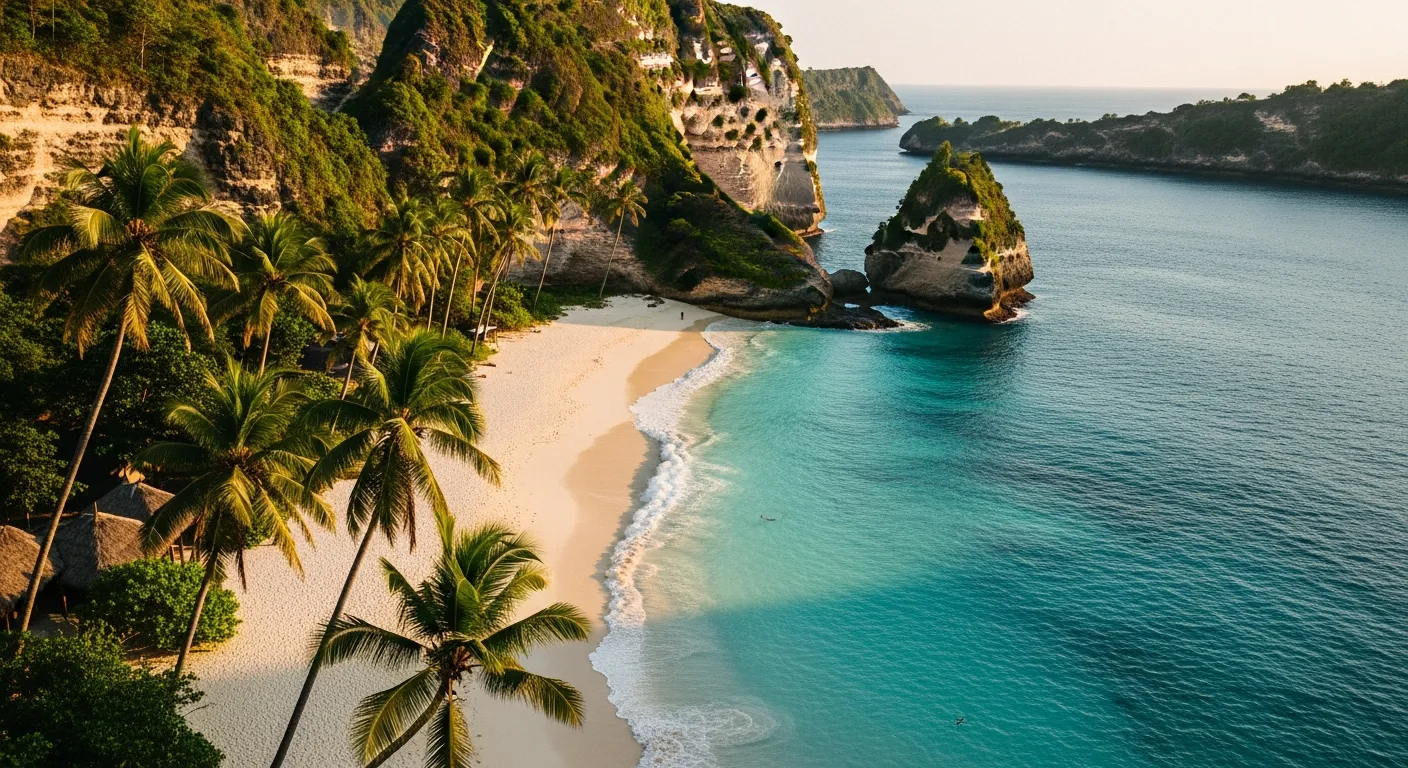
The twin-prop from Bali banks left over water the color of gasoline, and then Sumba appears — not gradually, like a coastline resolving from haze, but all at once, like someone pulled a curtain. Limestone cliffs. Rice terraces cut into hillsides so steep they look hand-carved with a razor. Thatched rooftops scattered across a jungle canopy that goes from shoreline to ridge without interruption. No high-rises. No cranes. No roads visible from this altitude.
The landing strip at Tambolaka is a concrete ribbon with a terminal the size of a gas station. A man in a Nihi Sumba polo holds a sign with my name, and the drive south takes an hour through villages where water buffalo share the road and stone-slab tombs sit in front yards — Sumba’s megalithic culture buries its dead at home, among the living, in tombs that can weigh thirty tons and take a hundred men to move. This is not Bali. This is not even close to Bali. And that, as it turns out, is the entire point.
The resort’s entrance is a set of wooden gates that open onto nothing — meaning they open onto a view of the Indian Ocean so enormous and so uninterrupted that your brain requires a moment to process the scale. A staff member hands you a welcome drink of turmeric and ginger. Your shoes come off here, and they don’t go back on until you leave. I spent four nights barefoot on stone, grass, sand, and the cool tile floors of a villa built into a cliff, and by the second morning the absence of shoes stopped feeling like a policy and started feeling like a philosophy.
The Arrival
Nihi Sumba is not easy to reach, and it doesn’t apologize for this. You fly into Bali — everyone does — then catch the morning Susi Air or Wings Air prop to Tambolaka, which operates once daily and costs about $150 each way. Miss that flight and you’re spending the night in Denpasar. The alternative is a private charter from Bali for around $3,500, which the resort will arrange with the same casual efficiency they’d use to book you a massage.
The hour-long drive from the airport is a journey through Sumba’s interior that doubles as a cultural briefing. Your driver — mine was a man named Amos who’d worked at the resort since it was still called Nihiwatu — points out the traditional clan houses with their soaring thatched roofs, explains the significance of the stone tombs, and mentions casually that the horse races held every February are the island’s social event of the year. “Everyone comes,” he said. “The government, the priests, the ancestors.” I wasn’t sure about that last group until I spent more time here.
The property itself sprawls across 530 acres of hillside above Nihiwatu Beach — named by Claude Graves, the American surfer who discovered the wave here in the 1980s, fell in love with the island, and eventually built what became this resort. Graves died in 2016, and the property was acquired by Chris Burch, co-founder of Tory Burch, who rebranded it from Nihiwatu to Nihi Sumba in 2017. Travel + Leisure had already named it the best hotel in the world — twice, in 2016 and 2017 — and the question hanging over every stay since is whether the resort that earned those accolades still deserves them.
The Room
Twenty-eight villas are scattered across the hillside in a layout that prioritizes privacy over convenience. The entry-level one-bedroom villas — called Marrangga and Luru — start at around $1,500 per night in peak season, which includes all meals, non-alcoholic drinks, and a curated roster of daily activities. The top-tier Raj Mendaka estate, a three-bedroom compound with its own pool, staff, and chef, runs north of $10,000 per night.
My villa — a one-bedroom Puncak, midway up the hill — was built from local timber and stone with a thatched alang-alang roof that gave the interior a warm, amber quality when the sun hit it. The plunge pool hung over the edge of a drop that fell away through jungle canopy to the ocean. The outdoor bathroom had a stone tub positioned so you could soak while watching the sunset, which sounds like every luxury resort brochure ever written except that here the sunset was happening over an ocean with nothing between you and Antarctica.
The honest part: some of these villas don’t have air conditioning. Mine had ceiling fans and open-air design, which works beautifully from May through October when the dry season keeps the humidity manageable and the ocean breeze climbs the hill. During the wet season — November through March — the combination of 90% humidity and no AC becomes a matter of personal tolerance. The resort has added AC to many villas in recent years, but ask specifically when booking, because the difference between a breezy hilltop villa in July and a sealed-tight room in January is the difference between romantic and miserable.
The other honest part: the hill is real. Some villas sit a fifteen-minute walk from the beach, and that walk involves steps — stone steps cut into a tropical hillside that gets slippery after rain. The resort offers a shuttle buggy service, but availability depends on demand, and during peak weeks in July and August, you might wait. I walked every time and arrived at the beach slightly winded and fully awake, which felt like a reasonable trade. But guests with mobility issues or an aversion to vertical hiking should request a beach-level villa and confirm the specifics before booking.
What’s genuinely impressive: the craftsmanship. Every surface was built by Sumbanese hands — the wood is local teak, the stone was quarried on the island, the textiles were hand-woven in nearby villages using techniques that predate European contact. The interiors feel less like hotel rooms and more like someone’s very beautiful home, which is exactly the effect they’re after. There’s no minibar, no room service menu on the desk, no laminated card explaining the pillow options. There’s a note from your butler — yes, every villa has a dedicated butler — telling you what time sunset is and whether the surf is good tomorrow.
The Wave
Let me address the surf, because it’s the reason this place exists and the reason a significant percentage of guests book.
Occy’s Left — named after Australian pro surfer Mark Occhilupo, who surfed it in the resort’s early days — is a world-class left-hand barrel that breaks over a shallow reef directly in front of the resort. It is, by any serious surfer’s assessment, one of the finest waves in Indonesia. And Nihi Sumba controls access to it. Only ten guests per day are permitted in the lineup, and you sign up the evening before on a first-come basis. The surf guide fee is $125 per session, on top of your room rate.
The wave is exceptional. On a solid southwest swell — four to eight feet, which is the sweet spot — it produces long, clean barrels that peel across a reef shelf for a hundred meters. The water is warm. The crowd is ten people maximum. The guide knows the reef like a street address and will tell you exactly where to sit and when to paddle. For experienced surfers, this is a genuine once-in-a-lifetime experience that justifies the entire trip.
The caveat that nobody in marketing mentions: Occy’s Left is not for intermediate surfers. The reef is shallow, the wave is powerful, and the consequences of a bad wipeout are sharp coral and a long hold-down. The resort’s own surf guides will assess your ability honestly and may suggest alternative breaks — there are several along the coast — if Occy’s Left is above your level. I watched two guests paddle out with visible anxiety and come in after thirty minutes with reef rash and bruised confidence. The wave doesn’t care about your room rate.
If you don’t surf, you’ll still love Nihi Sumba. But you should know that the energy of the resort shifts around the swell. When the waves are good, the surfers are vibrating with anticipation at dinner. When it’s flat, the resort takes on a different personality — quieter, more couples-oriented, more focused on the jungle and the spa. Both versions are excellent. But they’re not the same place.

The Dining
Meals at Nihi Sumba are included in the rate, which removes the psychological tax of resort dining — no scanning the menu for the least offensive markup, no mental math converting rupiah to dollars, no bill at the end that makes you question your life choices. You eat what the kitchen prepares, and what the kitchen prepares is remarkably good.
Ombak, the main restaurant, occupies an open-air pavilion above the beach with the Indian Ocean as your tablecloth. Breakfast is a buffet of tropical fruits, house-baked pastries, and made-to-order eggs, plus Sumbanese specialties like bubur sumba — a savory rice porridge with fried shallots and sambal — that I ate every morning and now dream about with uncomfortable frequency. Lunch is lighter: grilled fish, Indonesian salads, ceviche from the morning catch. Dinner is a multi-course affair that rotates nightly, drawing on Indonesian, pan-Asian, and Mediterranean traditions with ingredients grown on the resort’s own farm or sourced from island fishermen.
The Chef’s Table, available by advance booking, is the standout. Set in a candlelit pavilion behind the main kitchen, it seats twelve guests around a communal table for a seven-course dinner with wine pairings. The chef — an Indonesian-trained talent who spent years in Australia — cooks in front of you, explaining each dish’s connection to the island. A Sumbanese-style pork belly braised in candlenut and turmeric, served with hand-pounded sambal from the resort’s garden, was one of the best dishes I ate in all of Southeast Asia. The Chef’s Table runs an additional $200 per person above the included meal plan, and it’s worth booking on your first night before spots fill.
Beach dinners — private setups on Nihiwatu Beach with a dedicated chef and bonfire — are the resort’s most romantic offering and cost an additional $350 per couple. The food is simpler than the restaurant — grilled seafood, satay, tropical fruits — but eating by firelight while the Southern Cross appears overhead and the surf breaks fifty meters away is an experience that no restaurant in the world can replicate.
The honest criticism: drinks. Non-alcoholic beverages are included. Alcohol is not. A cocktail runs $18-22, wine by the bottle starts at $60 and climbs quickly, and a beer is $10. At a resort that charges $1,500 a night and positions itself as all-inclusive, the alcohol exclusion feels like a philosophical contradiction. Soneva Fushi in the Maldives — the most direct competitor in the barefoot-luxury category — includes a well-stocked wine cellar and cocktail menu in their rates. Nihi should do the same.
The Experience
What separates Nihi Sumba from every other luxury resort I’ve stayed at is the Sumba Foundation, and the way it transforms the experience from vacation into something you actually think about after you leave.
Founded by Claude Graves in 2001, the foundation operates the island’s largest malaria eradication program, has built over 60 water stations providing clean water to 30,000 people, runs medical clinics, and supports schools. The resort contributes $100 per occupied room night directly to the foundation — meaning your $1,500 stay generates a guaranteed donation without you signing a check or attending a fundraising dinner.
But it goes deeper than money. Guests can visit foundation projects — a morning at a village school, an afternoon helping build a water station, a conversation with clinic staff about the transformation they’ve witnessed over two decades. These aren’t staged tourist experiences with smiling children performing gratitude. They’re real encounters with real programs that have measurably changed life expectancy on Sumba from 35 years in the 1990s to over 60 today.
I spent a morning at a village school with a staff member named Yuli who’d grown up in one of these villages, received a foundation-funded education, and now works at the resort in guest relations. She translated while the teacher explained what the foundation had provided — books, desks, a solar-powered tablet for lessons — and what it hadn’t, which was everything else. The school had no running water. The road to it was unpaved. The gaps were visible, which made the progress more credible, not less.
The Spa Safari is the resort’s other signature experience. This isn’t a spa in the conventional sense — it’s a multi-hour journey through the jungle, stopping at various outdoor stations for treatments: a river-stone massage in a clearing, a chocolate-and-coconut scrub beside a waterfall, a meditation session on a cliff overlooking the ocean. The whole thing takes three to four hours, costs an additional $400 per person, and is the most extraordinary wellness experience I’ve encountered. The jungle canopy, the sound of the river, the isolation — by the third station, you’ve forgotten what timezone you’re in, which is precisely the point.
Beyond the surf and the spa, the daily activity roster reads like a particularly ambitious adventure itinerary: horseback riding along the beach and through rice paddies, spear fishing with local fishermen, mountain biking through Sumbanese villages, waterfall hikes, traditional ikat weaving workshops, and cultural visits to megalithic tomb sites. Most activities are included in the rate. You’ll need more than four nights to do even half of them, which is by design.
The Weather and the Bugs
Two things the brochure underplays: the wet season and the insects.
Sumba’s dry season — April through October — is spectacular. Low humidity, consistent offshore winds for the surf, clear skies, temperatures in the low 80s. This is when you should come. The resort operates year-round, but the wet season from November through March brings daily downpours, high humidity, flat surf, and — most notably — mosquitoes in quantities that make the malaria foundation’s work feel very personally relevant. The resort provides excellent repellent and netting, and the malaria risk is dramatically lower than it was twenty years ago, but guests with strong feelings about insects in their open-air villa should time their visit accordingly.
Even in dry season, you’ll share your villa with the occasional gecko, moth, or determined beetle. This is a resort built into a tropical jungle on a remote island. The creatures were here first. If you need hermetically sealed rooms and zero wildlife encounters, this isn’t your place.
The Competition
Nihi Sumba occupies a niche so specific that true competitors are rare, but they exist.
Soneva Fushi in the Maldives is the closest philosophical match — barefoot luxury, environmental commitment, all-inclusive pricing, remote island setting. Soneva charges roughly the same ($1,500-4,000/night) but includes alcohol, has a wider range of water activities, and offers a more conventionally relaxing experience. Where Soneva wins: the beach (white sand versus Nihi’s dramatic but rocky shore), the wine cellar, the ease of access from Malé. Where Nihi wins: cultural depth, adventure activities, the surf, and a sense of place that goes beyond “beautiful island.”
Six Senses Uluwatu in Bali offers cliff-edge luxury above world-class surf at roughly half the price. It’s easier to reach, has better nightlife access, and the surf options are more varied. But it doesn’t have Nihi’s isolation, its cultural immersion, or the feeling of being somewhere that hasn’t been discovered by everyone.
Misool Eco Resort in Raja Ampat is the adventure-dive equivalent — remote Indonesian luxury built around a specific natural phenomenon (diving versus surfing). Less polished, more eco-lodge than resort, and significantly cheaper. For divers, it’s the better choice. For everyone else, Nihi’s infrastructure and service are in a different category.
The Verdict
Nihi Sumba is that rare thing in luxury hospitality: a resort with a genuine reason to exist beyond extracting money from wealthy people in beautiful settings. The surf is world-class. The foundation work is real. The island is extraordinary. The staff — almost entirely Sumbanese — possess a warmth that comes from working on their home island, not from a hospitality manual.
Is it worth $1,500 a night? If you surf, the answer is unequivocal yes. Occy’s Left with ten people in the water, in warm water, with a personal guide, followed by a multi-course dinner above the beach — there is no equivalent experience available at any price.
If you don’t surf, the answer is more nuanced. You’re paying premium rates for a remote resort with no air conditioning in some villas, a steep hillside that demands physical fitness, insects that come with the territory, and alcohol that costs extra despite the all-inclusive positioning. The Spa Safari is extraordinary. The foundation visits are genuinely moving. The isolation is either restorative or claustrophobic depending on your tolerance for being genuinely far from everything.
What I can tell you is this: three weeks after leaving, I still think about the view from my plunge pool at dawn, when the ocean was flat and silver and the fishing boats were heading out and Amos was walking up the hill with my morning coffee, barefoot on the stone path, unhurried, as if time on this island moved at a speed the rest of the world had forgotten.
That feeling — of being somewhere that operates on its own terms, that hasn’t compromised its identity for a booking algorithm — is increasingly rare in luxury travel. Nihi Sumba still has it. For how long, with the Burch expansion plans and the growing Instagram fame, is the question I can’t answer.
The bottom line: A resort with soul, world-class surf, and genuine cultural depth that justifies its $1,500 price tag — if you time the season right, come prepared for the remoteness, and understand that barefoot luxury means actual bare feet on actual jungle hillside.
Book if: You surf. You want a luxury experience that means something beyond thread count. You’re fit enough for the hill. You’re visiting April through October.
Skip if: You need air conditioning everywhere. You want white-sand beach lounging. You’re uncomfortable with insects. You expect alcohol included at this price.
Don’t miss: The Spa Safari. The Chef’s Table on your first night. Sunrise from your plunge pool. A conversation with Yuli about what the foundation has changed.
Skip: The wet season entirely. Occy’s Left if you’re not an experienced surfer — take the guide’s honest assessment and surf the alternative breaks instead.
Worth reading next
More stories worth your time.

The Maldives Question: Is $2,000 a Night Worth It? (An Honest Answer)
I've stayed at four Maldivian resorts across three trips and two budgets. Here's the honest answer to whether those overwater villas are worth what they charge — and what nobody tells you about paradise before you book.

The White Lotus Hotels Are Real. The Experience Isn’t What You Think.
The White Lotus hotels are real, but staying at them now is a different experience than the fantasy the show sells.

St. Regis Bora Bora: Waking Up Above Water Is Not a Spiritual Experience
The brochure for the St. Regis Bora Bora promises a “transformative overwater experience.” The website uses words like “transcendent” and “soul-stirring.” Three different people told me, before I went, that waking up in an overwater villa would “change the way I see the world.” It didn’t change the way I see the world. It changed […]
About Kaira
Explore With Kaira is built for readers who want the atmosphere of a luxury travel magazine without the emptiness of sponsored copy.
About Kaira