Bali Beyond the Brunch: The Island That Reveals Itself to Those Who Leave the Tourist Triangle
Forget the Seminyak brunch circuit and the Ubud monkey selfies. The Bali that changed me is the one I found on black sand beaches where salt farmers still use hollowed coconut trunks, in valleys where rice terraces cascade toward a volcano nobody was photographing, and in villages so old the weavers measure time not in hours but in the years it takes to finish a single cloth.

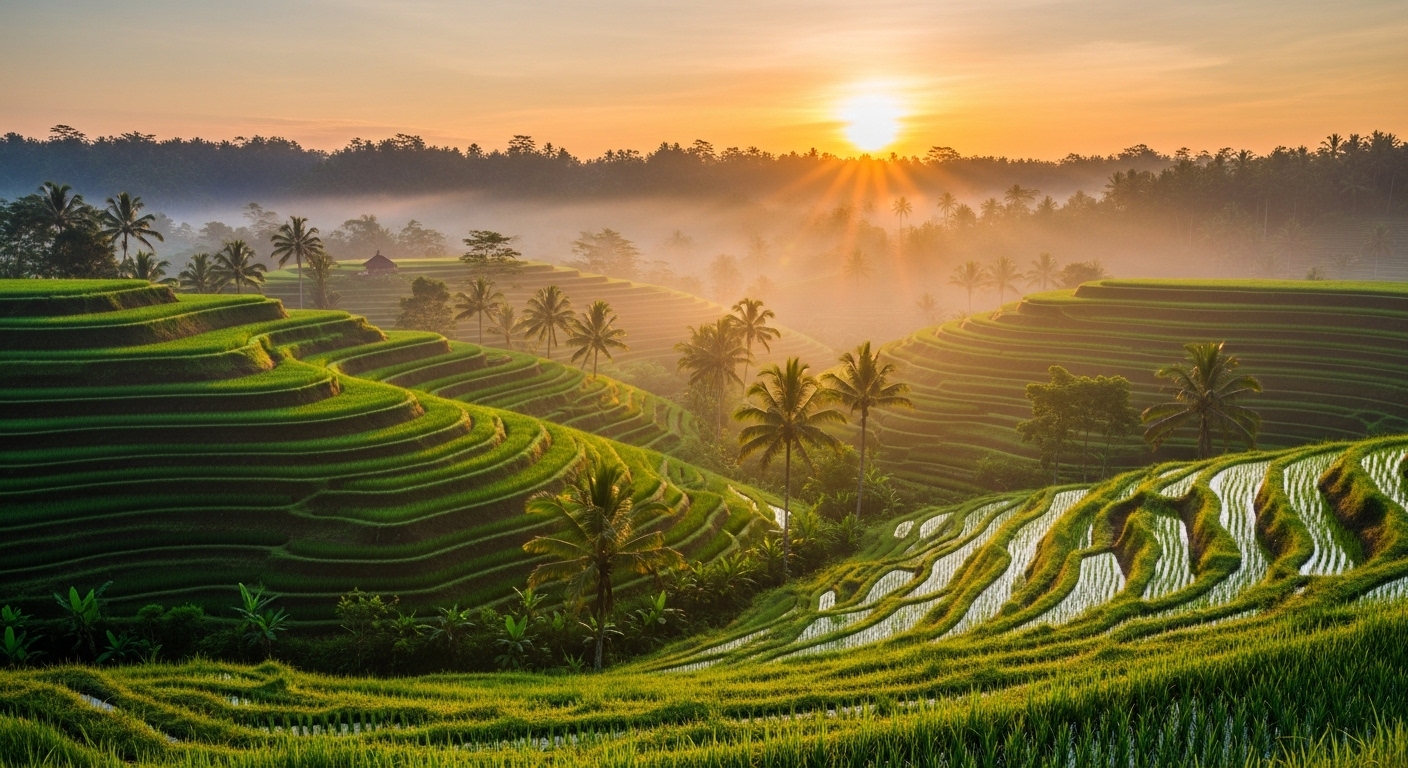
The incense found me before the temple did. I was walking a footpath through Sidemen Valley at half past six in the morning, the kind of path that’s barely wider than your shoulders and drops away on both sides into rice terraces so green they hurt, when the smoke drifted up from somewhere below — clove and sandalwood and frangipani, the particular sweetness of a canang sari offering left on a stone step before dawn. I stopped. The path was wet from overnight rain. Mount Agung filled the entire eastern sky, its summit dissolving into cloud the way mountains do when they’re too large to stay entirely visible, and somewhere in the terraces below me a farmer was already knee-deep in water, bending and rising, bending and rising, in a rhythm that predates tourism by about a thousand years.
I’d been in Bali for five days already. I’d done Seminyak — the brunch spots that exist primarily to be photographed, the beach clubs where the music never quite stops, the boutiques selling linen things at prices that assume you flew business class to get here. I’d done Ubud — the Monkey Forest, which is genuinely wonderful until you realise everyone in Bali has the same photo of a macaque sitting on their head, and Tegallalang, where the rice terraces are real but the experience of them has been curated into something that feels more like a set than a landscape. None of it was bad. All of it was expected. And expected is the enemy of the feeling I travel for — that jolt of recognition when a place shows you something you didn’t know you were looking for.
That feeling found me in Sidemen. And then in Amed, on a beach so black it looked like volcanic night. And then in Munduk, where a waterfall dropped through jungle so thick the light turned green. And then in a village called Tenganan, where a woman was weaving a cloth that wouldn’t be finished in her lifetime. The Bali that changed me is not the one in the Instagram grid. It’s the one that begins where the tourist triangle ends.
Sidemen Valley: The View That Walter Spies Chose Over Ubud
In the 1930s, the German painter Walter Spies — who did more than perhaps anyone to shape the Western imagination of Bali — left Ubud. He’d helped establish it as an artistic colony, entertained Charlie Chaplin and Noël Coward there, and then he packed his things and moved east to Iseh, a village in Sidemen Valley, because he said the view of Agung from Iseh was the most beautiful thing he’d ever seen. I understand now. Standing on the same ridge where Spies painted, watching the morning light turn the terraces from dark jade to brilliant emerald as the sun cleared the volcano’s shoulder, I understood that some views don’t just show you a landscape — they show you why landscape painting exists.
Sidemen is ninety minutes from Ubud, and that ninety minutes is doing a lot of work. The road climbs through villages where dogs sleep in the middle of the street because nobody drives fast enough to justify moving, past small temples wrapped in black-and-white checked cloth, through air that cools as the elevation rises. You arrive and the valley opens beneath you — terraced rice paddies descending in steps that follow the natural contours of the hillside, fed by the subak irrigation system that the Balinese have been refining for a millennium, with Agung presiding over all of it like something between a mountain and a deity, which in Bali it essentially is.
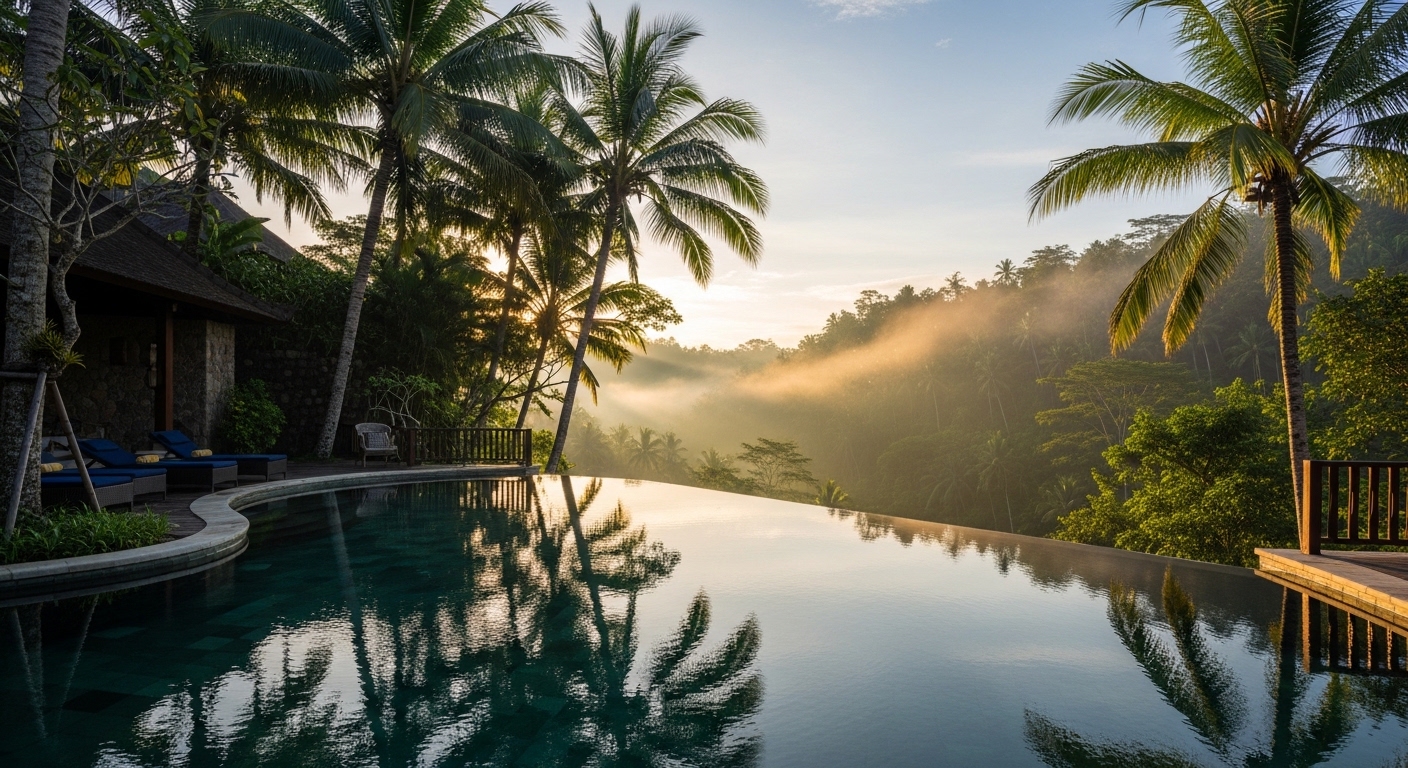
I stayed at Samanvaya, an adults-only resort where the infinity pools look directly onto the terraces and rooms start around $166 a night — absurd value for what you’re getting, which is a view that would cost four times that in Ubud and the silence to actually hear it. Wapa di Ume Sidemen is the other excellent option, a Balinese-owned five-star boutique with glamping tents and a two-tiered infinity pool, and if you want history over luxury, Villa Iseh has just three suites in the very rooms where Walter Spies slept and painted. The cycling tours through the valley run about 350,000 IDR with a local guide, and they take you down paths that no car could fit on, through villages where children wave and old women sit on porches weaving palm-leaf offerings with the speed and precision of people who’ve been doing it every single day of their lives.
Arrive early. Six in the morning early. The mist sits in the valley like something poured, and the terraces emerge from it in layers, and the only sounds are roosters and running water and the particular kind of silence that happens when a place hasn’t yet remembered it’s supposed to perform for visitors.
Amed: Where the Sand Is Black and the Coral Grows on Warships
The drive from Sidemen to Amed takes about an hour and a half, winding north and east along roads that narrow as the landscape dries and the volcanic soil darkens. You know you’re getting close when the sand turns black — genuinely, startlingly black, the kind of black that comes from centuries of Mount Agung shedding its skin onto the coastline. Amed isn’t one village but a string of seven — Amed, Jemeluk, Bunutan, Lipah, Selang, Banyuning, and Aas — stretched along about eight kilometres of coast, each one quieter than the last.
I came for the Japanese shipwreck, and it delivered. During World War II, a Japanese patrol boat went down just fifteen to twenty metres from shore near Amed village, and now it sits in six to twelve metres of water, encrusted with coral so vivid it looks like someone decorated a sunken warship for a party — trumpetfish hovering around the hull, butterflyfish threading through what used to be the wheelhouse, the whole thing pulsing with a life that has turned a machine of war into a reef. You don’t need to be a certified diver. You barely need to be a strong swimmer. Snorkel gear rents for about 50,000 IDR from the warungs on the beach, and within three minutes of wading in you’re floating over a piece of history that the ocean has been slowly, patiently reclaiming for eighty years.
But the thing I didn’t expect — the thing that made me stay an extra day — was the salt. Amed has been producing sea salt for centuries using a method so elemental it feels like watching the invention of civilization. Farmers rake the black volcanic sand into flat beds, pour seawater over it, and let the tropical sun do its work over several days. The dried, salt-crusted sand is then gathered and transferred into hollowed-out coconut palm trunks — split lengthwise, about two metres long, with the centres carved into shallow basins. More seawater is filtered through the salty sand, again and again, each pass concentrating the brine further, until the liquid is so saturated it crystallises in the tropical heat. The salt crystals are scraped from the coconut trunks and collected in bamboo baskets. No electricity. No machinery. Just sand, water, sun, and coconut trees — the same ingredients, in the same proportions, that their grandparents used. The salt has earned Geographical Indication status, Indonesia’s version of a PDO, and the Amed Salt Center lets you watch the entire process and buy bags of the finished product for almost nothing.
For dinner, skip anything with an English menu and find the warungs at Ibus Beach — no sun loungers, no beach vendors, just a small shack serving whatever the fishermen brought in that morning, grilled over coconut husks, served with rice and sambal that your sinuses will remember longer than your tongue. I ate grilled snapper there for 45,000 IDR — about three dollars — with my feet in black sand and the Lombok Strait turning copper as the sun dropped behind me. Amed doesn’t try to be anything. It just is. That’s increasingly rare, and increasingly valuable.
Munduk and Sekumpul: Where the Waterfalls Earn Their Difficulty
North Bali is a different island. I don’t mean that metaphorically. The south is limestone and beach and heat that presses down on you like a warm hand. The north is volcanic highlands, clove forests, coffee plantations, and a coolness in the air that makes you reach for a layer you haven’t needed since you landed. Munduk sits at about 1,200 metres above sea level, and the change in altitude changes everything — the vegetation, the temperature, the way mornings smell of wet earth and something sharp and sweet that turns out to be clove trees drying in the sun.
Sekumpul waterfall is an hour east of Munduk, and it requires earning. The entrance fee structure is tiered: 20,000 IDR gets you the viewpoint, but the viewpoint is like watching a concert from the parking lot. The medium trek runs 150,000 IDR, and the long trek — the one that takes you down through the jungle to the base of the falls, where the spray soaks you and the sound is so complete it replaces thought — costs 250,000 IDR with a mandatory guide. Take the long trek. The path drops steeply through bamboo forest and across a river, and when you emerge at the bottom and look up at twin waterfalls plunging eighty metres through a wall of green so dense it seems to breathe, you understand why people who’ve been to Niagara and Iguazu still call Sekumpul one of the most beautiful waterfalls they’ve ever seen. It’s not the scale. It’s the intimacy. The jungle closes around the falls like cupped hands, and you stand in the mist feeling like you’ve found something the forest was trying to keep for itself.
Back in Munduk, the twin lakes — Buyan and Tamblingan — sit in a volcanic caldera that holds them like a bowl holding water, which is essentially what it is. There’s no real entrance fee for the lakes themselves, though some viewpoints charge a small 10,000 to 20,000 IDR. Lake Tamblingan is the quieter of the two, surrounded by forest and home to Pura Ulun Danu Tamblingan, an ancient temple that’s still used for ceremonies and carries the kind of stillness that temples carry when they haven’t been turned into photo opportunities. You can arrange a traditional canoe crossing of Tamblingan — hollowed-out dugout, a local guide who paddles standing up — and the fog that settles on the lake in early morning turns the crossing into something that feels less like tourism and more like passage into another century.
Before you leave Munduk, visit a coffee plantation. Munduk Moding Plantation grows arabica at altitude, introduced to the region by the Dutch in the nineteenth century, and they’ll walk you through the entire bean-to-cup process — from the red cherries on the branch to the roasted grounds in your cup. The coffee is excellent. The view from the plantation, down through clove forests to the coast, is better. And the understanding of how much labour goes into a single cup of coffee — a small, useful correction to the way most of us drink it — is best of all.
Tenganan: The Village That Measures Time in Cloth
I almost didn’t go to Tenganan. It was a thirty-minute detour from the road to Candidasa, about five to ten kilometres inland, and I’d been driving for hours and the kind of tired where every side trip feels like a negotiation with yourself. I went because a woman at a warung in Amed had told me I had to, and she’d said it the way Balinese people say things that matter — quietly, with a pause before and after, as if the information needed space around it to be received properly.
Tenganan Pegringsingan is one of the oldest villages in Bali, home to the Bali Aga — the island’s original inhabitants, who predate the Hindu-Javanese influence that shapes most of Balinese culture today. They have their own customs, their own rules, their own cosmology. They don’t take an entrance fee but ask for a donation, which feels right — a transaction implies equivalence, and there is nothing equivalent about what this village gives you access to.
The village is laid out along a central avenue of smooth stone, flanked by identical walled compounds, with a precision that feels both ancient and deliberate — because it is both. But the reason Tenganan exists in the global imagination, the reason textile scholars and museum curators make pilgrimages here, is geringsing: double-ikat cloth that is made nowhere else in Indonesia and in only a handful of places on earth — parts of India, Japan, and here.
Let me explain what double ikat means, because the phrase doesn’t convey the madness of the process. In single ikat, you dye either the warp threads or the weft threads before weaving, creating a pattern in one direction. In double ikat, you dye both the warp and the weft before they’re woven together, which means you’re creating a pattern that must align perfectly in two dimensions on threads that haven’t been combined yet. It’s like writing a sentence by carving each letter onto a separate toothpick and then assembling the toothpicks in order. The margin for error is essentially zero. A single piece of geringsing cloth can take two to five years to complete.
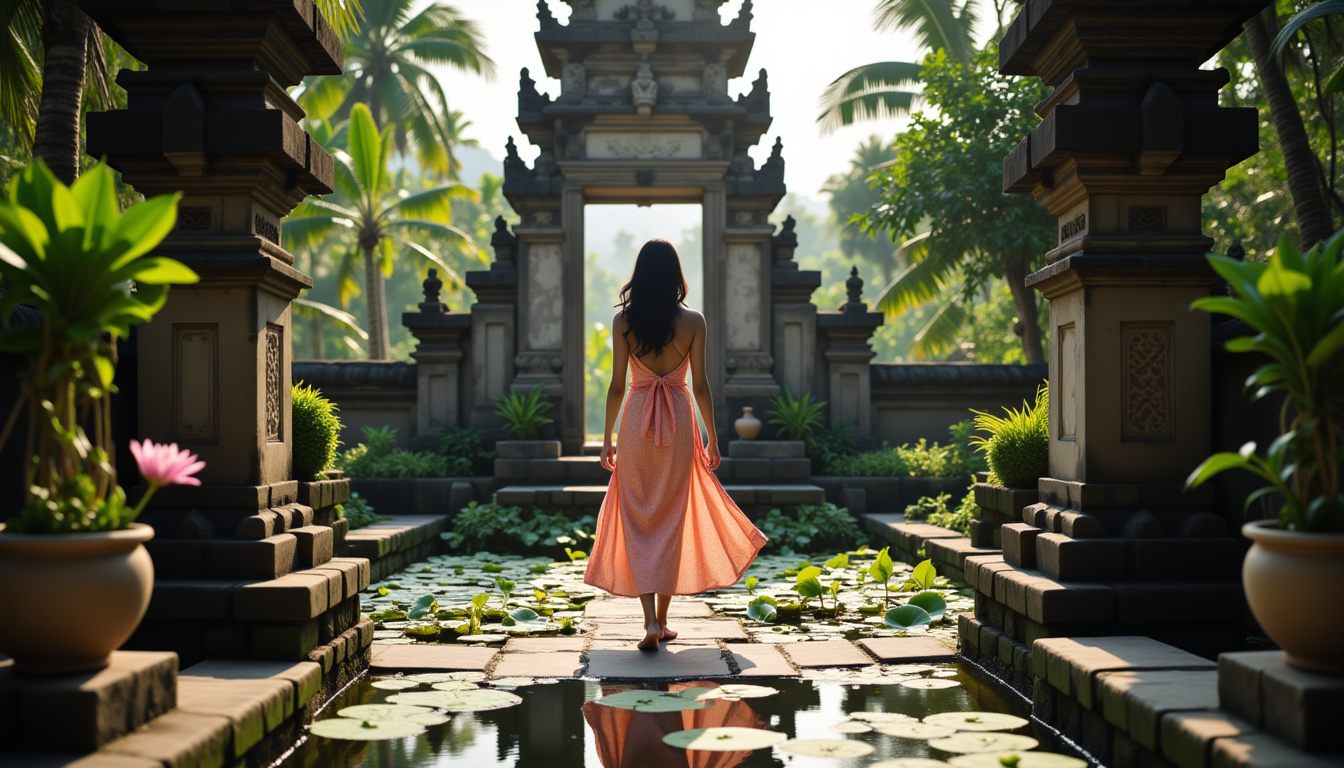
I sat with a woman who was working on a cloth she’d started before the pandemic. She didn’t hurry. She didn’t look up. Her hands moved with the kind of automaticity that only comes from doing something so many thousands of times that the body has memorised it below the level of thought. The cloth was dark red and brown and cream, the colours coming from natural dyes — indigo, mengkudu root — and the pattern was geometric and repeating and, if you stared at it long enough, seemed to vibrate slightly, as if it contained a frequency just below the threshold of hearing. Geringsing means “without sickness” — the cloth is believed to protect the wearer from evil. I bought a small piece for the equivalent of about thirty dollars. It sits on a shelf in my apartment now, and sometimes I look at it and think about how someone gave years of her life to make a thing that I bought in five minutes, and what that gap in time means about value.
Jatiluwih: The Terraces That UNESCO Tried to Explain
Tegallalang gets the crowds because it’s twenty minutes from Ubud and has swings. Jatiluwih gets UNESCO World Heritage status because it deserves it. The distinction matters.
Jatiluwih sits in the Tabanan Regency on the slopes of Mount Batukaru, and its rice terraces stretch across more than six hundred hectares in a system so vast that from certain viewpoints you can turn a full 360 degrees and see nothing but sculpted green. The entrance fee is 50,000 IDR for international visitors, 20,000 for children under twelve, and what you’re paying for is access to a landscape that has been continuously cultivated using the subak system for over a thousand years.
Subak is the reason this place exists, and it’s the thing that most visitors walk through without understanding. It’s a cooperative water management system — democratic, communal, older than any government on the island — that distributes water from mountain springs through an intricate network of canals, tunnels, weirs, and temples. Every farmer gets water. Every farmer contributes labour. The system is governed not by law but by a philosophy called Tri Hita Karana — harmony between people, harmony with nature, harmony with the divine — and the temples that dot the terraces aren’t decorative. They’re functional. Offerings are made to the water goddess before each planting. Ceremonies mark the growing cycle. The spiritual and the agricultural are not separate systems — they’re the same system, and the terraces are its visible expression.
Come before eight in the morning, when the mist hasn’t burned off and the light is soft and the terraces hold a silver quality that photographs can’t capture because photographs can’t capture temperature, and in the early morning Jatiluwih is cool in a way that Southern Bali never is. The walking trails are well-marked and take you through the heart of the paddies — across small streams, past traditional huts where farmers store tools, alongside the irrigation channels where water moves with a quiet, purposeful urgency. You can also cycle, and the routes range from gentle to genuinely challenging, taking you through hidden corners that the walking trails don’t reach. Either way, give yourself at least three hours. This isn’t a viewpoint to be consumed. It’s a landscape to be inhabited, even briefly.
Tirta Gangga: A King’s Apology to Water
The last king of Karangasem built Tirta Gangga in 1948, and the name — “water from the Ganges” — tells you what he intended: a sacred water palace, a place where royalty and ritual merged in pools and fountains and gardens arranged with the symmetry of devotion. Then Mount Agung erupted in 1963 and destroyed nearly all of it, which is the kind of thing that happens when you build beautiful things in the shadow of active volcanoes. The palace was partially restored, then more extensively renovated in the early 2000s, and what stands now is a layered thing — original stone and new stone, royal ambition and volcanic correction, the human desire for permanence and the earth’s quiet insistence that permanence is not on offer.
The entrance fee is between 70,000 and 90,000 IDR depending on what year’s pricing has been updated — call it about five to six dollars — and for that you get access to tiered water gardens, stepping stone paths over koi ponds where enormous golden and white fish glide beneath your feet, a central fountain surrounded by stone statuary, and the option to swim in spring-fed pools for an additional 10,000 IDR. The water is cold. Not cool — cold, the kind of cold that makes you gasp when it reaches your chest, fed by springs that come from deep in the volcanic rock. After days of tropical heat, that cold is a baptism.
Go in the morning. Not just because the light is better — though it is, turning the pools into mirrors and the spray from the fountains into something that catches and scatters like ground glass — but because Tirta Gangga before ten in the morning is nearly empty, and the palace was designed for contemplation, and contemplation requires the absence of crowds. Walk the stepping stones slowly. Watch the koi. Sit in the gardens and listen to the water, which moves through this place with the particular authority of something that has been moving through this place for a very long time and intends to continue. The king who built it is gone. The volcano that destroyed it is still there. The water keeps moving. There’s a sermon in that, if you want one.
The Offering That Nobody Explains
Here is the thing about Bali that took me the longest to understand, and that I think most visitors never understand at all, because it’s not something you can understand by looking at it — you have to understand it by seeing it repeated, day after day, in every conceivable context, until the repetition itself becomes the message.
The canang sari. The small palm-leaf basket filled with flowers, rice, incense, and sometimes a cracker or a cigarette or a piece of candy, placed on the ground or on a shrine or on the dashboard of a taxi or on the step of a 7-Eleven or at the base of a banyan tree or anywhere, really, because anywhere is where the spirits are. Every morning, Balinese women — and it is almost always women — make these offerings by the dozens. They make them at home. They make them at temples. They make them at the entrance to their shops. They make them at intersections. They make them in the rain. They make them on days when nothing particular is happening, because something is always happening in the Balinese cosmology — the balance between the divine and the demonic is being negotiated in every moment, in every space, and the canang sari is both the negotiation and the evidence that the negotiation is being taken seriously.
I watched a woman in Sidemen make one in about ninety seconds. Her hands folded the palm leaf into a square basket with a speed that suggested the shape lived in her fingers. She filled it with marigold petals, white frangipani, a pinch of rice, a stick of incense. She placed it on the ground outside her door, touched a match to the incense, pressed her palms together, and went back inside. The entire thing took two minutes. She would do it again before lunch. And again before dinner. And again tomorrow. And the day after. For the rest of her life. Not because anyone was watching. Not because it would bring her something she wanted. Because the world requires maintenance, and this is how she maintains it.
You will step on canang sari in Bali. It’s unavoidable — they’re everywhere, and they’re on the ground, and you’re looking at your phone or at the view or at anything other than your feet. When it happens, don’t panic. The offering has already been received by the spirits the moment the incense is lit. What you’re stepping on is the vessel, not the gift. But try to notice them. Try to count how many you see in a single block. Try to imagine making sixty of them before breakfast, every day, without exception, as an act of faith so embedded in daily life that it’s less like religion and more like breathing.
That’s the Bali beneath the Bali. It’s the reason the island feels the way it does — not just beautiful but charged, as if the air itself carries a current of intention. Every surface has been consecrated. Every threshold has been acknowledged. Every day begins with an act of devotion so small and so constant that it becomes invisible to visitors and indispensable to the people who live here. When someone tells you Bali is spiritual, this is what they mean. Not yoga retreats and sound baths and chakra alignments marketed to tourists. This. A woman folding a palm leaf in the dark before dawn, placing flowers on the ground, lighting incense, and going about her day. The most sacred thing I saw in Bali wasn’t in a temple. It was on a doorstep in Sidemen at six in the morning, and I almost missed it because I was looking at the mountain.
What Stays
I flew home with volcanic sand still in the treads of my shoes and the smell of clove smoke in a scarf I’d bought in Munduk, and for weeks afterward I kept reaching for things that weren’t there — the green of Jatiluwih at seven in the morning, the cold of Tirta Gangga’s spring-fed pools, the sound of water moving through a thousand-year-old irrigation channel in a rice terrace that existed before anyone thought to call it a destination.
The Bali that most people visit is real, and it’s fine, and nobody should feel guilty about enjoying a beach club in Seminyak or watching monkeys steal sunglasses in Ubud. But there’s another Bali — older, quieter, still working by rhythms that have nothing to do with check-in times or Instagram algorithms — and it’s not hiding, exactly. It’s just not performing. It’s in the black sand of Amed and the hollowed coconut trunks where salt crystallises in the sun. It’s in the double-ikat cloth that takes years to weave and carries a name that means “without sickness.” It’s in the subak channels that distribute water according to a philosophy that translates, roughly, as harmony with everything. It’s in the canang sari on every doorstep, every morning, placed there by someone who believes the world needs tending and has decided to tend it.
You don’t find this Bali by staying in the tourist triangle. You find it by driving east until the sand turns black, or north until the air turns cool, or into valleys where the rice terraces have been falling down hillsides for a thousand years and will be falling down hillsides for a thousand more. You find it by arriving early, before the light gets harsh and the tour buses arrive and the day puts on its public face. You find it by sitting still long enough for the incense to find you.
It found me in Sidemen at half past six in the morning. I’m still carrying it.
Worth reading next
More stories worth your time.

Where to Stay in Tokyo: A Luxury Neighborhood Guide
An honest guide to where to stay in Tokyo, with the neighborhoods, hotel styles, and tradeoffs that matter before you book.

The Winter Alps: Where Luxury Means Wood Fires, Not Gold Leaf
Four Alpine towns, four different ideas of what winter luxury means. From Zermatt's car-free quiet to Courchevel's fur-coat chaos, a guide to the Alps for people who care about the fire in the lobby.

Where to Eat in Tokyo: A Guide for People Who Take Food Personally
Two weeks in Tokyo, eating three meals a day plus snacks, convenience store runs at midnight, and one life-altering omakase. A neighborhood-by-neighborhood guide for people who consider food a personality trait.
About Kaira
Explore With Kaira is built for readers who want the atmosphere of a luxury travel magazine without the emptiness of sponsored copy.
About Kaira