Montenegro: The Last Quiet Corner of the Mediterranean (For Now)
While Croatia drowns in fifteen million visitors a year, Montenegro — just ninety kilometres south — offers the same Venetian stone, the same Adriatic blue, and a fraction of the crowds. The luxury brands have arrived. The bay still belongs to the mornings. This is the window.

The first time I saw Boka Bay, I was driving south from Dubrovnik on a road that clings to the cliffs like it’s afraid of the water below. You cross the Croatian border — which can take forty-five minutes in summer, or ninety if the universe is punishing you — and then the highway drops through a tunnel and opens onto something that stops your breath. A fjord-shaped bay, the deepest natural harbour in the Mediterranean, walled by mountains that rise straight from water so still it mirrors the stone villages on its shore. I pulled over at a lay-by that didn’t have a name. I sat on the guardrail. I stayed there for ten minutes, and in those ten minutes, not a single car passed.
That was September. By the time I left Montenegro ten days later, I understood something: this country is what Croatia was before the world found it. The same Venetian architecture. The same Adriatic light. The same mountains falling into the same sea. But quieter. Cheaper. And running on a clock that still has time left on it — though less than you’d think.
Montenegro draws about 2.6 million visitors a year. Croatia draws fifteen million. The distance between them is ninety-two kilometres. The math doesn’t make sense yet, but it will.
The Bay of Kotor: Venice’s Other Empire
Kotor has a double UNESCO listing — once for its Natural and Culturo-Historical Region in 1979, and again as part of the Venetian Works of Defence network. Four centuries under Venice, from 1420 to 1797, left behind the kind of stone and light that people travel to Dubrovnik to see. They called it Cattaro then, and the Venetian lion still watches from the city gate, and the clock tower in the square still doesn’t keep perfect time, and none of this has been ruined yet.
I say “yet” because cruise ships dock here. Between nine in the morning and five in the afternoon, the old town fills with the particular kind of crowd that moves through ancient places the way water moves through a pipe — purposeful, directed, not really touching the walls. But before eight in the morning, Kotor belongs to the cats.
There are thousands of them. Strays, originally, descendants of cats that arrived on sailors’ ships centuries ago. They sleep on windowsills and doorsteps and the warm hoods of parked cars. There’s a Cat Museum — one euro, barely bigger than a closet, charming in the way that things are charming when nobody is trying to monetise them — and the town has installed recycling machines that dispense cat food when you feed them plastic bottles. It’s a small, strange, perfect detail. It tells you everything about the relationship between this town and the creatures that inherited it.
The Fortress Climb
San Giovanni Fortress sits 254 metres above the old town, and the path up is 1,350 steps of uneven stone that Venetian soldiers once climbed in armour. Entry is fifteen euros now — free if you start before the ticket booth opens, though I didn’t tell you that. About halfway up, you reach the Church of Our Lady of Remedy, a fifteenth-century chapel where the views are already absurd and most people turn back. Don’t. The last third is the steepest, and the fortress walls at the top are crumbling in the specific way that things crumble when they’ve been doing it for five hundred years, and from the summit the bay unspools below you — Perast in the distance, the islands floating in the water, the mountains closing around all of it like cupped hands.
Start before nine in the morning during summer. By midday the stone radiates heat that you can feel through your shoes, and there’s no shade after the church. Bring water. Bring more water than you think you need.
Eating in Kotor
Galion sits on a glass terrace at the edge of the old town, the fortress reflected in the bay behind your table, and it’s the kind of restaurant where the setting does half the work and the kitchen does the rest. Expect to spend fifty euros a person, and expect not to mind. But the discovery is Konoba Scala Santa — outdoor seating on a quiet square, a violinist who plays on summer evenings, and pasta dishes that start at ten euros and taste like someone’s grandmother made them because someone’s grandmother probably did.
Here’s the number that matters: a seafood risotto in Kotor costs about twelve euros. The equivalent in Amalfi costs twenty-eight. The quality is the same. The view might be better. Montenegro is roughly eighteen percent cheaper than Croatia across the board, and compared to the Italian coast, it’s a different currency altogether.
Perast
Twenty minutes up the bay from Kotor, Perast is a Baroque village of three hundred people, seventeen palazzi built by maritime captains who made their fortunes at sea and spent them on stone, and no vehicles. You park at the edge and walk in, and the silence is immediate and specific — not the silence of abandonment but the silence of a place that decided it had enough.
From the waterfront, boats run to Our Lady of the Rocks for five euros round trip. It’s a man-made island, built since 1452 by the ritual of dropping stones — every sailor returning home would add a rock to the reef, and over centuries the reef became an island, and the island got a church, and the church got Tripo Kokolja’s paintings, and now you can stand in a building that exists because of an act of faith repeated ten thousand times. The ceiling is lower than you expect. The paintings are more beautiful than they should be, given the size of the space. The boat ride back is quiet in the way that boat rides are quiet when nobody wants to be the first to speak.
If you stay overnight — and you should — Vila Perast runs about 223 euros a night and sits directly on the water. The Conte Hotel is the other option. Either way, you’ll have Perast to yourself after the day-trippers leave, and the bay at sunset, seen from a waterfront table with a glass of local white wine, is one of those memories that becomes a measuring stick for everything after.
The Luxury Coast
Porto Montenegro
Tivat was a Yugoslav Navy base. Now it’s a Platinum-rated superyacht marina with 450 berths accommodating vessels up to 250 metres, a Buddha-Bar beach club, and the Regent Porto Montenegro — a five-star hotel that starts from around $154 a night in the off-season and carries a 9.4 guest rating that it earns. The infinity pool overlooks the marina. The boats in the marina cost more than the hotel.
Porto Montenegro is the part of this country that’s already arrived. The yachts are real. The money is real. The restaurants charge accordingly. But it exists in a strange tension with the rest of the bay — you can eat a three-euro burek in Kotor’s old town, drive fifteen minutes, and be poolside at a place where the champagne list has its own table of contents. That contrast is Montenegro’s particular magic, and it won’t survive the next decade of development unchanged.
One&Only Portonovi
The first One&Only in Europe, and if you’re going to announce yourself on a new continent, this is how to do it. Rates run from $306 a night to $19,934 — that top number is not a typo, it’s the Royal Villa, and I didn’t stay in it, and neither will you, but the fact that it exists tells you something about the clientele Montenegro is courting. The Espace Chenot spa is the real draw for anyone not arriving by helicopter: a medical wellness concept that takes recovery seriously enough to include things that feel more like treatment than indulgence.
The Sveti Stefan Question
I need to be honest about Sveti Stefan, because most travel writing isn’t. It’s the postcard image of Montenegro — a fortified island village connected to the mainland by a narrow isthmus, red roofs against blue water, the kind of place that looks like it was designed by someone who read too many fairy tales and had a very good architect.
It’s closed. Has been since 2021. Aman managed it as a resort — Elizabeth Taylor stayed there, and Sophia Loren, and Orson Welles, and Princess Margaret, and Kirk Douglas, and Marilyn Monroe — but the government and Aman are locked in a dispute, and the island sits empty. You cannot walk the lanes. You cannot book a room. You can stand on the mainland and take the photograph that every travel blog uses as a header image, and you can pay thirty to sixty euros for a sunbed on the main beach beside it, or a hundred and eighty euros for King’s Beach on the far side, and that’s all.
It matters to mention this because every “Montenegro luxury guide” I read before going still listed Sveti Stefan as if you could stay there. You can’t. Maybe someday — there’s talk of Banyan Tree, of new management, of reopening. But as of now, it’s a beautiful thing you can look at and not touch, which might be the most honest metaphor for what luxury travel is becoming.
What’s Coming
Mamula Island — a nineteenth-century Austro-Hungarian fortress on a tiny island at the mouth of Boka Bay — is being converted into a Banyan Tree resort with 32 suites, opening in 2026. SIRO Boka Place opened in 2025, a fitness-focused luxury brand that targets the kind of traveller who wants a personal trainer and a sea view. The Wulfenia Hotel launched in Kolašin the same year, bringing five-star mountain luxury to the interior. A Mövenpick is coming to Risan in 2026. The international brands are placing their bets. The smart money says Montenegro’s coast is five to eight years behind Dubrovnik’s trajectory. The smart money is probably right.
The Mountains Nobody Expects
Most people come to Montenegro for the coast and leave without realising that the interior exists. This is a mistake on the order of going to Switzerland and skipping the Alps.
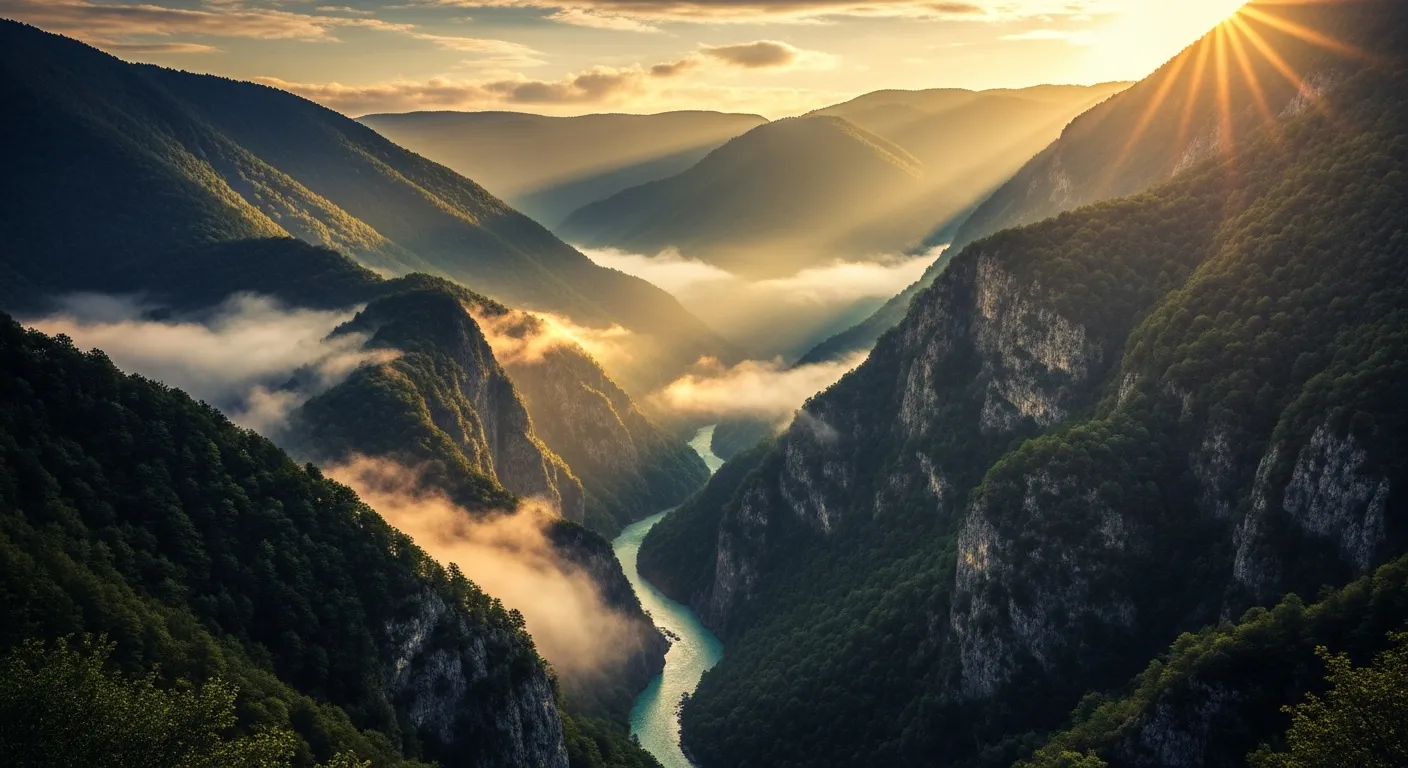
Durmitor National Park is a UNESCO site anchored by Tara River Canyon, the deepest canyon in Europe at 1,330 metres. That number doesn’t mean anything until you’re standing at the rim, looking down at a river that looks like a green thread stitched into stone, and your brain does the thing it does when scale exceeds comprehension — it simply refuses to process, and you stand there feeling smaller than you’ve felt in years.
Rafting the Tara is either a half-day at seventy euros or a full day at a hundred and fifty, and the full day is worth every cent. The rapids are Class III and IV in the upper sections, calming to glass-flat stretches where the canyon walls rise on both sides and the only sounds are the paddle and the water and whatever bird is calling from the cliff face. The season runs April through October. Book ahead in July and August — this is one of the few adventure experiences in Montenegro that’s already well-known.
Black Lake — Crno Jezero — sits ten minutes from Žabljak, the town that serves as Durmitor’s base. It’s a glacial lake at the foot of mountains that still hold snow in June, and the 3.5-kilometre walk around its shore is the kind of trail where you stop every few minutes not because you’re tired but because the reflection in the water has changed again. Above it, Bobotov Kuk rises to 2,523 metres — the highest point in Montenegro, accessible to experienced hikers, requiring no technical gear but demanding respect.
The contrast between the coast and the mountains is what makes Montenegro more than a beach destination. Two hours of driving separates superyacht marinas from canyon-rim silence. The country is smaller than Connecticut. It contains more topographic drama than countries ten times its size.
The Table
Montenegrin food doesn’t try to impress you. It succeeds by not caring whether you’re impressed.
Njeguški steak is the national dish, and I’m still thinking about it. Veal pounded thin, stuffed with njeguški pršut — a smoked ham from the mountain village of Njeguši that has a PDO designation and a flavour that sits somewhere between prosciutto and something wilder — and kajmak, a clotted cream-cheese that tastes like what would happen if butter and ricotta had a conversation and decided to become one thing. It’s rolled, breaded, fried, and served with potatoes that nobody pretends are the point. The point is the inside: the moment the knife breaks through the crust and the kajmak runs and the smoke from the pršut hits your nose.
The mussels in the Bay of Kotor are cultivated in water fed by cold mountain springs, and they taste nothing like Mediterranean mussels from further west. Brinier. Cleaner. More mineral. Smaller than you’d expect, which means more flavour per shell. I ate a pot of them at a waterfront konoba in Perast for less than the appetiser would have cost in Positano, and the bay was right there, and the boats were tied to the dock ten feet from my table, and I thought about how the same sea can taste completely different depending on what the mountains are feeding it.
Burek — phyllo pastry stuffed with cheese or meat or spinach, coiled into a spiral and baked — costs one to two euros from any bakery and is the breakfast that fuels the Balkans. Eat it with yoghurt. Eat it standing up. Eat it before the fortress climb and be grateful that someone, somewhere, decided that flaky pastry filled with cheese was an acceptable way to start the day.
And then there’s rakija. Fruit brandy. Plum, grape, pear, quince — every family makes their own, and every family’s is the best. It appears before meals, during meals, after meals, and at times that have nothing to do with meals. A waiter in Kotor poured me a glass at eleven in the morning because I complimented the bread. Refusing would have been ruder than drinking it. The bread was excellent. The rakija was better.
What Most People Miss
Skadar Lake and the Wine That Never Leaves
Skadar Lake is the largest in the country, shared with Albania, home to 270 bird species including the Dalmatian pelican — one of the world’s rarest. But the lake is also the gateway to Montenegro’s wine country, and the wine country is the thing I’d go back for.
The Crmnica region, on Skadar’s western shore, is the cradle of Vranac — an indigenous red grape that produces wines of deep ruby colour, full body, and dark cherry intensity. Plantaže, the largest winery in Southeast Europe, cultivates 2,310 hectares and produces seventeen million bottles a year, and their Vranac is the one you’ll find if you look hard enough in European wine shops. But the wines worth finding don’t leave the country.
Virpazar is the village to aim for — quiet, unhurried, ringed by vineyards that most wine maps don’t bother to mark. The local konobas pour bottles from producers so small they don’t export, and a glass of something that would win medals if anyone outside the Balkans ever tasted it costs less than a coffee in Dubrovnik. I sat in a garden restaurant in Virpazar and drank a Vranac that the owner told me came from vines his grandfather planted, and the wine was rough and honest and full of the mountain, and it paired with the grilled fish from the lake in the way that local wine always pairs with local food — not because someone designed the pairing, but because the grape and the fish grew up in the same soil and the same water.
Ostrog Monastery
Ostrog is carved into a cliff face at 900 metres, and from the road below it looks like someone photoshopped a white building onto a vertical rock wall. Over 100,000 people visit each year — Christians and Muslims alike, which tells you something about the monastery’s reputation that transcends doctrine. The upper monastery is reached by a steep, winding road that tests both your nerves and your transmission, and inside, the chapel is so small that three people fill it, and the frescoes glow in candlelight, and the silence is the specific silence of a place where people have been praying for three hundred years without stopping.
The Cultural Edge
Montenegro is 620,000 people. Independent since 2006. NATO member since 2017. EU candidate. It sits at the intersection of Venetian, Ottoman, and Slavic heritage, and the layers are visible everywhere — in the architecture, in the food, in the way that a Catholic church and an Orthodox monastery can share a valley without anyone finding it remarkable. The spiritual identity is Serbian Orthodox, but the cultural identity is something harder to pin down: Mediterranean in its rhythm, Balkan in its warmth, Venetian in its stone, and entirely its own in the way it holds all of these things together without choosing between them.
The Window
I’m going to tell you something that every honest travel writer knows but few say plainly: the best time to visit a place is before everyone agrees it’s worth visiting.
Montenegro is in that window. Croatia’s coast — the same water, the same mountains, the same Venetian stone — draws fifteen million visitors and charges accordingly. Montenegro draws 2.6 million and still has mornings where you can stand on a fortress wall and hear nothing but wind. The luxury brands have placed their bets: One&Only, Regent, Banyan Tree, SIRO, Mövenpick, and more coming. The infrastructure is being built for a future that’s already on the calendar.
Tivat airport now has direct flights from London on BA and easyJet, from Paris, Barcelona, Vienna, Frankfurt, Istanbul, and Belgrade. The currency is the euro — adopted unilaterally, though Montenegro isn’t an EU member — which means no exchange hassle. US, UK, and EU passport holders get ninety days visa-free. The Dubrovnik-to-Kotor drive is ninety-two kilometres and takes an hour and forty minutes, or longer in summer when the border crossing tests your patience.
May and June are ideal. September and October are better — the summer heat has broken, the cruise ships have thinned, and the light goes gold in the way that Mediterranean light goes gold when it’s done performing and starts just being beautiful. July and August are hot, crowded at the coast, and priced accordingly.
The new luxury openings tell the story: SIRO in 2025, Wulfenia in 2025, Mövenpick in 2026, Mamula Island by Banyan Tree in 2026. By 2030, the guidebooks will be thicker and the prices will be higher and the mornings on the fortress wall will have company. The trajectory is Dubrovnik’s trajectory, delayed by five to eight years, and anyone who’s watched that progression knows what comes next.
In September, you can still feel like you found something. That feeling has an expiration date.
What Stays
I’ve been back from Montenegro for weeks, and what I keep returning to isn’t the bay or the fortress or the wine, though I return to all of those things. It’s the scale. This is a country smaller than Connecticut that contains a fjord-shaped bay, a UNESCO canyon, a cliff-face monastery, glacial lakes, Baroque villages, superyacht marinas, and a wine country that the world hasn’t discovered. It holds more per square kilometre than places ten times its size, and it holds it lightly — without the self-consciousness of a country that knows it’s being watched.
That lightness is the thing that won’t last. Already, on the waterfront in Porto Montenegro, you can feel the weight of what’s coming — the brands, the berths, the build-out. Already in Kotor, the cruise ships rehearse the future every day between nine and five. The country is aware of what it has. The development plans are drawn. The trajectory is set.
But right now — right now — there are mornings on the Bay of Kotor when the water is so still it erases the line between the mountains and their reflection, and you can’t tell which version of the world is real. There are konobas in Virpazar pouring wine that will never see the inside of an export container. There are fortress walls where the only other living things are cats sleeping in the sun. There’s a man-made island built by sailors dropping stones for five hundred years, and a canyon deeper than anything in North America, and a country of 620,000 people that hasn’t yet learned to perform for visitors.
Go now. Not because it won’t be beautiful later — it will always be beautiful. But because the version of Montenegro that exists right now, in this specific window between obscurity and discovery, is the version that will stay with you longest. The one where you felt like you found something. The one where the quiet was real.
Worth reading next
More stories worth your time.

Where to Stay in Tokyo: A Luxury Neighborhood Guide
An honest guide to where to stay in Tokyo, with the neighborhoods, hotel styles, and tradeoffs that matter before you book.

The Winter Alps: Where Luxury Means Wood Fires, Not Gold Leaf
Four Alpine towns, four different ideas of what winter luxury means. From Zermatt's car-free quiet to Courchevel's fur-coat chaos, a guide to the Alps for people who care about the fire in the lobby.

Where to Eat in Tokyo: A Guide for People Who Take Food Personally
Two weeks in Tokyo, eating three meals a day plus snacks, convenience store runs at midnight, and one life-altering omakase. A neighborhood-by-neighborhood guide for people who consider food a personality trait.
About Kaira
Explore With Kaira is built for readers who want the atmosphere of a luxury travel magazine without the emptiness of sponsored copy.
About Kaira