Banyan Tree AlUla: The $2,000 Desert Hotel Saudi Arabia Built to Change Its Reputation
Banyan Tree AlUla charges $2,000 a night for a tented villa in a Saudi Arabian canyon with no alcohol, no nightlife, and a 2,000-year-old Nabataean city as your neighbor. It’s the most architecturally ambitious hotel opening in the Middle East since the Burj Al Arab — and it raises questions that no amount of desert sunset can answer.

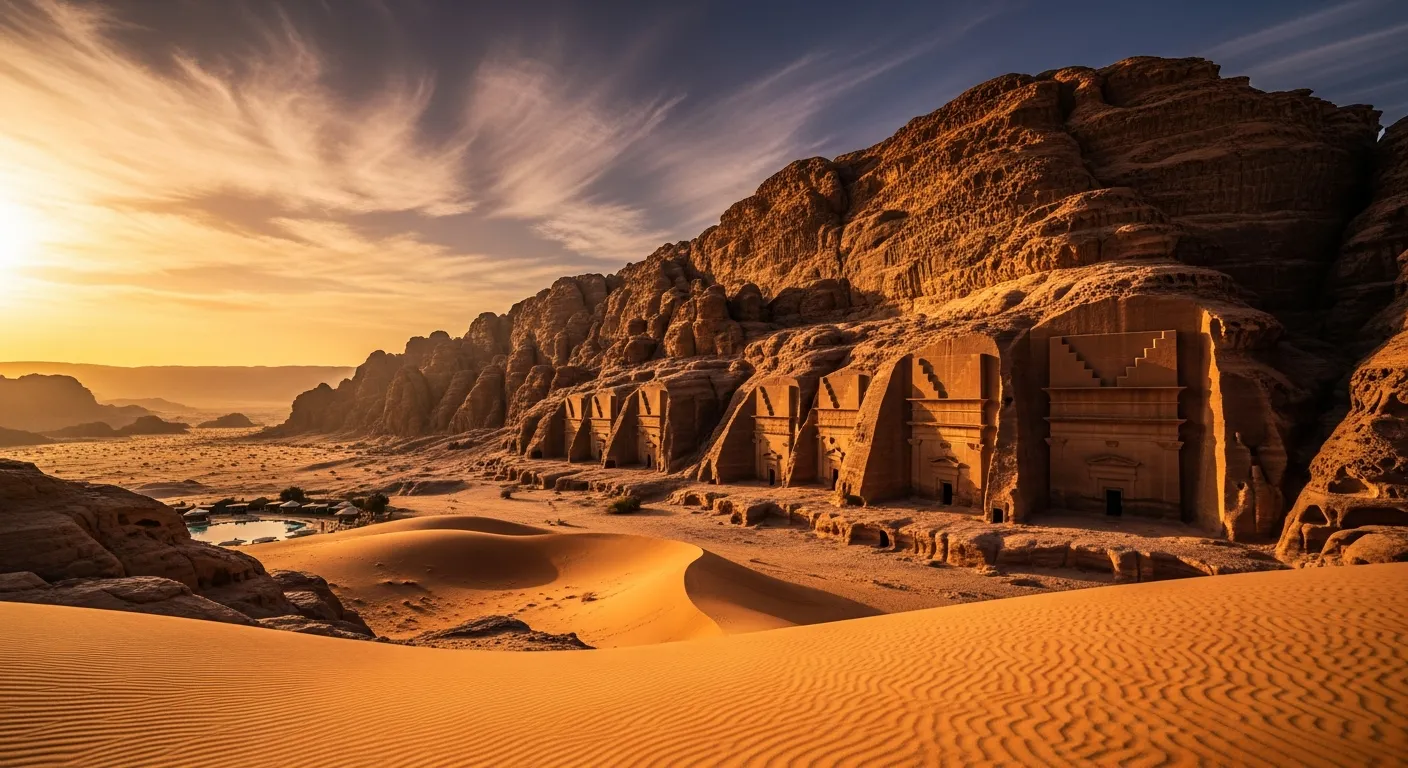
The canyon walls rise two hundred feet on either side, sandstone the color of burnt sienna, and the silence is so complete that I can hear my own pulse. It’s 6 AM in AlUla, and I’m standing on the terrace of my villa watching the first light turn the rock face from grey to pink to gold in a transformation that takes exactly eleven minutes. I’ve timed it. There’s nothing else to do at 6 AM in a Saudi Arabian canyon except witness the oldest light show on earth, and it is — I say this without the hyperbole that usually attends luxury hotel reviews — genuinely magnificent.
A hoopoe bird lands on the plunge pool’s edge, drinks, and leaves. The call to prayer rises from somewhere beyond the canyon rim, echoing off stone walls that have been reflecting sound since the Nabataeans carved their tombs into this rock two thousand years ago. The coffee that room service left at my door is Arabic qahwa — cardamom-forward, unsweetened, served in a brass dallah that feels ancient even though it was probably manufactured last year. Everything in AlUla feels ancient. The rocks. The light. The trade routes that once made this valley the crossroads between the Mediterranean and the Arabian Peninsula. And then you look down at your hotel, with its tented roofs and infinity pools and imported Italian furniture, and you feel the full weight of what Saudi Arabia is attempting here: to build a tourism industry from scratch, in a place most Westerners couldn’t find on a map three years ago.
The Arrival
Getting to AlUla is easier than it should be, which is part of the plan. Direct flights now operate from Riyadh (90 minutes), Jeddah (75 minutes), and Dubai (2.5 hours), with seasonal routes from London and Paris during the winter season. The airport is new, small, and efficient — you’re through arrivals in fifteen minutes and into a hotel car that covers the thirty-minute drive to the resort through a landscape that looks like someone crumpled Mars and laid it flat.
Saudi Arabia’s tourist visa, launched in 2019, takes five minutes online and costs roughly $120. The transformation this represents cannot be overstated. Until 2019, Saudi Arabia did not issue tourist visas. Period. The country that closed itself to casual visitors for decades is now building luxury resorts in its archaeological heartland and inviting the world to come see. Whether this represents genuine cultural openness or a calculated rebrand — the Vision 2030 strategy that Crown Prince Mohammed bin Salman calls his “post-oil economy” — is a question that follows you through every interaction here. Everyone I met in AlUla, from hotel staff to archaeological guides, spoke about it with a mixture of pride and careful optimism that felt rehearsed and sincere in equal measure.
The resort sits within Ashar Valley, a narrow sandstone canyon that the Royal Commission for AlUla has designated as the luxury hospitality corridor. Banyan Tree is one of three properties currently operating — Habitas and Dar Tantora are the others — with Aman and Jean Nouvel’s Sharaan resort (being carved directly into the rock face) planned for future opening. The density of ambition per square kilometer here is extraordinary. Saudi Arabia isn’t just building hotels. It’s building a destination from the geological foundations up.
The Room
Banyan Tree AlUla has 82 villas arranged along the canyon floor, each designed to mirror the sandstone environment while providing the kind of luxury that the Banyan Tree brand has spent thirty years perfecting in Southeast Asia. The entry-level Canyon View villas start at around 5,000 SAR per night — roughly $1,300 — while the Royal Heritage villas, with private pools and panoramic canyon views, run upward of 37,000 SAR, or close to $10,000.
My villa was a Canyon Pool villa, midrange at approximately $2,000 per night, and it was stunning. The design references Nabataean architecture — massive stone walls, arched doorways, carved detail that echoes Hegra’s tomb facades — while the interior is unmistakably contemporary: Italian linens, a rain shower the size of a small room, a freestanding tub positioned at the window with a view of the canyon wall so close you could almost touch it. The private pool, heated to precisely the right temperature for desert mornings, sits on a terrace of local stone with sun loungers pointed toward the canyon’s best light.
The tented roof structure — a tensile fabric canopy stretched over the stone walls — creates a play of light and shadow that changes throughout the day. In the morning, the fabric filters the sun into soft, warm patches that drift across the bed. At night, the tent structure means you can lie in bed and see the outline of the canyon rim against the sky through the translucent ceiling sections. In a region where the night sky is essentially unpolluted by light, this is a genuine architectural gift.
What’s genuinely impressive: the sense of place. Every material, every angle, every design choice references where you are. The stone is local. The color palette is drawn from the canyon. The furniture is custom-made. This doesn’t feel like a luxury hotel that could be anywhere, which is the fatal flaw of most resort design. It feels like a luxury hotel that could only be here, and that distinction matters more than any amenity list.
What’s less impressive: the villa spacing. At 82 units in a narrow canyon, the density is higher than the photographs suggest. My terrace was private from most angles, but I could hear my neighbors’ pool — a splash, a conversation, music that someone forgot to contain. This is not the total isolation that the marketing imagery implies. During full occupancy in peak season (October through March), the canyon can feel more resort-corridor than wilderness retreat. Request an end-of-valley villa if privacy is essential.
The Dining
Let me address the elephant in the canyon: there is no alcohol at Banyan Tree AlUla. Saudi Arabia’s prohibition is total — no hotel bar, no wine with dinner, no minibar bottles, no exceptions. If you arrive expecting a workaround, a discreet arrangement, or some five-star sleight of hand, you’ll be disappointed. The bar does not exist.
What does exist is an unexpectedly sophisticated non-alcoholic program. The resort’s mixologist — yes, they employ a dedicated mixologist — creates mocktails using local ingredients: AlUla citrus, date syrup, desert herbs, Arabic coffee infusions. A “desert sunset” made with pomegranate molasses, orange blossom, and something smoky I couldn’t identify was genuinely one of the best drinks I had during my stay. The selection of non-alcoholic wines has improved dramatically from the early days, and a Saudi-produced non-alcoholic beer called Barbican is better than it has any right to be.
Does it matter? Yes, honestly. Dinner at a luxury resort without wine is dinner with something missing, and no amount of pomegranate molasses fully compensates. For some travelers — those who don’t drink, those willing to try something different, those who see the cultural context as part of the experience — the absence of alcohol is a non-issue or even refreshing. For others, it’s a fundamental disqualifier, and there’s no reason to pretend otherwise.
The food itself is the strongest argument for the resort’s existence. Saffron, the main restaurant, serves a cuisine that draws on the Arabian Peninsula’s position at the crossroads of trade routes — North African spices, Levantine technique, Gulf ingredients, and a finesse that owes something to the executive chef’s training in European kitchens. A slow-cooked lamb shoulder with AlUla date glaze and hand-rolled couscous was extraordinary — the meat falling apart, the dates adding a caramel sweetness that played against preserved lemon and harissa. Dinner for two runs about 800-1,200 SAR ($215-320), which is expensive but not outrageous for this tier of resort.
Harrat, the poolside restaurant, handles lunch with lighter fare — grilled meats, mezze, flatbreads from a stone oven, and the best hummus I’ve had outside of Beirut. The AlUla citrus salad — a local specialty using fruit from the valley’s ancient oasis groves — appears on every menu and deserves to.
A private dinner in the canyon — set up among the rock formations with lanterns, rugs, and a dedicated chef — costs approximately 5,000 SAR ($1,300) for two and is, theatrical pricing aside, one of the most memorable dining experiences available anywhere in the Middle East. Eating food this good in a setting this ancient, under a sky this dark, with no phone signal and no ambient light, produces a feeling I can only describe as temporal vertigo. You’re eating in the present, sitting in the past, and the rock walls don’t care about the difference.

The Experience: Hegra and Beyond
The reason AlUla exists as a destination — the reason Saudi Arabia is investing billions in this valley — is Hegra. Known as Madain Salih in Arabic, this UNESCO World Heritage Site is the southern capital of the Nabataean Kingdom, the same civilization that built Petra in Jordan. Except Hegra is older, better preserved, and receives a tiny fraction of Petra’s visitors.
The resort arranges guided visits to Hegra as a complimentary excursion, and it is the single best thing you’ll do during your stay. The site contains over 100 monumental tombs carved into sandstone outcrops, their facades decorated with eagles, sphinxes, and inscriptions in Nabataean script that date to the first century AD. The craftsmanship is astonishing — clean geometric lines cut into stone by hand, with a precision that makes you question everything you thought about ancient technology.
What Hegra has that Petra doesn’t: space and silence. At Petra, you navigate a site overwhelmed by tour groups, souvenir vendors, and the relentless soundtrack of someone else’s guided tour. At Hegra, my group was six people. Our guide — a Saudi archaeologist named Fahad who’d worked on the site for twelve years — led us through the tombs at a pace that allowed actual contemplation. We spent twenty minutes inside a single tomb, watching the light move across a carved falcon relief, while Fahad explained how the Nabataeans controlled water in a desert through an engineering system of channels and cisterns that modern hydrologists still study. Nobody hurried us. Nobody appeared behind us with a selfie stick.
Beyond Hegra, the resort offers desert excursions to Elephant Rock, a natural sandstone formation that looks exactly like its name; stargazing sessions in the canyon with a resident astronomer and Celestron telescopes that resolve Saturn’s rings; hiking through Dadan, the ancient Dadanite kingdom with rock-cut lion tombs; and helicopter tours over the valley that reveal the full geological drama of AlUla’s landscape. Most excursions cost an additional 500-2,000 SAR ($130-530) per person.
The resort’s own spa occupies a series of canyon-floor pavilions, and the Rainforest Hydrotherapy experience — a circuit of hot and cold pools, steam rooms, and sensory showers — is Banyan Tree’s signature adaptation of their Asian spa heritage to a desert context. Treatments run 700-1,500 SAR ($185-400), with a desert-stone hot massage using heated sandstone that is either brilliant or gimmicky depending on your relationship with wellness marketing. I found it brilliant.
The Saudi Question
I can’t write an honest review of a luxury hotel in Saudi Arabia without addressing what you’re already thinking. The country’s human rights record, the murder of Jamal Khashoggi in 2018, the restrictions on women that have only recently begun to loosen, the ongoing war in Yemen — these are not footnotes. They are the context in which you’re considering spending $2,000 a night.
Every traveler draws their own ethical lines, and I’m not going to draw yours for you. What I can tell you is what I observed: women traveling independently, women driving cars, women working at the hotel in guest-facing roles, a social atmosphere that was visibly more relaxed than Saudi Arabia of even five years ago. The young Saudis I met in AlUla — guides, hotel staff, restaurant workers — spoke about Vision 2030 with the same mixture of hope and skepticism that young people everywhere apply to their government’s grand promises. Change is real. Whether it’s deep or performed is a question that probably won’t be answerable for another decade.
The tourism strategy itself is transparent in its ambition: Saudi Arabia wants AlUla to be its Luxor, its Angkor Wat, its Machu Picchu — a world-heritage anchor for a tourism economy that diversifies the kingdom away from oil dependency. The billions being invested in infrastructure, conservation, and hospitality are staggering. Whether a country can build a tourism identity this quickly, this deliberately, without the organic development that usually creates authentic destinations, is an experiment without precedent. You’re staying inside the experiment.
The Competition
AlUla’s competitive set is unusual because the destination itself is the differentiator rather than the hotel.
Habitas AlUla, also in Ashar Valley, offers a more bohemian interpretation of desert luxury — communal dining, wellness-focused programming, a younger and more social atmosphere — at roughly half Banyan Tree’s price point ($700-1,200/night). If you want the AlUla experience without the premium pricing, Habitas delivers the same canyon, the same Hegra access, and a community-oriented vibe that some travelers prefer to Banyan Tree’s privacy-focused model.
Aman’s Sharaan resort, designed by Jean Nouvel to be carved into the sandstone cliff face, is the future competition. When it opens — projected timeline has shifted multiple times — it will likely become the most talked-about hotel in the Middle East. But it doesn’t exist yet.
Royal Mansour Marrakech is the closest comparison in the Arab-world luxury category — a resort built by a monarchy to showcase cultural heritage. Royal Mansour has alcohol, more established service culture, and Marrakech’s centuries of hospitality infrastructure. But it doesn’t have Hegra, and it doesn’t have the novelty of a destination that most travelers have never heard of.
The Verdict
Banyan Tree AlUla is a genuinely remarkable hotel in a destination that has no equivalent on earth. The canyon setting is theatrical. The food is excellent. The villas are among the most architecturally considered I’ve seen in the Middle East. And Hegra — ancient, vast, uncrowded, humbling — is a world-heritage site that deserves the same recognition as Petra and receives a fraction of the attention.
Is it worth $2,000 a night? For the destination, yes. For the hotel alone, probably not — the villa density is higher than the price suggests, the lack of alcohol is a real limitation for many travelers, and the service, while competent, lacks the intuitive grace of the best Asian Banyan Trees. You’re paying a pioneer premium: the cost of being among the first to experience a destination that the rest of the travel world will discover over the next decade.
The deeper question is whether you’re comfortable being part of Saudi Arabia’s tourism experiment — enjoying the product of a Vision 2030 investment while holding space for the complications that context implies. I don’t have a clean answer. The canyon doesn’t offer one. It just stands there, two hundred feet of sandstone that has witnessed Nabataeans, Romans, Ottoman traders, and now luxury tourists, absorbing each era’s ambitions with the same geological patience.
What I know is that I left AlUla with something I rarely take from luxury hotels: a genuine sense of having been somewhere new. Not new-to-me-personally, but new-to-the-world — a destination that didn’t exist for Western travelers five years ago and now offers an experience unlike anything else available. That novelty carries a weight that outlasts the thread count.
The bottom line: A stunning canyon hotel with world-class architecture and a UNESCO site next door, limited by the absence of alcohol, higher-than-expected density, and the complex ethics of Saudi tourism — but offering a destination experience that genuinely cannot be replicated anywhere else on earth.
Book if: You want to see Hegra before everyone else does. You appreciate architecture that responds to landscape. You’re comfortable with the Saudi context. October through March for ideal weather.
Skip if: Wine with dinner is non-negotiable. You expect total isolation at this price point. You’re not comfortable with the political context. Summer temperatures exceed 45°C.
Don’t miss: The guided Hegra visit at dawn. A private canyon dinner. The canyon-rim hike at sunset. The astronomer’s stargazing session.
Skip: The helicopter tour unless you specifically want aerial photography — the ground-level experience of the canyon is more powerful than the view from above.
Worth reading next
More stories worth your time.

The Maldives Question: Is $2,000 a Night Worth It? (An Honest Answer)
I've stayed at four Maldivian resorts across three trips and two budgets. Here's the honest answer to whether those overwater villas are worth what they charge — and what nobody tells you about paradise before you book.

The White Lotus Hotels Are Real. The Experience Isn’t What You Think.
The White Lotus hotels are real, but staying at them now is a different experience than the fantasy the show sells.

St. Regis Bora Bora: Waking Up Above Water Is Not a Spiritual Experience
The brochure for the St. Regis Bora Bora promises a “transformative overwater experience.” The website uses words like “transcendent” and “soul-stirring.” Three different people told me, before I went, that waking up in an overwater villa would “change the way I see the world.” It didn’t change the way I see the world. It changed […]
About Kaira
Explore With Kaira is built for readers who want the atmosphere of a luxury travel magazine without the emptiness of sponsored copy.
About Kaira