The Salt-Sweet Secret: Amalfi Coast’s Hidden Gems Beyond the Postcards
The Salt-Sweet Secret There is a moment on the Amalfi Coast when the air changes. You round a bend on some ancient path and the breeze shifts from the warm, exhaust-tinged breath of the Strada Statale to something older — salt and wild thyme and the faintest sweetness of lemon blossom carried up from groves […]

The Salt-Sweet Secret
There is a moment on the Amalfi Coast when the air changes. You round a bend on some ancient path and the breeze shifts from the warm, exhaust-tinged breath of the Strada Statale to something older — salt and wild thyme and the faintest sweetness of lemon blossom carried up from groves you cannot yet see. That shift is the border crossing. On one side: the coast of postcards and Positano panoramas, the Instagram terraces, the EUR 22 Aperol Spritz. On the other: the coast that has been here for a thousand years, waiting for anyone curious enough to wander past the obvious.
I spent three weeks tracing that invisible border, and what I found on the other side changed the way I think about this stretch of shoreline entirely. The famous places are beautiful — I would never deny that. But the Amalfi Coast that truly broke my heart was the one I had to earn: through pre-dawn starts, crumbling staircases, and conversations in broken Italian with people who have never once considered leaving.
Where the Gods Walked
The Path of the Gods costs nothing but your willingness to wake before dawn. I caught the first SITA bus from Amalfi to Bomerano — EUR 1.50, departure around 7AM — and stepped onto the trailhead just before eight, when the limestone was still cool and the only company was a stray cat with opinions. The name comes from Greek mythology: this was the route the gods themselves used to race along the clifftops, warning settlers of Saracen raids sweeping up from the south. Standing at the trailhead, 580 meters above the sea, that story felt less like myth and more like memory.
The seven-kilometer trail from Bomerano to Nocelle takes roughly two hours if you don’t stop — but you will stop. You will stop a dozen times, because the coast keeps revealing itself in ways that demand stillness. The path descends mostly, which is merciful, but there is no shade anywhere along it, and not a single vendor selling water or snacks. Bring both. I carried a liter and a half of water and a paper bag of dried figs bought from a woman outside the Bomerano church, and both were gone by the final kilometer.
Halfway through, the trail opens onto a rocky outcrop where the entire Gulf of Salerno spreads beneath you like a secret told in shades of blue. On a clear morning — and that morning was blindingly clear — you can see the Li Galli islands, those jagged limestone teeth where Rudolf Nureyev once lived, and beyond them the pale silhouette of Capri floating at the edge of the visible world. I sat on that outcrop for nearly an hour, legs dangling over nothing, watching fishing boats trace white lines across water so far below they looked like slow-moving insects.
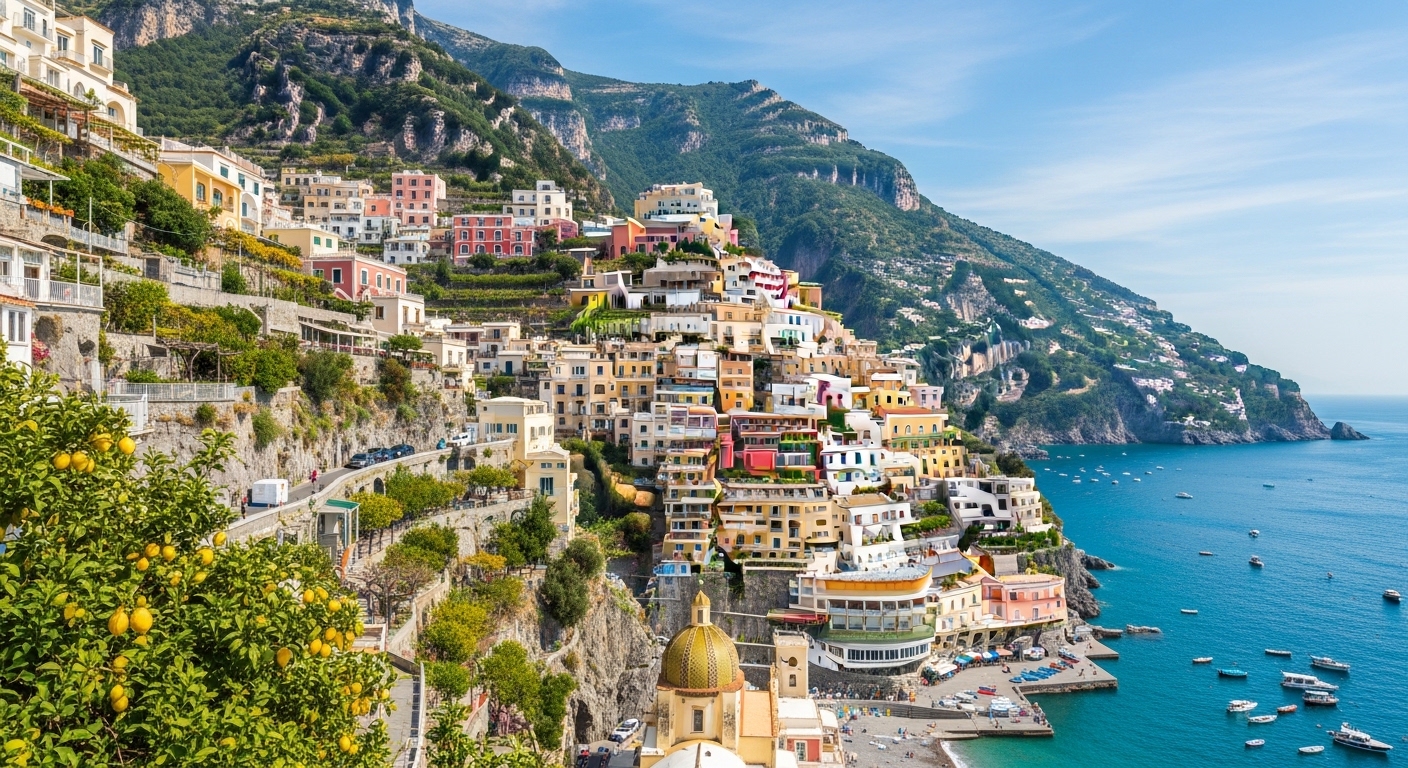
The trail ends in Nocelle, a village that clings to the cliff face above Positano like a bird’s nest built by someone with no fear of heights. From there, you have a choice: 1,500 stone steps spiraling down to Positano — your knees will have something to say about that — or a local bus that spares you the descent. I took the stairs. My knees did not forgive me for two days, but the views on the way down were worth every wince.
The Valley That Time Kept
Most people who visit Amalfi never learn that the town was once the papermaking capital of Europe. In the thirteenth century, water-powered mills along the valley above the town center produced paper that was shipped across the Mediterranean. The Valle delle Ferriere — the Valley of the Mills — is what remains: a three-kilometer trail climbing from the center of Amalfi into a gorge so lush and enclosed it feels more like Costa Rica than Campania.
The EUR 5 entrance fee buys you something money rarely can on this coast: solitude. While the Path of the Gods draws its share of hikers, the Valle delle Ferriere remains genuinely uncrowded — I encountered maybe a dozen people over two hours. The trail winds past the ruins of ancient paper mills, their stone walls now bearded with moss and threaded through with tree roots, until you reach a waterfall that drops into a grotto filled with Woodwardia radicans — a species of giant fern that has survived here since the Ice Age. Let that settle for a moment. These ferns were growing in this exact gorge when mammoths still walked the earth, and they are still here, in defiance of everything the intervening millennia have thrown at them. Standing beneath them, in that green half-light with the sound of falling water filling the air, I felt the particular kind of vertigo that comes from brushing up against deep time.
The Crack in the Earth
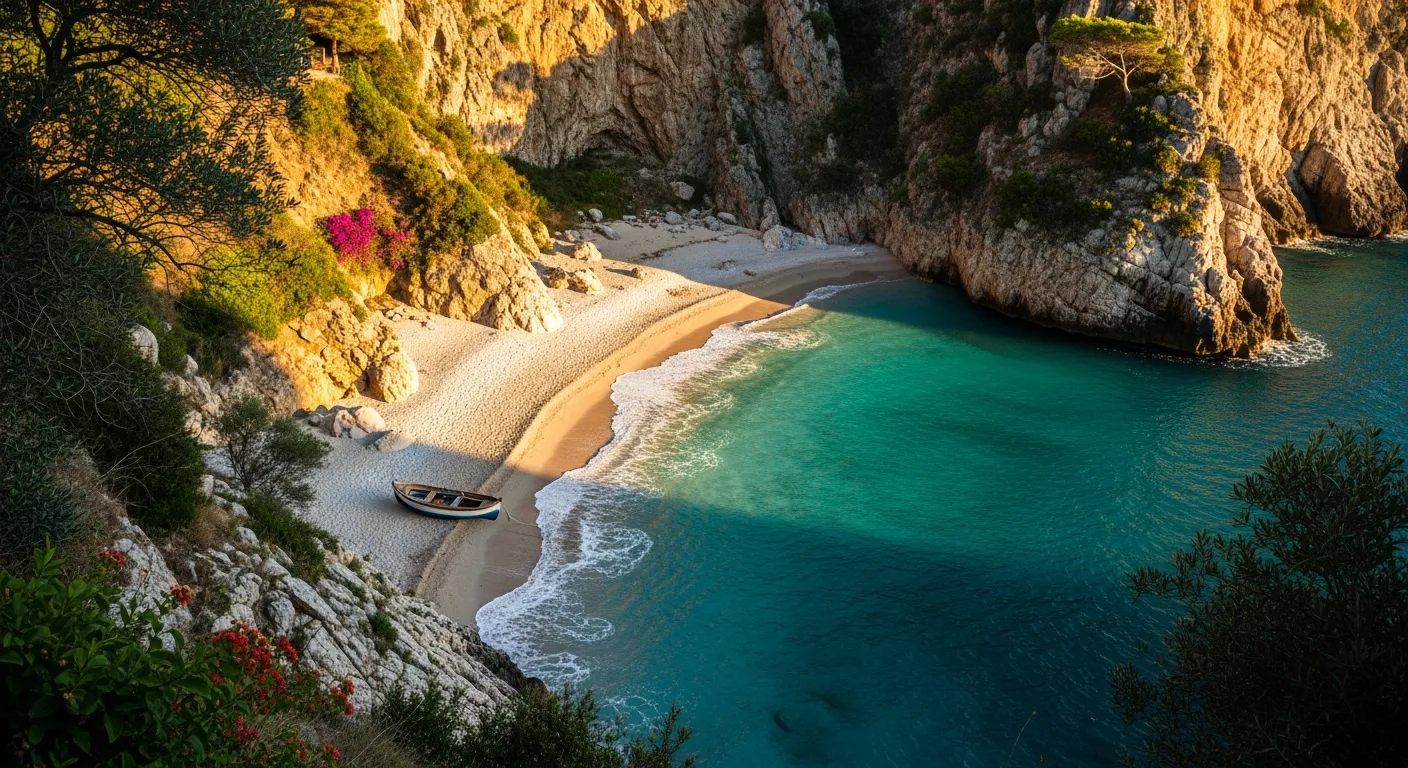
Between Amalfi and Positano on the SS163, the earth splits open. There is no other way to describe the Fiordo di Furore. Two hundred steps — I counted — switchback down from road level through wild vegetation until suddenly the limestone walls close in on either side, rising sixty meters straight up, and you are standing on a pebble beach no longer than twenty-five meters. A crack in the coastline that the sea has been slowly, patiently widening for millennia.
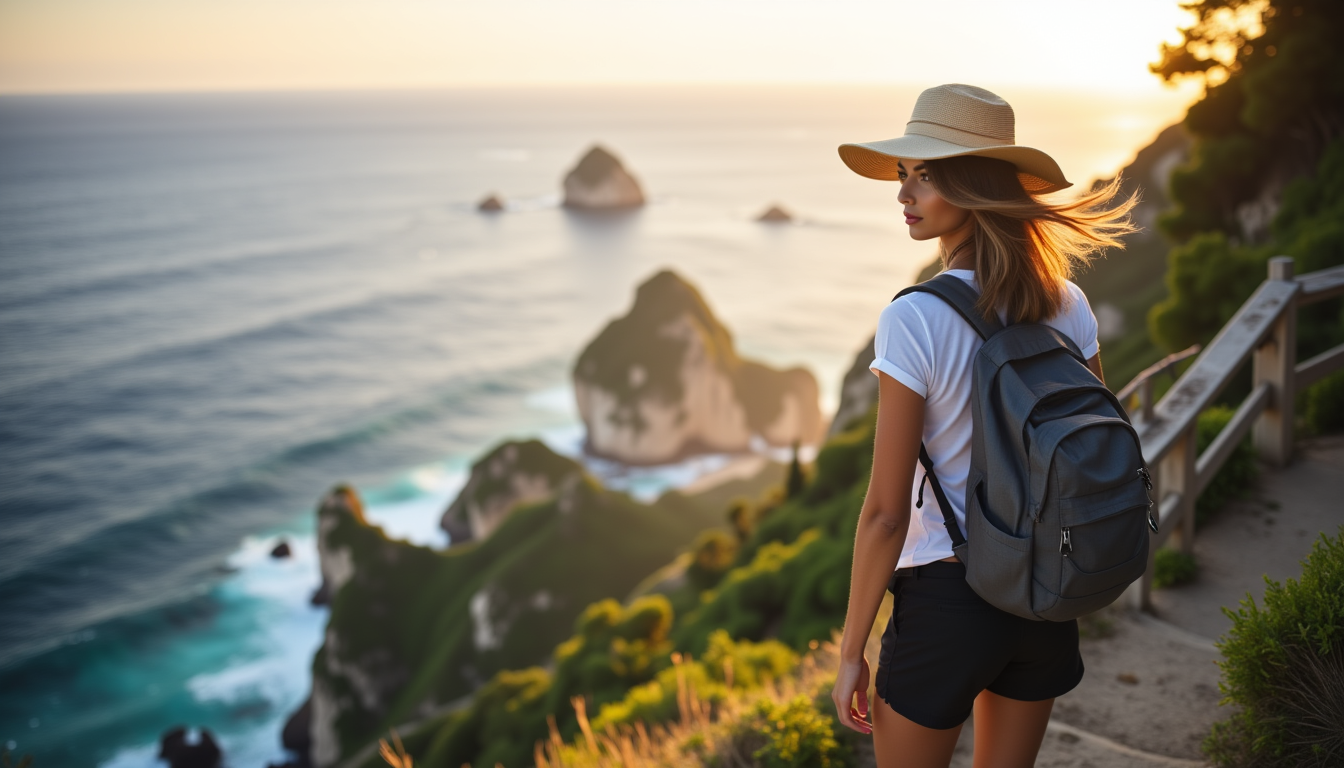
The water inside this fjord is the color of liquid gemstones — turquoise so transparent you can see the bottom at twenty feet. I spent an afternoon diving off the rocks into water cold enough to steal the breath from my lungs, then floating on my back and watching clouds drift across the narrow ribbon of sky visible between the walls. Every July, professional divers launch themselves from a platform above the fjord for the Mediterranean Cup high-diving competition, plummeting toward that turquoise from heights that made my stomach clench just imagining it.
Above the fjord sits the village of Furore itself — one of Italy’s borghi più belli, its most beautiful villages — home to roughly 800 people and almost no tourists compared to the chaos of Positano just up the road. It was here, on a terrace overlooking the sea, that I discovered Marisa Cuomo’s wines. Her vineyards are among the most dramatically situated in the world: grapes grown on terraces cut directly into the cliff face, suspended above the sea like something from a fever dream. The Fiorduva Bianco, made from nearly extinct local grape varieties, tasted like the coast distilled — mineral and salt and sun-warmed stone. At EUR 15 to 45 a bottle at the estate, and with tours available by appointment, it remains one of the finest secret splurges on this entire coastline.
The View That Silenced Gore Vidal
Ravello sits above the coast like a balcony that forgot to stop climbing. Two gardens here deserve your time, your money, and your willingness to arrive when the light is right.
Villa Rufolo came first in my itinerary. For EUR 8 you walk into a thirteenth-century garden built by the Rufolo family — merchants wealthy enough to construct paradise on a clifftop and eccentric enough to blend Norman, Arab, and Sicilian architecture into something that shouldn’t work but absolutely does. Richard Wagner visited in 1880 and was so overwhelmed that he wrote the garden scene of Parsifal’s second act about this place. The Ravello Festival now runs from June through September, staging concerts on a platform suspended over the sea where Wagner once stood speechless. Tickets start at EUR 30, and watching a string quartet play against a backdrop of open Mediterranean and fading daylight is the kind of experience that makes you briefly believe the world was designed for beauty.
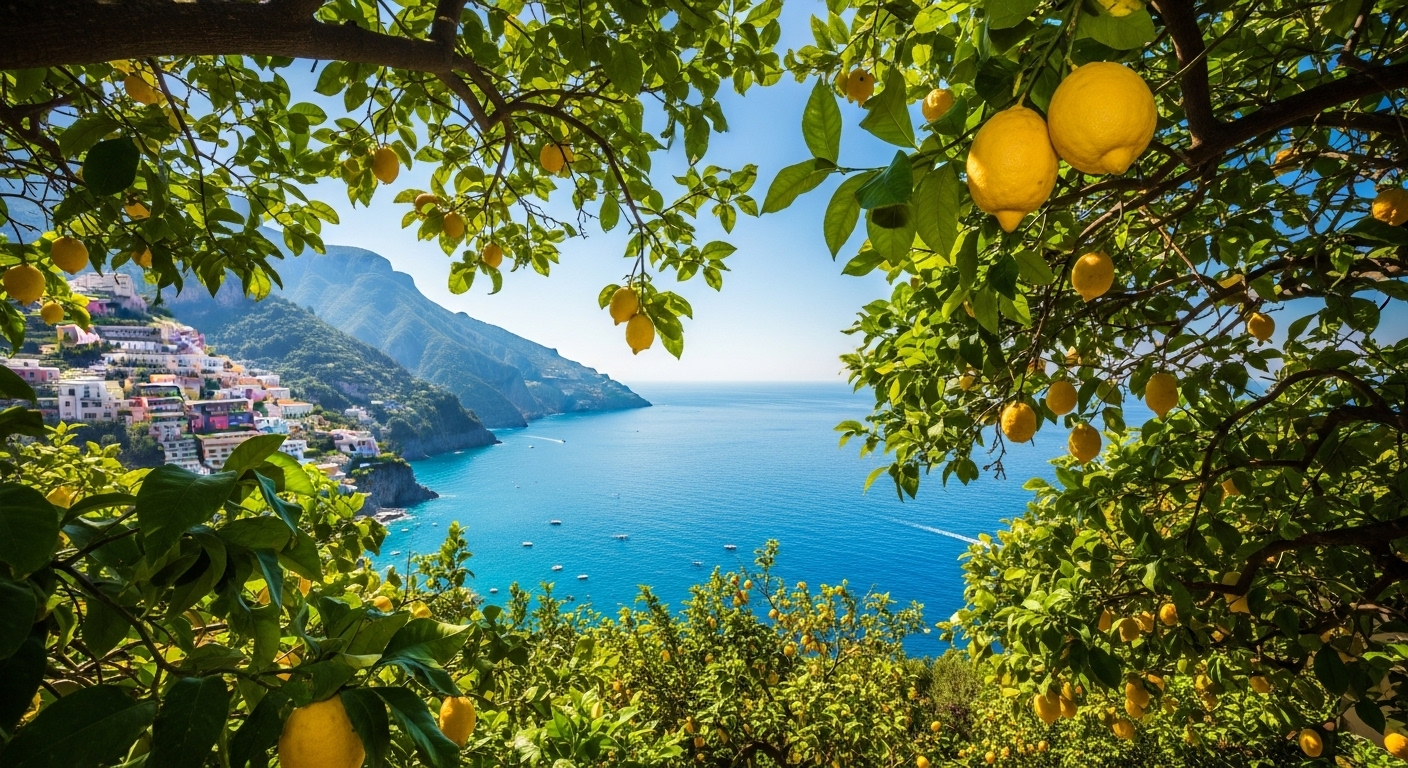
But it was Villa Cimbrone that undid me. Seven euros at the gate, a walk through fourteenth-century gardens threaded with temples, grottos, and rose gardens heavy with scent, and then — the Terrace of Infinity. Gore Vidal, who was not a man given to easy superlatives, called it “the most beautiful view in the world.” Standing at that marble balustrade, looking out over a drop that seems to fall directly into the Tyrrhenian Sea, I understood why Greta Garbo fled here in 1938 with conductor Leopold Stokowski when they needed to disappear from the press. Some places are so beautiful they become a kind of hiding. Part of the estate is now a luxury hotel — rooms from EUR 550 a night — but the gardens are open to anyone wise enough to arrive at dawn or late afternoon, when the light goes golden and the tour groups have already descended back to the coast.
The Anchovy Confessional
Cetara is fifteen minutes east of Amalfi by car and roughly fifty years behind it in sensibility. This is a working fishing village in the truest sense — no luxury boutiques, no souvenir shops selling ceramic lemons, just nets drying in the sun and the smell of salt and the sound of men arguing over coffee at the harbor bar. The fishermen here still use traditional lampara boats, heading out at night with bright lights to draw anchovies to the surface, a technique that has not changed in centuries.
Cetara’s gift to the culinary world is colatura di alici — an amber fish sauce made from layered, salted anchovies that is the direct descendant of ancient Roman garum. It carries DOP protection now, this liquid, and tasting it for the first time was a revelation: not fishy, but deeply savory, almost sweet, with a complexity that made me rethink everything I thought I knew about anchovies. I had it drizzled over spaghetti at Al Convento, a restaurant housed in a former convent where every dish orbits the anchovy with the kind of reverence most restaurants reserve for truffles. For something more refined, Acqua Pazza holds a Michelin star — Chef Gennaro Esposito’s cooking is the kind of precise, ingredient-driven work that makes you eat in focused silence and then want to talk about it for days.
The Smallest Square on the Sea
Ask anyone in Amalfi where they go when they want to escape tourists and they will point you through a short tunnel that opens, five minutes later, into Atrani. Italy’s smallest municipality — 0.12 square kilometers, roughly 900 residents, no car access whatsoever. The entire village is pedestrian, a maze of stairways and covered passages that spill out into the Piazza Umberto I, a small square built directly on the sea.
I sat in that square on a Tuesday evening with a glass of local white wine and watched the light change on the thirteenth-century Collegiata di Santa Maria Maddalena. An old man told me, with the kind of pride that does not need volume, that during winter storms the sea rushes up through ancient drains and floods the piazza, turning it into a temporary lagoon that reflects the lights of houses built into the cliff face. He described it the way someone describes a difficult relative — with exasperation and absolute love. Atrani is not trying to be discovered. It is simply being itself, and that self happens to be extraordinary.
Clay, Cobalt, and Centuries of Blue
Vietri sul Mare guards the eastern gateway to the Amalfi Coast, and it announces itself in color. Ceramics have been made here since the fifteenth century, and the tradition has seeped into every surface — tiled staircases, painted doorways, entire building facades glazed in patterns of donkeys and fish and lemons and geometric Moorish designs that trace their ancestry back to the Arab influence on southern Italy.
The Ceramica Artistica Solimene building alone is worth the detour: a wavy facade of glass and ceramic designed by architect Paolo Soleri that looks like the sea itself decided to become architecture. But the real treasures are in the workshops behind it — small studios where artisans still mix mineral oxides by hand. Cobalt for the blues that make Vietri ceramics instantly recognizable. Antimony for the warm yellows. Manganese for the deep browns. I spent a morning in one of these workshops, hands covered in slip, attempting to paint a traditional fish pattern on a tile under the patient guidance of a woman who had been doing this since she was fourteen. The painting classes run from EUR 17 for a simple tile to EUR 63 for a more involved piece, and what you take home is not just a souvenir but proof that you touched something real.
What the Coast Teaches
On my last evening, I sat on the terrace of a pensione in Furore — population 800, ambition zero — drinking Marisa Cuomo’s white wine and watching the sun turn the limestone cliffs the color of old gold. Below me, invisible from the road, the fjord held its turquoise secret. Behind me, somewhere up in the hills, the Path of the Gods was empty and waiting for the next person willing to catch a EUR 1.50 bus before dawn.
The Amalfi Coast everyone knows — the one on the posters and in the films — is genuinely beautiful. I would never argue otherwise. But it is a beauty designed to be observed, photographed, consumed. The coast I found in those three weeks was something different. It was a beauty that asked something of me: to climb, to listen, to sit still in a flooded piazza, to taste an anchovy sauce that connects the twenty-first century to ancient Rome, to stand beneath ferns that have survived since the Ice Age and feel, for one vertiginous moment, how brief and lucky my time on this earth really is.
The famous coast will always be there. But the secret coast — the salt-sweet one, the one that smells of wild thyme and colatura and mineral-oxide glaze — that is the one worth crossing the world for.
Worth reading next
More stories worth your time.

Where to Stay in Tokyo: A Luxury Neighborhood Guide
An honest guide to where to stay in Tokyo, with the neighborhoods, hotel styles, and tradeoffs that matter before you book.

The Winter Alps: Where Luxury Means Wood Fires, Not Gold Leaf
Four Alpine towns, four different ideas of what winter luxury means. From Zermatt's car-free quiet to Courchevel's fur-coat chaos, a guide to the Alps for people who care about the fire in the lobby.

Where to Eat in Tokyo: A Guide for People Who Take Food Personally
Two weeks in Tokyo, eating three meals a day plus snacks, convenience store runs at midnight, and one life-altering omakase. A neighborhood-by-neighborhood guide for people who consider food a personality trait.
About Kaira
Explore With Kaira is built for readers who want the atmosphere of a luxury travel magazine without the emptiness of sponsored copy.
About Kaira