Between Sea and Sky: The Amalfi Coast’s Most Extraordinary Hotels
The Elevator Through Stone I didn’t know where I was going. That’s the thing about Il San Pietro di Positano — the hotel doesn’t announce itself. There’s no gilded sign from the road, no grand portico, nothing at all except a small chapel that the Cinque family built when they carved this place into the […]

The Elevator Through Stone
I didn’t know where I was going. That’s the thing about Il San Pietro di Positano — the hotel doesn’t announce itself. There’s no gilded sign from the road, no grand portico, nothing at all except a small chapel that the Cinque family built when they carved this place into the living rock in 1970. You turn off the Amalfi Drive, and for a moment you wonder if you’ve made a mistake. Then you step inside, the floor drops away, and the entire Mediterranean opens beneath your feet.
The elevator descends through solid cliff face — not alongside it, not near it, through it — depositing you onto a private beach that the rest of the coast pretends doesn’t exist. I stood there the first morning, salt spray on my skin, looking up at sixty-two rooms and suites stacked into the limestone like a vertical garden, every single one with a private terrace facing the sea, and I understood why the Cinque family has never sold. Some things you don’t let go of.
Rooms start around $1,129 in shoulder season, climbing well past $2,000 when the August crowds arrive. But what that buys you is something beyond thread count and turndown service. It buys you dinner at Zass, Chef Alois Vanlangenaeker’s Michelin-starred terrace restaurant suspended over the water, where Mediterranean cuisine arrives on plates that look like they were painted by the sunset itself. It buys you mornings wandering terraced gardens heavy with bougainvillea and wisteria and lemon trees so fragrant you can taste them before breakfast. It buys you a boat that will take you directly to Positano’s harbor whenever you feel like descending from your perch in the clouds.
And there’s a tennis court, which I found absurd and wonderful — the idea of lobbing a ball back and forth on the edge of a cliff, as if the Amalfi Coast were merely a backdrop for your backhand.
Four Hundred Candles and a Filmmaker’s Ghost
Le Sirenuse was never meant to be a hotel. It was the Marchetti family’s home, and in 1951 they simply decided to let the rest of us in. Walking through the 58 rooms, each filled with family antiques and Neapolitan art that no interior designer could replicate because it was collected across generations rather than commissioned for a mood board, you feel less like a guest and more like a friend who’s been given the best bedroom.
But what makes Le Sirenuse ache in your memory is La Sponda. Someone — and I need to know who this person is and buy them a drink — decided that every evening, four hundred candles would be lit by hand before dinner service begins. Four hundred. I counted none of them because I was too busy watching the room transform from a restaurant into something that felt like the inside of a cathedral dedicated to the god of beautiful evenings. La Sponda holds a Michelin star, and it deserves it, but the candles deserve their own constellation.
Franco Zeffirelli thought so too. The filmmaker was a fixture here for decades, and his favorite table is still quietly marked — a small act of devotion to a man who understood that drama isn’t something you create, it’s something you surrender to. From $834 a night (closer to $1,500 in peak season), you’re not paying for a room. You’re paying for admission to a family’s impeccable taste.
Before dinner, take the stairs to Aldo’s Cocktail Bar on the rooftop terrace. After dinner, slip into Franco’s Bar on the outdoor terrace for what Positano regulars will tell you is the best sunset view on this side of the coast. Cocktails run EUR 18-25, which feels like a bargain when you consider that the view is doing most of the work and the Negroni is doing the rest. The Marchettis also run a small boutique downstairs with curated Emilio Pucci pieces and their own fragrance line — the kind of shopping that happens when you weren’t looking for anything and find exactly what you didn’t know you needed.

The Pool That Swallowed the Sky
A thousand feet above the sea, in a palace that has been standing since the 11th century, someone built a perfect circle of turquoise water and aimed it at the horizon. The infinity pool at Belmond Hotel Caruso in Ravello is, I’m now convinced, the single most photographed body of water in Italy that isn’t the Grand Canal. But photographs lie by omission. They can’t capture the way the pool’s edge seems to dissolve into the air itself, the way swimming here at sunset makes you feel like you’ve slipped through a seam in the atmosphere and are floating somewhere between the mountain and the Mediterranean with no particular obligation to return to either.
The Caruso occupies a former palace with 50 rooms dressed in hand-painted Vietri tiles and antiques that have survived nine centuries of Italian history, which is to say they’ve survived everything. Rates run $820 to $1,639 depending on whether you’re wise enough to visit in October or stubborn enough to compete with August. Wagner composed portions of Parsifal in the gardens here, which makes perfect sense — there’s an operatic quality to the light in Ravello, something that demands to be scored. Greta Garbo chose this as her Mediterranean refuge, and the hotel has the grace not to make too much of it, which is exactly the kind of discretion Garbo would have appreciated.
The Belvedere restaurant occupies a panoramic terrace that makes dinner feel like an act of flight. The gardens — ancient stone pathways threading between fountains, olive trees, hidden grottos — are where I lost an entire afternoon with a book and a glass of limoncello, emerging only when the shadows grew long enough to remind me that even paradise has an evening.
Where the Nuns Invented Pastry
I need to tell you about Monastero Santa Rosa in Conca dei Marini, because it might be the most remarkable hotel on this coast, and it’s the one most people have never heard of.
It was a 17th-century Dominican monastery. The nuns who lived here invented sfogliatella — yes, that sfogliatella, the shell-shaped pastry that every bakery in Naples claims to have perfected. The nuns did it first, in this building, overlooking this exact stretch of water. Now it’s an adults-only hotel with just 20 rooms, which means that on any given night, fewer people sleep here than in most New York restaurants. The infinity pool sits where monks once kept their quarters, and I swam in it at dawn while the rest of the coast was still dreaming, watching the mist lift off the water like the Mediterranean was exhaling.
Rates range from $805 to $2,022, and every dollar buys you something increasingly rare in the age of the mega-resort: genuine silence. Il Refettorio, the restaurant, occupies the former refectory where nuns once ate in contemplative quiet. The spa is buried in the vaulted monastery cellars, and lying there in the candlelit stone, listening to nothing at all, I understood what the Dominicans were after. They weren’t hiding from the world. They were finding the version of it that doesn’t need to shout.
One thing to know: the Santa Rosa closes from November through April. The coast hibernates, and this monastery returns to its silence. Plan accordingly — or don’t, and let fate decide.
The Pink Palace and the Actor’s Bar
Palazzo Avino is visible from across the valley in Ravello, its pink-hued facade catching the light like a blush on the mountainside. A 12th-century private villa turned 32-room hotel, it has the widest price range on the coast — $522 for a standard room to $5,437 for the presidential suite — which tells you something about the spectrum of experience available within a single building. The hand-painted majolica floors throughout are original, each tile a small act of devotion to beauty that has been walked on for eight centuries and shows no sign of minding.
Rossellinis holds a Michelin star under Chef Pino Lavarra, who does things with Southern Italian ingredients that feel less like cooking and more like alchemy. But it’s Harvey’s Bar that earned my loyalty — named after Harvey Keitel, who is apparently a regular, which is the kind of detail that makes you scan the room every time you lift your glass. The Clubhouse by the Sea, their beach club accessible by shuttle or boat, is where afternoon happens on the Palazzo Avino calendar, and I can confirm that afternoon is their best event.
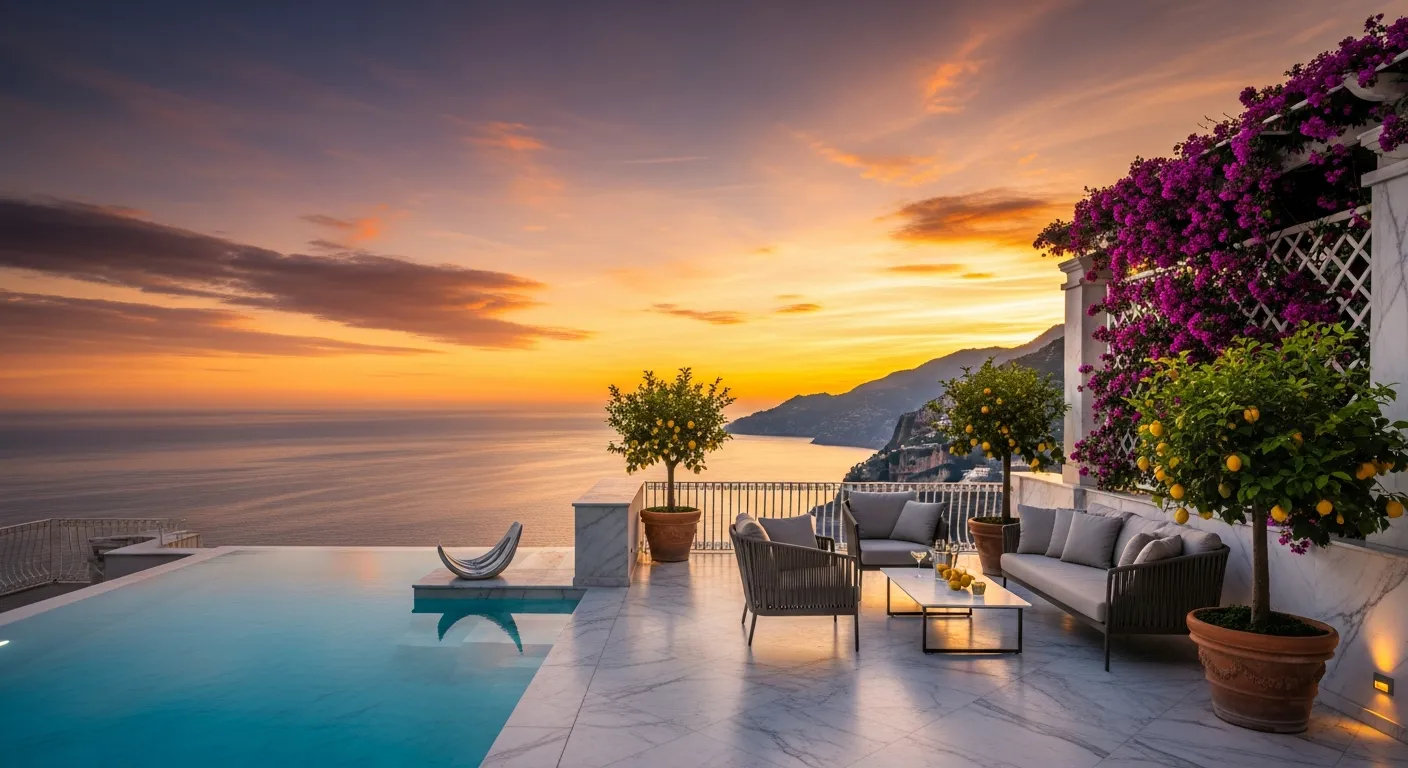
The Glass Elevator and the Lemon Grove
Santa Caterina sits in Amalfi town itself, which matters more than you’d think. Most of the coast’s great hotels perch in Positano or Ravello, beautiful and remote, requiring boats and hairpin drives to reach anything resembling a piazza. Santa Caterina lets you walk to the Amalfi Cathedral, wander the town’s narrow streets for gelato, and return to a hotel that has been family-owned since 1880 — making it older than most of the countries currently issuing passports.
The glass elevator descends through their private lemon grove to a sea-level pool and sun deck, and riding it feels like sinking slowly through a perfumed cloud. I found reading nooks hidden among the lemon trees — actual nooks, with cushions, shaded by branches heavy with fruit — and I spent a morning in one with an Aperol spritz and Elena Ferrante, which is the most specifically Amalfi Coast experience I can imagine. Rates start at a genuinely surprising $261 in low season and climb to $4,336 for the best suites in August, making Santa Caterina either the coast’s greatest value or its most extravagant splurge, depending on your calendar.
Dinner happens at Glicine, on a wisteria-covered terrace where the flowers form a living ceiling above your table. Wisteria, I’ve decided, is the official plant of the Amalfi Coast — it grows everywhere, it smells like someone distilled the color purple, and it makes even a mediocre meal feel significant. The meals at Glicine are not mediocre.
A Floor in the Sky
Casa Angelina exists to disagree with everything else on this coast, and I respect it enormously for that. Where every other hotel leans into terracotta and antiques and hand-painted tiles, Casa Angelina chose stark white minimalism — clean lines, pale stone, furniture that whispers instead of declaiming. Set in Praiano, the quiet village between Positano and Amalfi where the day-trippers don’t bother to stop, its 39 rooms feel like a gallery exhibition on the theme of Mediterranean light.
The restaurant is called Un Piano nel Cielo — “A Floor in the Sky” — and the name is not metaphorical. You dine at an elevation and with a transparency that makes the evening feel boundaryless. The infinity pool is carved into the cliff, because on this coast even the minimalists can’t resist a good infinity pool, and I swam in it while Praiano’s church bells counted the hour below and the sun did something unspeakable to the horizon.
From $565 a night, Casa Angelina is for the traveler who loves the Amalfi Coast but doesn’t need it to look like a postcard. It’s the coast filtered through a different sensibility — proof that luxury doesn’t require gilt, just intention.
What the Coast Teaches You at Dawn
Here’s what I’ve learned from sleeping in seven different clifftop beds along this stretch of Italian coastline: the Amalfi Coast has two versions of itself, and most people only meet one.
The daytime coast is the one you know — the hairpin roads choked with tour buses, the Instagram crowds jostling for the same shot of the same pastel buildings, the restaurants that know you’ll never come back and price accordingly. That coast is fine. It’s beautiful in the way that obvious things are beautiful.
But the early morning coast — the one that exists between first light and about 8 a.m. — belongs to nobody. The mist rises from the sea like the water is remembering something. The lemon trees release their scent into air that hasn’t yet been claimed by exhaust or sunscreen. The terraces of these grand hotels, which by noon will be filled with the gentle choreography of poolside service, sit empty and enormous and yours.
October is when the coast offers both versions most generously. The water is still 75 degrees, perfect for swimming. The restaurants, freed from the tyranny of peak-season demand, cook with a kind of relaxed joy that you can taste. Rates drop to their shoulder-season floors. And the light — the October light on the Amalfi Coast is the color of honey held up to a candle, warm and golden and impossibly kind to everything it touches.
If you’re planning a summer visit, book four to six months ahead or prepare to be disappointed. Most of these hotels close entirely from November through March or April, retreating into their stones like the coast itself is taking a long, slow breath before the next season begins. And one last thing the concierges won’t always tell you: half-board — breakfast and dinner included — is often the best value at these hotels, because their restaurants are the reason you came, and eating elsewhere would be like buying opera tickets and leaving at intermission.
Private boat transfers between hotels run EUR 100-200, and I’d argue they’re the single best money you can spend on this coast. Arriving anywhere by sea changes the story. You’re not stuck in traffic on the Amalfi Drive, white-knuckling a bus around a blind curve. You’re gliding in from the water, watching the cliffs rise to meet you, seeing these hotels the way they were meant to be seen — from below, looking up, marveling at the audacity of building something so beautiful in a place so impossible.
Worth reading next
More stories worth your time.

The Maldives Question: Is $2,000 a Night Worth It? (An Honest Answer)
I've stayed at four Maldivian resorts across three trips and two budgets. Here's the honest answer to whether those overwater villas are worth what they charge — and what nobody tells you about paradise before you book.

The White Lotus Hotels Are Real. The Experience Isn’t What You Think.
The White Lotus hotels are real, but staying at them now is a different experience than the fantasy the show sells.

St. Regis Bora Bora: Waking Up Above Water Is Not a Spiritual Experience
The brochure for the St. Regis Bora Bora promises a “transformative overwater experience.” The website uses words like “transcendent” and “soul-stirring.” Three different people told me, before I went, that waking up in an overwater villa would “change the way I see the world.” It didn’t change the way I see the world. It changed […]
About Kaira
Explore With Kaira is built for readers who want the atmosphere of a luxury travel magazine without the emptiness of sponsored copy.
About Kaira