A Weekend in Marrakech: Three Days of Spice, Light, and Ancient Walls
Seventy-two hours in Marrakech — from the 8 AM silence of Majorelle to the midnight fountains of a medina riad. A day-by-day guide that tells you exactly what things cost, where to eat at every price point, and why putting your phone away for one hour will be the best decision you make all trip.

Why Three Days Is Perfect
The call to prayer drifts across terracotta rooftops at dawn, and I’m already awake in my riad, watching shadows dance across carved cedar walls. Somewhere below, a fountain murmurs the way it has for three hundred years. Marrakech is pure theater — where Berber traditions tango with French colonial elegance, where ancient medina walls contain rooftop bars serving champagne under African stars, where a single wrong turn can deliver you to a courtyard so beautiful it stops your breath.
A weekend here isn’t too short. It’s perfectly distilled — like a shot of mint tea, sweet and strong, leaving you buzzing with possibility and aching to return. Here’s exactly how I’d spend seventy-two hours if I were doing it again for the first time.
Before You Land
Marrakech Menara Airport is close and well-connected — Ryanair and easyJet run cheap, frequent routes from London, Paris, and Madrid, often under €50 one-way. From the US, there’s no direct flight except a seasonal Delta route from Atlanta; most Americans connect through Paris, Madrid, or Casablanca, where Royal Air Maroc hops to Marrakech in under an hour.
The airport sits just 6 km from the medina. At arrivals, walk past anyone who approaches you inside the terminal — the official taxi stand is outside. Agree on 70 to 100 MAD before getting in, or ask your riad to arrange a private transfer for 200 to 400 MAD. US, UK, and EU passports get visa-free entry for 90 days — just show up with six months of validity remaining.
Your first decision shapes everything: where to sleep. Inside the medina walls, riads range from $50 a night (basic but atmospheric) to $400 and beyond (transformative). You’ll hear the call to prayer five times a day, smell bread baking at dawn, navigate by instinct, and drag your luggage through alleys where cars cannot follow. The Gueliz district — the French-built new city — is tree-lined boulevards and international restaurants at $80 to $250 a night, a different experience entirely. Hivernage, the luxury hotel district, puts you within walking distance of the medina with modern infrastructure beneath your feet. La Mamounia lives here.
Pick up a Maroc Telecom SIM at the arrivals hall — about 200 MAD for 30GB of data, good for a month. You’ll need it. The medina’s WiFi is poetry in theory and unreliable in practice.
Day One: Falling In
Start at Jardin Majorelle before the world wakes up. Gates open at 8 AM; be there by 8:15. The contrast hits immediately — that electric Majorelle blue against every shade of green, the morning light filtering through palms and creating patterns that shift like living kaleidoscopes. By 10 AM the tour buses arrive and the spell breaks, so use the golden hour wisely. Tickets are 170 MAD, online only — they stopped selling at the gate and I’ve watched the confusion this causes. Buy the Berber Museum add-on for 30 MAD.
From Majorelle, walk south into the medina. Enter through Bab Laksour and put your phone away — not forever, just for an hour. Let the maze take you where it wants. The walls shift from pale pink to deep terracotta depending on the light, and suddenly you understand why they call this the Red City. You will get lost. This is the point.
Find your way to Ben Youssef Madrasa — the 14th-century Quranic school whose interior will silence you. Fifty MAD, and worth arriving before the midday crowds. Then wander toward the spice souk, where pyramids of saffron and cinnamon create their own sunset palette, and let your nose lead you to lunch.
Lunch at Nomad, on the edge of the spice square — modern Moroccan on a rooftop with medina views. The lamb tagine with prunes and sesame is the standout. Expect 150 to 250 MAD per person. No reservation needed before 1:30 PM.
In the afternoon, walk south to the Saadian Tombs (100 MAD) — the royal burial chambers hidden for centuries and rediscovered by accident in 1917. The Chamber of the Twelve Columns earns every superlative. Nearby, Bahia Palace (70 MAD) unfolds room by painted room, its ceilings so intricate you’ll develop a permanent neck ache from looking up. Both are within ten minutes of each other in the Kasbah district.
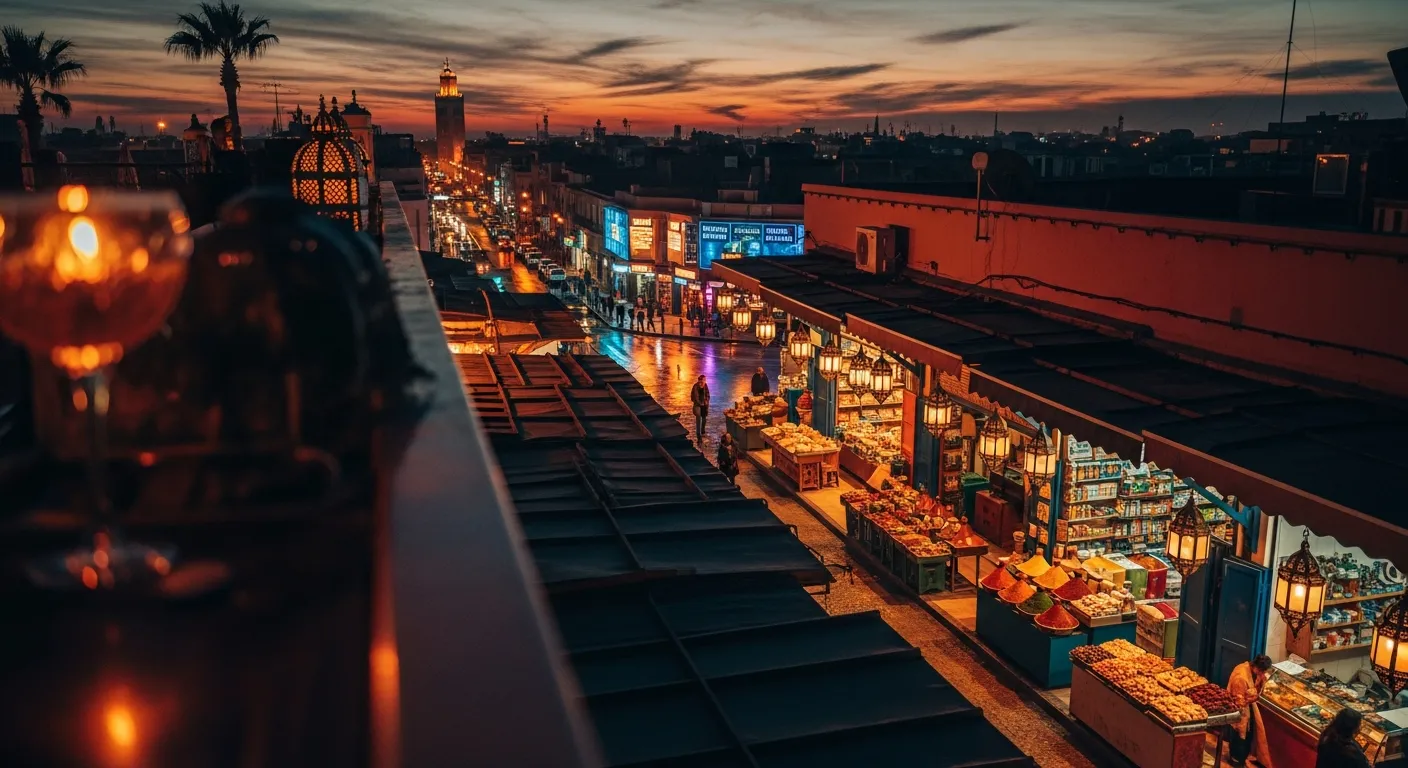
At sunset, there’s nowhere else to be but Jemaa el-Fnaa. Grab an upper terrace at Café de France or Le Grand Balcon du Café Glacier — a mint tea costs 20 to 30 MAD and buys you the best seat in Africa. Below, the square transforms: storytellers, musicians, acrobats, and food stalls emerge as if the night summoned them. For dinner, the numbered stalls in the square are safe and delicious — grilled merguez, snail soup, fresh orange juice for 4 MAD. Budget 60 to 100 MAD for a feast.

Day Two: Deeper
Morning: the hammam. This is non-negotiable. Ask your riad to point you toward either a neighborhood hammam — 30 to 60 MAD, bring your own black soap, raw and communal and centuries-old — or a mid-range spa like Heritage Spa or Les Bains de Marrakech, where the full gommage and rhassoul clay treatment runs 300 to 600 MAD. Either way, you’ll emerge feeling like someone has scrubbed away not just dead skin but accumulated stress, noise, and the Western compulsion to always be going somewhere. Allow two hours. Don’t rush. The hammam doesn’t reward rushing.
Late morning: the souks with purpose. Yesterday you wandered; today you hunt. Here’s what things actually cost after haggling, so you can enjoy the negotiation instead of dreading it: babouche slippers, 80 to 150 MAD. Brass lanterns, 200 to 500 MAD. Argan oil (cosmetic grade, one liter), 250 to 400 MAD. Start at a third of whatever the vendor asks. Meet around 40 to 50 percent. Walk away if you can’t agree — the slow retreat is the most powerful tool in this ancient game, and you’ll often hear a better number called after you before you’ve gone ten steps.
Lunch in the mellah. Walk south to the Jewish Quarter, where the food stalls serve the most honest street food in the city and the tourist density drops by half. Maakouda fritters, msemen flatbread, grilled kefta — 30 to 50 MAD for a full meal eaten standing up in a narrow alley that smells like cumin and charcoal.
Afternoon: Le Jardin Secret and the Mouassine quarter. The restored 16th-century riad complex (80 MAD, tower climb another 40 for the best medina panorama in the city) is quieter, more cerebral, and more beautiful than Majorelle — I’ll die on this hill. Afterward, wander the Mouassine quarter: restored fondouks, contemporary galleries, boutique shops that feel curated rather than chaotic.
Evening: a dinner you’ll remember. If you want to splurge, Le Jardin at the Royal Mansour is one of the few restaurants open to non-guests — reserve a week ahead and expect a meal that redefines what Moroccan cuisine can be. For the full theatrical experience, Dar Yacout serves a multi-course feast in a palatial setting for 500 to 800 MAD per person. For rooftop ambiance without the price tag, Terrasse des Épices delivers medina views and good food at 200 to 400 MAD.
Day Three: Beyond the Walls
You’ve earned a departure. Two options, depending on who you are in the morning.
If you want mountains: Take a grand taxi to the Ourika Valley — an hour south, where the Atlas Mountains rise so suddenly the temperature drops ten degrees and the air tastes like water from a cold spring. At Setti Fatma, hire a local guide (100 to 150 MAD) and hike to waterfalls that cascade down rose-colored rocks while he explains which plants heal, which peaks are sacred, and why the Berber villages clinging to the hillsides have outlasted every empire that tried to claim them. A private driver through your riad runs 500 to 800 MAD for the day, with a stop at Anima Garden on the way back.
If you want to stay: Spend the morning in a cooking class — $34 to $65 for a group session that starts with a guided market visit and ends with you making tagine, couscous, and pastilla from scratch, carrying home recipes and spice knowledge that will haunt your kitchen for months. La Maison Arabe has run theirs since 1946, but the smaller riad-based classes where you cook alongside the family chef are the ones I remember most.
Either way, save your last afternoon for Maison Tiskiwin (20 MAD) — the private museum of Saharan artifacts that feels less like a tourist attraction and more like entering a stranger’s obsession. Then one last walk through the medina in the golden hour, when the walls glow their deepest pink and the evening call to prayer echoes between buildings that have heard it a hundred thousand times before.
What It Actually Costs
Marrakech bends to almost any budget, which is part of its genius.
A budget weekend — basic riad, street food, walking everywhere — runs $250 to $450 for three nights. You’ll eat beautifully, see everything that matters, and sleep in rooms that would cost four times as much anywhere in Europe.
The mid-range version — a boutique riad, mix of street food and rooftop restaurants, a hammam and a cooking class — lands between $550 and $900. This is the sweet spot. Enough comfort to feel indulgent, enough authenticity to feel real.
The luxury version — Royal Mansour or La Mamounia, private guides, fine dining — starts at $1,500 and climbs to $5,000 or beyond. At this level, the city becomes a private performance staged entirely for you.
The Things Nobody Tells You
Cover your shoulders and knees in the medina. Not because anyone will confront you, but because the city opens differently to those who show respect for its rhythms.
Ask before photographing people. Some vendors will pose happily for 10 to 20 MAD. Some women will not pose at any price. The camera is not a passport.
Learn four words of Darija and watch doors open: salaam alaikum (peace be upon you), la shukran (no thank you), bslama (goodbye), besh-hal (how much). That last one, spoken with a smile, transforms every souk transaction from confrontation to collaboration.
Tipping: 10 to 20 MAD for kindnesses. 10 to 15 percent at restaurants. 50 to 100 MAD for your hammam attendant, who just scrubbed you harder than anyone has in your life and somehow made it feel like love.
In an emergency: Police 190. Ambulance 150. Tourist Police near Jemaa el-Fnaa, staffed evenings and weekends.
Leave Room
Pack light for Marrakech. Leave room in your luggage for the babouches that caught your eye, the brass lantern that will never look quite as magical in your apartment but that you’ll love anyway, the spice blend you’ll try to recreate at home and never quite match.
And leave room in yourself — for the way the light falls on ancient walls at 6 PM, for the sound of a fountain in an empty courtyard, for the particular silence that fills a riad when the heavy door closes behind you and the city, vast and loud and ancient and alive, agrees to wait outside until you’re ready.
Worth reading next
More stories worth your time.

Where to Stay in Tokyo: A Luxury Neighborhood Guide
An honest guide to where to stay in Tokyo, with the neighborhoods, hotel styles, and tradeoffs that matter before you book.

The Winter Alps: Where Luxury Means Wood Fires, Not Gold Leaf
Four Alpine towns, four different ideas of what winter luxury means. From Zermatt's car-free quiet to Courchevel's fur-coat chaos, a guide to the Alps for people who care about the fire in the lobby.

Where to Eat in Tokyo: A Guide for People Who Take Food Personally
Two weeks in Tokyo, eating three meals a day plus snacks, convenience store runs at midnight, and one life-altering omakase. A neighborhood-by-neighborhood guide for people who consider food a personality trait.
About Kaira
Explore With Kaira is built for readers who want the atmosphere of a luxury travel magazine without the emptiness of sponsored copy.
About Kaira