Behind Marrakech’s Heaviest Doors: The Riads That Redefine Luxury
Behind the unassuming doors of Marrakech’s medina lie worlds that feel plucked from fever dreams — from Royal Mansour’s underground tunnels to La Mamounia’s hammam rituals. A guide to the riads and hotels that don’t just offer rooms, but passage into a different way of living.

The Weight of Velvet Curtains
The brass key turns with a satisfying click, heavy in my palm like a secret. Behind me, the chaos of Marrakech’s medina fades to a whisper — the calls of vendors, the clatter of donkey carts, the symphony of a thousand conversations in Arabic and French. But here, in the shadowed entrance of a riad that has sheltered travelers for four hundred years, silence wraps around me like cashmere.
This is the paradox of Marrakech’s finest accommodations: they exist in plain sight yet remain utterly hidden, their unassuming doors opening onto worlds that feel plucked from fever dreams. And after five visits and a dozen properties, I’ve learned something the brochures won’t tell you — the city’s luxury isn’t the polished, predictable kind you find in European grand hotels. Here, it’s layered like the city itself. Ancient Berber traditions wrapped in Islamic artistry, touched by French colonial elegance, all of it alive and breathing in spaces where every surface has been shaped by human hands.
Where the King Dreams
I still remember my first step inside Royal Mansour. The door closed behind me, and the medina simply ceased to exist. In its place: a walled village of 53 individual riads — not rooms, riads — each one the product of 1,500 artisans working for four years with techniques their grandfathers taught them. Hand-painted zouak ceilings that took months to complete. Doors inlaid with mother-of-pearl that catch the light like frozen rain. Brass fixtures that seem to glow from within, as if the metal itself remembers the fire that forged it.
King Mohammed VI built this place as a love letter to Moroccan craftsmanship, and it reads like poetry in three dimensions. Even the “standard” riads — starting around $1,553 per night — unfold across 1,800 square feet with private plunge pools and rooftop terraces where the Atlas Mountains float on the horizon like a painted backdrop. The Grand Riad, a three-bedroom palace within the palace, exists in a stratosphere around $30,000 a night that I can only describe as having once glimpsed through a briefly opened door.
But what haunts me most is the invisible infrastructure. Staff move between riads through underground tunnels so you never see a trolley or hear a knock you didn’t request. Your breakfast appears on the rooftop terrace as if conjured. It’s luxury distilled to its purest form: the feeling that the entire world has been arranged for your comfort, and you’ll never see the hands that arranged it.
Dinner at La Grande Table Marocaine — ranked #22 among MENA’s 50 Best — confirmed what I’d suspected all day. Chef Yannick Alléno deconstructs Moroccan classics the way a jeweler dismantles a vintage watch: pigeon pastilla rendered into ethereal, translucent layers; a tagine where every element has been refined to its essence without losing its soul. The tasting menu runs about 2,500 MAD, and I’d pay it again without blinking. For non-guests, Le Jardin serves lunch beneath orange trees and is the one way to taste this world without sleeping in it — though you’ll need to reserve well ahead.

The Garden That Remembers Churchill
La Mamounia doesn’t have history — it is history. The kind that hums beneath your feet when you walk its halls at midnight, when the gardens are empty and the fountains sound like whispered conversations between centuries. Winston Churchill set up his easel here. Roosevelt and de Gaulle debated in these corridors. The 20-acre gardens themselves were a wedding gift from an 18th-century sultan to his son — imagine receiving a paradise as a dowry.
At 209 rooms, La Mamounia is more accessible than Royal Mansour. Rooms start around $480 in the quiet summer months when temperatures push past 40°C and the city empties, climbing past $800 during the golden season from October through April. But even the entry-level rooms deliver something money can’t easily buy — high ceilings that breathe, marble bathrooms that echo faintly, and garden views that Churchill himself would have painted.
The hammam stole my heart. Built in the traditional style with heated marble slabs and star-punctured domed ceilings that scatter light like a planetarium, it offers the kind of gommage — that ritualistic scrubbing with black soap — that leaves your skin feeling not just clean but somehow new. The full treatment runs 1,500 to 2,500 MAD, and you’ll emerge understanding why Moroccans consider the hammam sacred rather than merely hygienic. For context, the neighborhood hammams where local women gather weekly charge 30 to 60 MAD — an entirely different experience, rawer and more communal, and worth trying at least once if your riad can point you to the right one.
A small detail I love: the patisserie is overseen by Pierre Hermé, and the morning pastries rival anything I’ve had in Paris. Breakfast is included in most rates — take it in the garden, where the orange blossoms are strongest before the heat sets in. And if you’re dining at the Italian restaurant in the evening, pack something elegant. They enforce a dress code, and they mean it.
The Quiet Ones
Not all of Marrakech’s magic lives behind grand facades. Some of my most transcendent moments have happened in properties with fewer than twenty rooms, where the line between guest and family dissolves by the second evening.
Riad Kheirredine has been called the finest riad in Africa, and after staying there I understand why — though the ranking feels too clinical for what the place actually does to you. With only a handful of suites (starting around $413), it operates more like a private palace that happens to welcome strangers. The rooftop pool is small, but floating in its warm water as the sun disappears behind the medina’s earthen walls, watching the sky turn from copper to indigo while the evening call to prayer rises from a dozen minarets — that ranks among my most transcendent travel moments. The owner’s family recipes at dinner feel less like hotel dining and more like being welcomed into someone’s home.
IZZA Marrakech, which opened in 2023 with just 14 rooms, represents something new — contemporary design that respects tradition without being enslaved to it. Clean tadelakt walls, a single fountain, bougainvillea framing the sky. At around €220 per night, it’s where I’d send a friend who wants to feel Marrakech without the intimidation of the grand palaces.
And for those who need the safety net of an international brand, the Mandarin Oriental sits among olive groves outside the medina walls — 58 private villas starting around $1,155, delivering the chain’s signature precision in a Moroccan garden setting. It’s beautiful, comfortable, and slightly removed from the sensory overload that makes Marrakech extraordinary. Choose this if you want a retreat. Choose the medina if you want transformation.
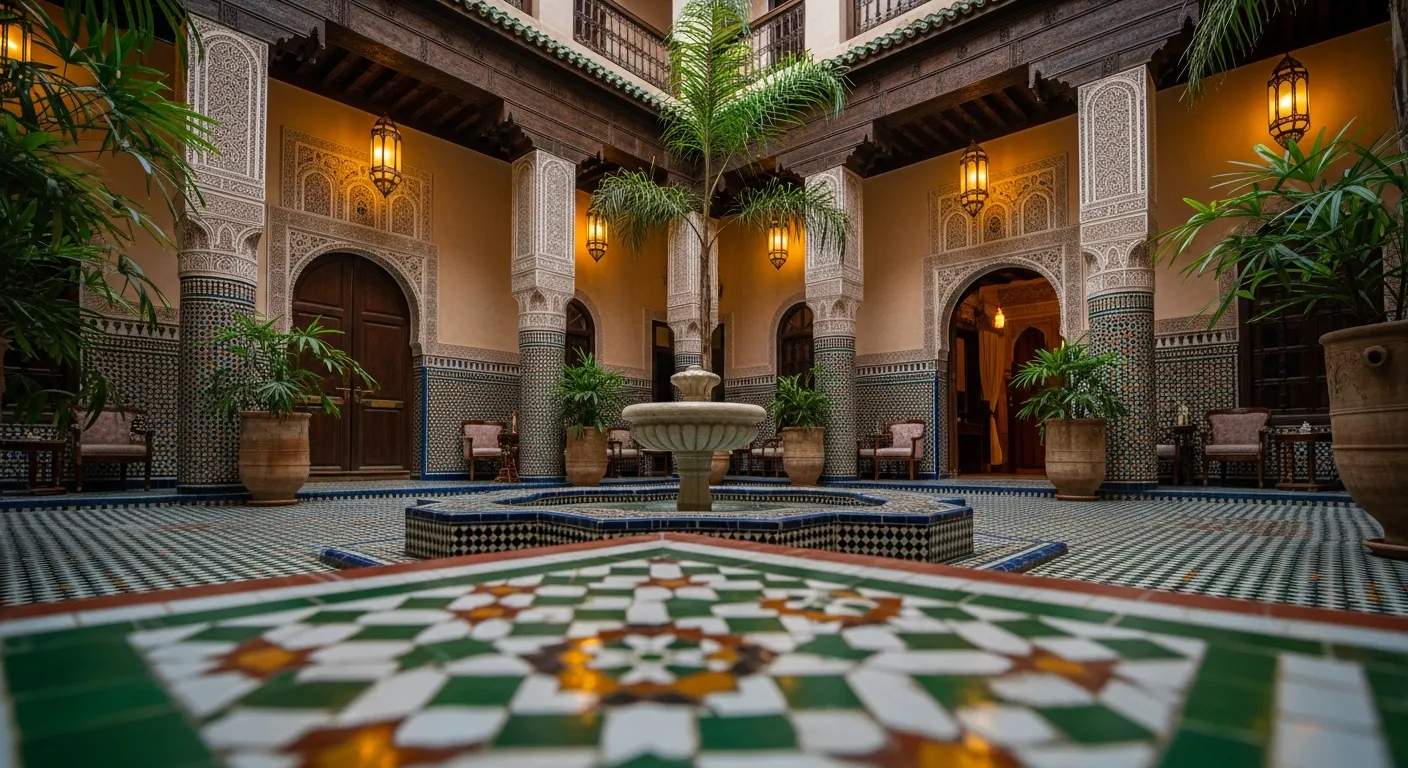
Where Design Becomes Prayer
The architecture of Marrakech’s luxury riads tells the story of a city shaped by desert nomads, Islamic scholars, and French colonials — a story written in surfaces. Tadelakt walls polished with black soap and burnished with river stones until they feel like silk beneath your fingertips. Zellige tilework — tiny geometric pieces cut and glazed by hand — creating patterns that seem to shift and breathe as the light changes through the day, as if the building itself is alive and dreaming.
I spent an afternoon watching a zellige artisan work in a medina workshop, cutting each tile with a chisel and arranging them into patterns guided by mathematical principles that predate algebra textbooks by centuries. He’d been doing this for thirty years. His father did it before him. The patterns he creates will outlast everyone reading this, and he charged me nothing to watch — just asked that I not rush him with questions while his hands were moving.
The Rhythm of When
Marrakech reveals different faces depending on when you arrive. The golden months — March through May, September through November — offer warm days around 25 to 30°C, lush gardens, and the most forgiving light for falling in love with a city. This is when the rooftop terraces earn their reputation.
Summer is for the bold or the budget-conscious. Temperatures breach 40°C regularly, and the medina at midday feels like walking through an oven with beautiful walls. But hotels slash rates — La Mamounia can dip below $400 — and the city belongs to those willing to nap through the afternoon and come alive after dark.
One thing most visitors don’t plan for: Ramadan, which in 2026 falls roughly from February 17 through March 19. Luxury hotels operate normally for guests, but much of the medina quiets during daylight hours — restaurants shutter, the souks thin out, and the city takes on a contemplative stillness that I found unexpectedly beautiful. And the iftar dinners that break the fast each evening — especially at the grand hotels — are among the most extraordinary cultural dining experiences Morocco offers.
The Things They Don’t Put in the Brochure
Riads inside the medina mean navigating narrow alleys to reach your door — your luggage will arrive on a cart or on someone’s shoulders. The first time feels disorienting. By the second evening, you’ll realize the walk is the threshold between worlds. The moment the alley narrows and the noise fades is the moment your vacation actually begins.
Tipping runs 10 to 20 MAD for small kindnesses, 10 to 15 percent at restaurants. The airport taxi to the medina is 70 to 100 MAD — agree before you get in, and ignore anyone who approaches you inside the terminal. Carry cash; the medina runs on dirhams, not plastic. One US dollar buys you about 9.2 MAD, and the ATMs in Gueliz are more reliable than the ones near tourist sites.
The Invitation
Three months after leaving Marrakech, I still dream in zellige patterns. The scent of orange blossom ambushes me in unexpected places — a candle shop in Brooklyn, a garden in Lisbon — and each time it pulls me back to a breakfast courtyard where fountains sang and the morning light turned everything to gold.
Marrakech’s riads don’t offer accommodation. They offer passage into a way of living that prioritizes beauty above efficiency, craftsmanship above speed, and the sacred pause between sunset and prayer above the relentless forward motion that defines everywhere else. Find the door that calls to you. Turn the heavy key. Let the silence take you.
Worth reading next
More stories worth your time.

The Maldives Question: Is $2,000 a Night Worth It? (An Honest Answer)
I've stayed at four Maldivian resorts across three trips and two budgets. Here's the honest answer to whether those overwater villas are worth what they charge — and what nobody tells you about paradise before you book.

The White Lotus Hotels Are Real. The Experience Isn’t What You Think.
The White Lotus hotels are real, but staying at them now is a different experience than the fantasy the show sells.

St. Regis Bora Bora: Waking Up Above Water Is Not a Spiritual Experience
The brochure for the St. Regis Bora Bora promises a “transformative overwater experience.” The website uses words like “transcendent” and “soul-stirring.” Three different people told me, before I went, that waking up in an overwater villa would “change the way I see the world.” It didn’t change the way I see the world. It changed […]
About Kaira
Explore With Kaira is built for readers who want the atmosphere of a luxury travel magazine without the emptiness of sponsored copy.
About Kaira