Fogo Island Inn: The $2,500 Hotel at the Edge of the World That Might Be Worth Every Dollar
Fogo Island Inn charges $2,500 a night for rooms smaller than a mid-range Tokyo hotel, excludes drinks from its all-inclusive rate, and sits on a Newfoundland island you can only reach by ferry. It might be the most important hotel in the world.

The ferry pulls away from Farewell — yes, the town is actually called Farewell — and for forty-five minutes you watch mainland Newfoundland shrink into fog and grey water until there’s nothing left but the North Atlantic and the growing certainty that you’ve made a spectacular mistake.
Then the island appears. Low and treeless at first, like a dark smudge someone forgot to erase. And rising from its eastern shore, improbable and startling against the barrens, a building that looks like it was designed by someone who’d seen an iceberg and thought: I could do that in wood.
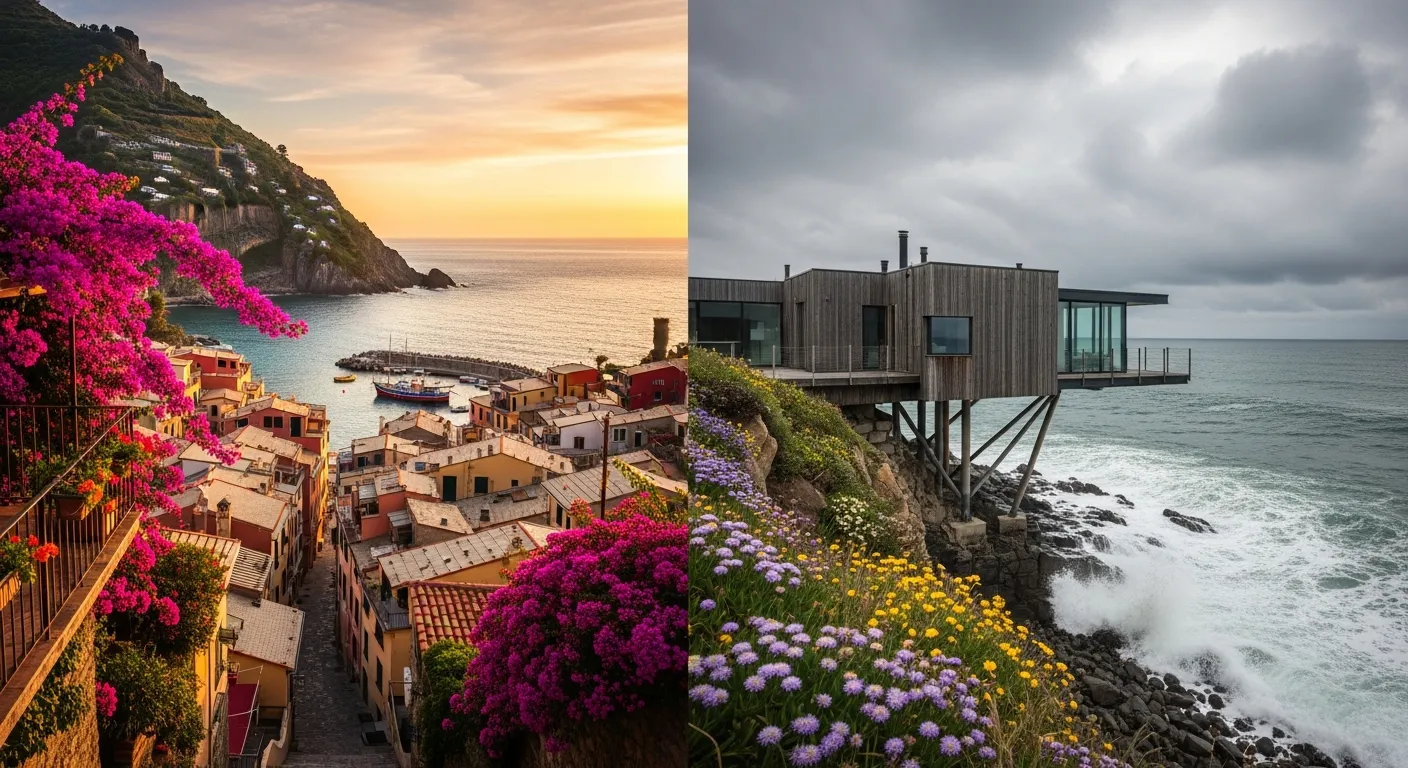
Fogo Island Inn doesn’t photograph the way it feels. In pictures it’s a striking piece of architecture — all angles and cantilevers and floor-to-ceiling glass hovering above the rocks on thirty-foot steel stilts. In person, standing on the shore of Joe Batt’s Arm with the wind rearranging your certainties about the meaning of cold, it’s something else entirely. It’s a dare. A building that says: Luxury doesn’t need sunshine.
I came for three nights. I stayed for five. I’ve been trying to figure out why ever since.
The Arrival
Getting to Fogo Island is the first test. You fly to Gander — the town that sheltered 7,000 stranded passengers on September 11th, which tells you everything about Newfoundland hospitality and nothing about Newfoundland weather. From Gander, it’s an hour’s drive through boreal forest and fishing communities so quiet they feel abandoned even when they’re not, until you reach the ferry terminal at Farewell.
The ferry runs five times daily, takes forty-five minutes, and cannot be reserved in advance for walk-on passengers. Locals queue for hours. I watched a man in a pickup truck eat an entire sleeve of crackers during the wait. The inn can arrange a helicopter from Gander — about thirty minutes, roughly CAD $3,000 return — but taking the ferry is the point. The crossing strips away whatever you arrived with. No cell signal. No urgency. Just water, gulls, and the slow reveal of an island that has been losing population for fifty years and has decided, through an act of architectural audacity, to reverse the narrative.
A staff member meets you at the ferry terminal — they know exactly who you are and which sailing you’re on. The drive to the inn takes fifteen minutes along a coastal road that would be beautiful in any weather, including the horizontal rain that greeted me in October. When the building appears around the final bend, perched on its corten steel stilts above the 400-million-year-old rocks of Joe Batt’s Arm, you understand Todd Saunders’ design in a way that no photograph can deliver. The stilts aren’t decorative. They’re a reference to the fishing stages — the elevated wooden platforms that Newfoundland’s outport communities have used for centuries to process cod. This building hovers above the land the same way those stages hover above the water. It’s paying respect without making a show of it.
Check-in is quiet. No marble lobby. No champagne. A woman named Bridget hands you a cup of tea and your room key — an actual physical key, not a card — and explains that everything is included: three meals, afternoon tea, a half-day island orientation with a Community Host, guided hikes, boat tours, berry picking in season, laundry, and gratuities. What’s not included: alcoholic beverages. At CAD $2,475 to $8,575 per night, this omission is either a philosophical position about conscious consumption or a miscalculation about what people expect when they spend this kind of money. I’ve landed on the side of miscalculation.
The Room
There are twenty-nine rooms across four floors, and not one of them looks like any other. Every room was designed in collaboration with local artisans who participated in a five-week workshop with international designers, creating wallpaper, furniture, quilts, hooked rugs, and light fixtures by hand. The result is a kind of folk-modernism — floor-to-ceiling windows framing the North Atlantic on one side, hand-stitched quilts and locally carved rocking chairs on the other. The collision shouldn’t work. It works beautifully.
Entry-level rooms on the first and second floors are 350 square feet — not large by luxury standards but adequate, with the ocean view doing most of the heavy lifting. Third-floor Reverie rooms add a soaking tub, a rain shower, and a wood-burning stove, which is not a decorative object. On my second night, the temperature dropped to minus four and I fed that stove birch logs for two hours while the Atlantic threw itself against the rocks below my window. It was, without exaggeration, one of the better evenings of my life.
Fourth-floor skyrooms have soaring ceilings and access to the rooftop sauna and hot tubs — the highest rooms in the house with the most dramatic views. The Captain’s Quarters suite spans 1,100 square feet with a walk-in shower, a soaker tub, and its own wood stove. The Family Loft Suite is 835 square feet split across two stories, with two king beds and a convertible sofa, designed for families of up to five.
What’s genuinely impressive: the quality of the handcraft. The wallpaper in my room depicted a stylized coastal landscape — waves, rocks, seabirds — in a pattern that read as modern design until you looked closely and saw the hand. Every room has a different pattern, all of them produced on the island. The quilts are thick, warm, beautiful, and made by women whose grandmothers made the same quilts for the same reasons. The rocking chair by my window was carved from local spruce. I sat in it every morning with tea and watched the ocean change colour for an hour before breakfast. In-floor heating keeps the natural wood floors warm. Heated towel racks. Heated toilet seats with built-in bidets. A Bose sound system and white noise machine. Books, playing cards, and a hand-knit scarf are left in each room for your use during the stay.
What’s less impressive: the rooms are not large for the price. At CAD $2,475 for a first-floor room — roughly USD $1,800 — you’re paying a significant premium for concept over square footage. The Mandarin Oriental in Tokyo gives you similar floor space for half the money. The Aman Venice gives you triple the space for the same. The counter-argument — that you’re paying for the craft, the community, the experience, the meals, the activities, the radical reimagining of what a hotel owes its location — is compelling. But you feel the room size on the third morning, especially if the weather has pinned you indoors.

The Dining
Executive Chef Timothy Charles moved to Fogo Island in 2012 to help open the inn, and in the years since he’s bought 35 acres of his own land to establish an organic farm with his wife, Jennifer. Eighty percent of what he serves comes from Fogo Island and the immediate region — foraged berries, root vegetables from community gardens that survive the winter in grass-topped cellars, North Atlantic cod from the fishing co-op, snow crab pulled from the cold waters off the eastern shore.
Lunch and dinner offer three choices each — meat, seafood, vegetarian — and the menu changes daily based on what the island provides. This is not a marketing claim. The morning I arrived, the boat hadn’t gone out due to weather, so the cod preparation was pulled and replaced with caribou from Labrador. Nobody apologized. Nobody needed to.
The standout dishes over my five nights: a salt fish croustade with bakeapple and parsley that tasted like a love letter to Newfoundland, the kind of dish that makes you understand why people stayed on this island for five hundred years despite the weather. Snow crab toast with chanterelle, bone marrow, and crabapple — the crabapple cutting through the richness of the bone marrow with a sharpness that felt deliberate and earned. Cod with sunchoke, foie gras, and chicories — the foie gras a surprise and a controversy, given the inn’s otherwise fiercely local sourcing, but the combination was extraordinary.
Every lunch and dinner begins with a cup of warming broth and house-made pickles. Every evening ends with something small and sweet — fermented honey truffles, bakeapple tarts, rhubarb compote. The dining room has vaulted ceilings and floor-to-ceiling windows that face the ocean, and eating dinner here as the Atlantic darkens is an experience that makes conversation unnecessary.
On two evenings, the inn hosted a communal boil-up in The Shed — a large outbuilding behind the main structure. Guests gather at a single long table for lobster, crab, mussels, and everything that came out of the cold water that morning, cracked open with mallets and eaten with your hands while someone tells stories about the island. The boil-up is the single best meal experience at the inn, and it’s the one that most captures what Fogo Island is trying to be — a place where food is community, not performance.
The honest criticisms: the daily-changing menu means you occasionally get a dinner that’s more experimental than successful. My fourth night produced a caribou preparation that was underseasoned and slightly overcooked — not terrible, but noticeable when you’re paying this rate. Breakfast, while uniformly good, doesn’t have the creative spark of dinner — it’s a well-executed spread of pastries, fresh fruit, eggs to order, and local cheeses that could appear at any well-run boutique hotel. And the drinks exclusion is genuinely jarring. A glass of Newfoundland-made wine costs CAD $18. A beer is $12. A cocktail is $16. These aren’t outrageous prices individually, but at a property that positions itself as all-inclusive and charges $2,500 a night, the a la carte bar tab feels misaligned with the ethos. The AFAR review noted this directly: compared to Explora in Chile, which is a comparable-standard remote luxury lodge that includes all beverages, Fogo Island Inn’s exclusion “felt out of step with expectations at this level.” I agree.
The Experience
On my first morning, a woman named Gladys arrived at the inn to take me on my half-day island orientation. Gladys is seventy-three, has lived on Fogo Island her entire life, and remembers when the cod moratorium in 1992 nearly killed the community. She drove me around the island in her pickup truck for four hours, stopping at root cellars, abandoned fishing stages, her cousin’s house, the cemetery where six generations of her family are buried, and a headland where we watched icebergs — actual icebergs, the size of apartment buildings — drift south from the Labrador Current.
The Community Host Program is the inn’s most distinctive offering and the one that makes it different from every other luxury hotel I’ve stayed at. Every guest is paired with a lifelong Fogo Islander who spends half a day showing you their island — not the tourist version, but the real one. Where they fish. Where they pick berries. Where they were born. It’s not curated in the way that luxury experiences usually are. Gladys told me about the time her father’s fishing boat sank and he swam to shore in November. She told me about the families who left when the cod disappeared. She told me about Zita Cobb coming home.
Zita Cobb is the reason this building exists. An eighth-generation Fogo Islander who left, studied business at Carleton University, became CFO of JDS Fitel and then senior vice president of JDS Uniphase during the fiber-optics boom, retired at forty-three with enough money to do whatever she wanted, and decided what she wanted was to save her island. She founded the Shorefast Foundation and built the inn as a social enterprise — 100% of operating surpluses return to Fogo Island through the foundation. Every item the inn sells comes with an “economic nutrition label” breaking down the percentage that goes to labour, materials, and community reinvestment. This is not a marketing gimmick. It’s radical economic transparency applied to luxury hospitality, and it’s the reason the room costs what it costs.
The activities beyond the Community Host are varied and genuine. Fourteen hiking trails cross the island, from easy coastal walks to more serious scrambles over the barrens. Guided foraging workshops teach you about the twenty varieties of edible berries that grow here — bakeapple, partridgeberry, blueberry, raspberry — and their use in the kitchen. Boat tours visit abandoned fishing communities on nearby islands, where colourful fishing huts still stand and the silence is complete. The four artist studios scattered around the island — Long Studio, Bridge Studio, Squish Studio, Tower Studio — are all designed by Todd Saunders and all open to guests. Each sits on a dramatic promontory, each is powered entirely off-grid, and each makes you want to quit your job and move here to make art.
The rooftop has two wood-fired saunas and two outdoor hot tubs that face the open ocean. Sitting in a hot tub at eleven PM, watching the stars over the North Atlantic while the wind tries to rearrange your hair, is an experience that belongs to the category of things you can’t buy anywhere else because nobody else was foolish enough to put hot tubs on a rooftop at the 49th parallel. The inn also has a thirty-seven-seat cinema, a small art gallery, a library, and a lounge with a bar where the non-included drinks are served.
What it does not have: a spa. No pool beyond the hot tubs. No nightlife beyond the lounge. No golf, no tennis, no yoga pavilion, no wellness programming. This is either a principled rejection of luxury bloat or a gap in the offering. At this price point, most guests will have stayed at properties where a spa is assumed. Its absence is noticeable.
The Weather Question
Every review of Fogo Island Inn must address this directly: the weather can be brutal. Fogo claims seven seasons — not as a marketing conceit but because the climate genuinely shifts that many times. I visited in October and experienced sunshine, horizontal rain, dense fog, and near-zero temperatures in the span of three days. The wind is a permanent resident. Some guests have reported visiting in late April or early May and finding the island icier and colder than anticipated, with outdoor activities limited.
The best window is June through September. June and July bring icebergs — enormous, blue-white sculptures drifting past the inn’s windows, visible from every ocean-facing room. August and September bring berry season, warmer temperatures, and the longest days. But “warmer” is relative. This is Newfoundland. Pack layers and accept that the weather is part of the experience, not an obstacle to it.
The ferry adds a genuine logistical variable. Bad weather can delay or cancel sailings. The inn advises building buffer time into your travel plans — arriving a day early in Gander rather than cutting it close is the experienced traveler’s play.
The Competition
There isn’t much direct competition, which is part of the point. Deplar Farm in Iceland offers a similar proposition — remote luxury lodge, dramatic landscape, all-inclusive, adventure activities — at a higher price point with heli-skiing and horseback riding instead of community hosts and cod. Explora Patagonia offers comparable remoteness with more polished service and better drinks inclusion at a lower nightly rate (from roughly USD $1,760, all-inclusive with beverages).
But neither of those places is trying to do what Fogo Island Inn is doing. Deplar Farm is a luxury adventure lodge. Explora is a guided-exploration company. Fogo Island Inn is a social enterprise disguised as a hotel — or a hotel that refuses to separate itself from the community it serves. The value proposition isn’t just the room and the food. It’s the knowledge that your $2,500 pays for Gladys’s granddaughter’s scholarship and the preservation of a cod-fishing culture that would otherwise vanish. Whether that’s worth the premium is a question only you can answer, but the question itself is what makes this place singular.
The Verdict
Fogo Island Inn is the most interesting hotel I’ve ever stayed at. Not the best. Not the most luxurious. Not the most comfortable. The most interesting.
The architecture is world-class — Todd Saunders created a building that honours its place without surrendering to it. The food is excellent and deeply local, with Chef Timothy Charles achieving something rare: a cuisine that’s genuinely of a place rather than merely in one. The Community Host Program is unlike anything I’ve experienced in luxury hospitality, and Gladys alone was worth the trip. The social enterprise model — Zita Cobb’s vision of luxury as a mechanism for community survival — is genuinely revolutionary, and the economic nutrition labels prove it’s not just talk.
But the honest assessment requires acknowledging what $2,500 a night doesn’t buy you. It doesn’t buy you a spa, or an included bar, or rooms larger than a mid-range hotel in most major cities. It doesn’t buy you reliably good weather or easy access. It doesn’t buy you the kind of operational polish that Aman or Four Seasons or Explora deliver at comparable price points — my anniversary went unacknowledged despite being noted at booking, which is a small thing that a $2,500 hotel cannot afford to miss.
The weather is a genuine variable. If you get fog and rain for three days straight — which is entirely possible — you’ll spend a lot of time in a beautiful but finite set of indoor spaces. The rooftop hot tubs and the cinema help. The library helps more. But this is not a property where bad weather is offset by a robust indoor programme of spa treatments and cooking classes.
What Fogo Island Inn gets right — and what almost nobody else in luxury hospitality even attempts — is purpose. You leave this hotel knowing that your money built something. Not a shareholder dividend, not a private equity return, but a fishing community’s future. You leave knowing Gladys’s name and her father’s story. You leave having eaten cod tongues fried by a chef who drives to the co-op at dawn because he believes ingredients should come from the place you can see through the window.
Whether that’s worth $2,500 a night depends on what you think hotels are for.
The bottom line: A genuinely singular hotel — part architectural marvel, part social experiment, part love letter to a disappearing way of life — that charges luxury rates for a luxury of a different kind: the luxury of meaning.
Book if: You believe travel should change you, not just pamper you. You want a hotel that’s embedded in its community rather than insulated from it. You’re willing to trade spa treatments and predictable sunshine for icebergs, cod tongues, and a seventy-three-year-old named Gladys who’ll change how you think about the word “home.”
Skip if: You want warm weather, a pool, a spa, and drinks included. You need reliable logistics — the ferry and the weather are variables. You think $2,500 a night should buy square footage and thread count, not philosophy and purpose.
Don’t miss: The communal boil-up in The Shed. The rooftop hot tubs at midnight. The Long Studio on a clear day. And Gladys — request her by name.
Skip: Visiting in November through April unless you genuinely love winter. The helicopter transfer — take the ferry. The crossing is the overture.
Worth reading next
More stories worth your time.

The Maldives Question: Is $2,000 a Night Worth It? (An Honest Answer)
I've stayed at four Maldivian resorts across three trips and two budgets. Here's the honest answer to whether those overwater villas are worth what they charge — and what nobody tells you about paradise before you book.

The White Lotus Hotels Are Real. The Experience Isn’t What You Think.
The White Lotus hotels are real, but staying at them now is a different experience than the fantasy the show sells.

St. Regis Bora Bora: Waking Up Above Water Is Not a Spiritual Experience
The brochure for the St. Regis Bora Bora promises a “transformative overwater experience.” The website uses words like “transcendent” and “soul-stirring.” Three different people told me, before I went, that waking up in an overwater villa would “change the way I see the world.” It didn’t change the way I see the world. It changed […]
About Kaira
Explore With Kaira is built for readers who want the atmosphere of a luxury travel magazine without the emptiness of sponsored copy.
About Kaira