Deplar Farm: The $4,000 Converted Sheep Farm Where Luxury Means Helicopter Fuel and Communal Dinner
A 15th-century sheep farm in northern Iceland charges $4,000 a night for thirteen rooms, communal dinner, and the chance to heli-ski terrain nobody else can reach. The food has problems. The weather makes promises it can’t keep. And it might be exactly what adventure luxury should look like.

The helicopter banks left over the Troll Peninsula and suddenly there’s nothing below you but snow, basalt, and the kind of silence that has weight. The pilot points toward a valley — the Fljot — and nestled in it, barely distinguishable from the landscape, a black corrugated building with a turf roof that looks less like a luxury lodge and more like something the mountain grew on its own.
Deplar Farm doesn’t announce itself. No golden signage, no manicured entrance, no architectural statement designed to photograph well from a drone. It’s a 15th-century sheep farm that someone converted into a thirteen-room hotel, and if you didn’t know it was there — if you hadn’t paid roughly $4,000 a night to sleep inside it — you’d drive past without a second look. From the outside, it reads as agricultural. From the inside, it reads as the most interesting contradiction in luxury hospitality: a property that brands itself on sustainability while burning aviation fuel to drop you on untouched Arctic peaks.
I came for the heli-skiing. I stayed because of the geothermal pool. I left thinking about the dinner problem.
The Arrival
Getting to Deplar Farm is itself a filtration system. The property sits forty minutes southwest of Siglufjordur, ninety minutes northwest of Akureyri, on a peninsula in northern Iceland that most Icelanders have never visited. Your options are: fly into Keflavik, take a forty-five-minute domestic hop to Akureyri on Air Iceland Connect (a couple of flights per day, weather permitting), then endure a ninety-minute 4WD transfer through terrain that makes your Range Rover back home feel like a prop. Or you can drive from Reykjavik — five hours in clear weather, which is a phrase that should come with an asterisk in Iceland. Or you can take the helicopter, which is dramatic and expensive and means your luggage arrives separately via Air Iceland Connect because of weight limits. I chose the helicopter. My bag chose Tuesday.
The lodge appears all at once — you don’t approach Deplar Farm so much as discover it. The turf roof merges with the valley floor. The black corrugated cladding echoes the basalt ridgelines. The two helipads out front are the only concession to modernity visible from the air. A woman named Sigrun met me at the pad with a wool blanket and a glass of something warm that turned out to be birch schnapps, which is exactly the drink you need after thirty minutes in a helicopter over the North Atlantic in March.
The lobby — if you can call it that — is a single room with leather sofas, a fireplace, and sheepskin throws that are doing actual thermal work, not decorative work. Check-in took four minutes. There’s no marble. No art collection. No concierge desk with a bell. A man named Olafur showed me to my room, pointed out the geothermal pool, and told me dinner was at seven-thirty and communal. That last word would turn out to be the most important detail of the entire stay.
The Room
Thirteen rooms. Ten King Suites, two Queen Suites, one Bunk Room that sleeps four. Maximum capacity: twenty-six to thirty-two guests depending on configuration. Every room is named after an Icelandic saga character, which is a detail that would feel gimmicky if the sagas weren’t written about people who actually lived in valleys like this one.
The design is Scandinavian minimalist with texture — sheepskin on the bed, Moroccan wool on the floor, textured walls that look hand-plastered because they are. Walk-in steam showers. Flat-screen TVs that nobody uses because why would you watch television when you’re looking at the Fljot Valley through floor-to-ceiling glass. Four of the rooms — the Gallery Suites — have mezzanine lofts with daybeds and hammocks, which sounds whimsical until you’ve spent six hours heli-skiing and need somewhere to collapse that isn’t a bed.
What’s genuinely good: the views. Every room faces either the lake, the river, or the mountains, and at $3,970 a night in winter season, the landscape is doing most of the justification. The steam showers are excellent — the kind where you stand in volcanic heat for twenty minutes and emerge feeling like a different species. The minibars are stocked and included.
What’s honest: the rooms are beautiful but modest. These are converted sheep-farm proportions, not purpose-built luxury dimensions. You’re not getting the acreage of an Aman or the marble of a Four Seasons. The walls are thick but the building is old, and on my second night I could hear the couple next door discussing whether the wine upsell at dinner was worth it. (It wasn’t — but we’ll get to that.) At $4,000 a night, you’re paying for where you are and what you can do. Not for square footage. Not for thread count. If that equation works for you, the rooms are wonderful. If it doesn’t, the Retreat at Blue Lagoon is three hours south and has a spa the size of a municipal building.
The Food Problem
Chef Gardar Gardarsson won Iceland’s Chef of the Year in 2018, and at Deplar Farm he’s working within constraints that would break most kitchens. Iceland’s remote northern peninsula doesn’t grow much. The nearest meaningful supply chain is in Akureyri, ninety minutes by 4WD. Fresh produce is seasonal at best and imported at worst. What Gardarsson does have is lamb — mountain lamb from farms in the valley that tastes like nothing you’ve had before — and salmon, and Arctic char from the Fljotaa river that runs through the property, and whatever the fishermen pulled from cold water that morning.
Breakfast is solid: Icelandic pancakes, fresh pastries, eggs to order, smoothies that taste like they were made by someone who cares. Lunch is gourmet packed affairs for adventure days — well-assembled, portable, designed to be eaten on a mountainside in wind. Dinner is served at seven-thirty, communally, and here’s where Deplar Farm both earns and loses its stars.
The lamb is extraordinary. Slow-roasted, seasoned with wild thyme, served with root vegetables from community gardens that survive winter in grass-topped cellars. The salmon is impeccable. The Arctic char, pulled from the river you can see from the dining room, is some of the best freshwater fish I’ve eaten anywhere. On three of my five nights, dinner was genuinely special — the kind of meal where the remoteness becomes an asset because you know this food couldn’t exist anywhere else.
On the other two nights, it wasn’t. A steak preparation that was underseasoned and slightly overcooked. A bread service that was dense and heavy in a way that felt under-proofed rather than intentional. And the wine situation — oh, the wine situation. Iceland’s import restrictions make building a cellar difficult, and Deplar’s solution is to include a standard pairing with dinner and offer an upgraded “reserve” pairing for an additional charge. Being asked every single night whether you want the included wine or the paid upgrade feels transactional in a way that undermines the communal, house-party atmosphere the lodge is trying to create. At $4,000 a night, the answer should be: pour whatever’s best and don’t ask me to choose between tiers.
Multiple guests on review sites have flagged food as Deplar’s weakest point. “Meal selections extremely limited.” “Significant culinary upgrades necessary for the prices charged.” I wouldn’t go that far — the peaks are genuinely high — but the valleys are noticeable, and at this rate, the valleys shouldn’t exist. The honest truth is that Gardarsson is talented but constrained, and no amount of culinary ambition can overcome the fact that almost nothing grows within a hundred miles of the kitchen.

The Geothermal Pool (The Real Star)
If Deplar Farm has a single image that justifies the price, it’s the geothermal pool. Indoor-outdoor, heated by the earth itself, with a swim-up bar where the water temperature hovers around 38°C and the air temperature in March hovers around minus five. I spent more time in this pool than in any hotel amenity I can remember. At ten PM, after heli-skiing and a three-course dinner, floating in volcanic water while snow falls on your face and the valley disappears into Arctic darkness — this is the thing. This is what you’re paying for.
The spa complex extends beyond the pool: indoor and outdoor Viking saunas, a steam room, cold plunge pools that will reorganize your relationship with discomfort, open-air hot tubs facing the mountains, saltwater flotation pods (one guest called them “boring” — I’d call them “unnecessary”), and massage studios. The gym is well-equipped. The yoga studio exists and is used primarily by people recovering from heli-skiing.
The pool is where Deplar’s communal model works best. You’re floating alongside the same twenty-odd people you’ll dine with later, and something about hot water and cold air and volcanic geology makes conversation happen naturally. I met a tech founder from Austin who was on his third visit. I met a couple from London who’d come for the northern lights and stayed for the lamb. I met a drummer — more on that in a moment.
The Heli-Skiing (And the Weather Truth)
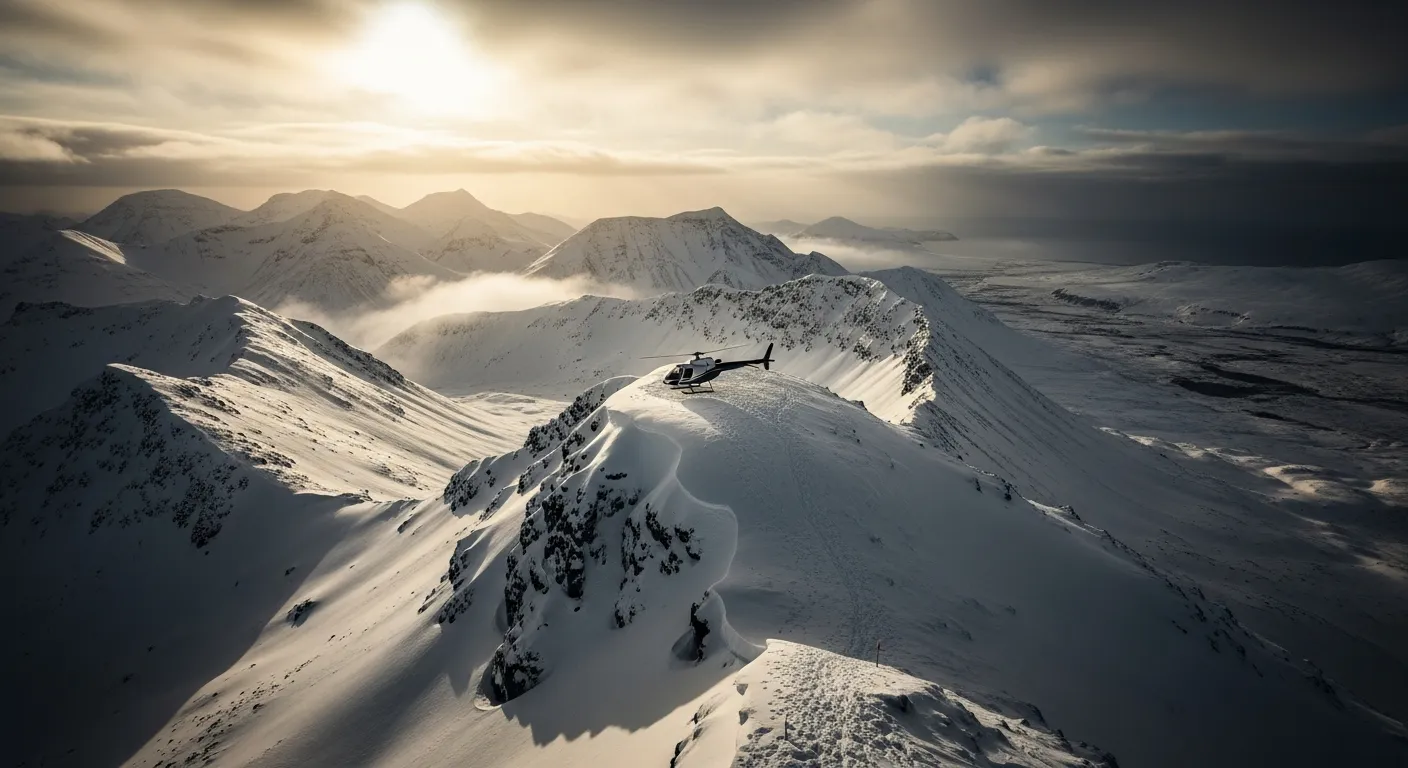
Deplar Farm’s headline draw during heli-ski season — roughly March through early June — is access to terrain that nobody else can reach. Two A-Star B3 helicopters, a 4:1 guest-to-guide ratio, and 300,000 acres of skiable terrain across the Troll Peninsula. The descents are long, the snow is consistent, and the sensation of being dropped on a peak in northern Iceland where no human has skied before is worth approximately everything.
On day two, the weather closed in. Fog settled into the valley like it owned the place, and the helicopters stayed on their pads. The guides offered snowshoeing, cross-country skiing, snowmobiling. I chose the pool. Day three, same fog. Day four, we flew, and the skiing was transcendent — two thousand vertical feet of untracked powder with the North Atlantic visible below the tree line. Day five, fog again.
Here is the truth that Deplar Farm’s marketing cannot tell you: heli-skiing is weather-dependent, full stop. You could spend $20,000 on a five-night stay and never get airborne. The spa is your consolation prize. Is the spa worth $4,000 a night? That’s the question you need to answer before booking. If your trip depends on skiing, you’re gambling. If you’re comfortable with the possibility that your $20,000 buys world-class soaking and mediocre weather instead of world-class skiing, then the gamble is manageable. But go in with your eyes open.
Summer season — July through September — replaces helicopters with hiking, fly fishing (Atlantic salmon in the Fljotaa river, prime July-August), whale watching in Eyjafjordur, fat biking, sea kayaking, and twenty-four hours of daylight. Winter season — October through March — brings northern lights, snowshoeing, and the kind of deep Arctic darkness that either terrifies you or transforms you. Rates drop to roughly $2,775 a night in summer, which is still an extraordinary amount of money for a converted sheep farm but begins to feel more proportional to what you receive.
The Communal Gamble
Here’s the thing nobody warns you about: at twenty-six guests maximum, your stay at Deplar Farm is shaped entirely by who else is there. The communal dining model means shared tables, shared conversation, shared evenings. When the mix works — interesting people, good chemistry, the kind of candlelit dinner where strangers become friends over lamb and imported wine — it’s magic. The house-party energy is real.
When the mix doesn’t work, there’s nowhere to hide. One TripAdvisor reviewer described a stay ruined by a loud group who dominated the common spaces. The recording studio — Floki Studios, a legitimate professional facility with its own label, built as a passion project by Eleven Experience founder Chad Pike — means musicians occasionally book alongside regular guests. Pike is a former Blackstone executive who named his company after Spinal Tap’s “these go to eleven.” The clientele skews finance, tech, and entertainment. The vibe is “adventure bro who made $100 million” rather than old-money grand tour.
My advice: ask specifically about group bookings before confirming your dates. A full lodge buyout — from $57,350 a night in winter — is the safest option if you have the friends and the budget. Otherwise, you’re rolling the dice on dinner companions for five nights. Most of the time, the dice land well. When they don’t, you’ll remember it.
The Sustainability Question
Deplar Farm markets itself as environmentally conscious. Geothermal energy powers the heating and pool — genuine, since Iceland’s grid is 100% renewable. Living turf roofs provide natural insulation. Sourcing is local: lamb from the valley, fish from the river, bread from the kitchen. Natural stone and locally sourced materials throughout.
And then there are the helicopters. Two A-Star B3s burning aviation fuel to ferry skiers onto pristine Arctic peaks. The carbon footprint of a single heli-ski day would offset months of geothermal virtue. This isn’t a criticism unique to Deplar — every heli-ski operation on Earth carries this contradiction. But Deplar brands itself more aggressively on sustainability than most, which makes the gap between the turf roof and the fuel burn more visible.
I don’t think this should stop you from going. I think it should stop them from pretending the contradiction doesn’t exist.
The Verdict
Deplar Farm is not a palace. It’s a spectacularly located converted sheep farm with great guides, a world-class geothermal spa, and unmatched access to Arctic wilderness. The rooms are beautiful but modest. The food ranges from extraordinary to disappointing. The communal model is either the best or worst thing about the experience depending on your fellow guests. The heli-skiing, when the weather cooperates, is among the best in the world. When it doesn’t, you’re paying $4,000 a night for a very nice pool.
The competition is thin. Sheldon Chalet in Alaska charges $25,000 a night per couple and offers even more dramatic remoteness but no heli-ski operation. Fogo Island Inn in Newfoundland offers a similar “remote luxury with purpose” model at a lower price point with a social enterprise backbone that Deplar doesn’t attempt. ION Adventure Hotel near Thingvellir costs $350 to $600 a night and gives you Iceland’s design-hotel experience without the adventure programming — different category entirely.
Is it worth the money? If you’re coming for heli-skiing and the weather cooperates: absolutely. The terrain is otherworldly, the guides are exceptional, and the post-ski soak in geothermal water is the best après experience I’ve ever had. If you’re coming for a general luxury lodge experience and expect the food, rooms, and service to justify $4,000 a night on their own: you’ll be disappointed. Deplar Farm earns its rate on access and location, not on operational polish.
The bottom line: A converted sheep farm that charges palace prices for something palaces can’t offer — helicopter access to 300,000 acres of Arctic terrain, a geothermal pool that might be the best amenity in hospitality, and the gamble of communal dinner with twenty-five strangers in a valley where nothing grows except the certainty that you’re very, very far from everything.
Book if: You ski, you accept weather risk, and you understand that $4,000 buys terrain and location, not marble and room service. The heli-ski season (March through June) is the reason this place exists.
Skip if: You want guaranteed activities, private dining, a robust spa menu, or rooms that justify the rate on their own. The weather can ground you, the communal model can’t be escaped, and the food has real limitations.
Don’t miss: The geothermal pool after dark. The lamb. A clear day on the mountain with 2,000 vertical feet of untracked powder below your skis.
Skip: The flotation pods. The wine upsell — take the included pairing and spend the savings on helicopter karma.
Worth reading next
More stories worth your time.

The Maldives Question: Is $2,000 a Night Worth It? (An Honest Answer)
I've stayed at four Maldivian resorts across three trips and two budgets. Here's the honest answer to whether those overwater villas are worth what they charge — and what nobody tells you about paradise before you book.

The White Lotus Hotels Are Real. The Experience Isn’t What You Think.
The White Lotus hotels are real, but staying at them now is a different experience than the fantasy the show sells.

St. Regis Bora Bora: Waking Up Above Water Is Not a Spiritual Experience
The brochure for the St. Regis Bora Bora promises a “transformative overwater experience.” The website uses words like “transcendent” and “soul-stirring.” Three different people told me, before I went, that waking up in an overwater villa would “change the way I see the world.” It didn’t change the way I see the world. It changed […]
About Kaira
Explore With Kaira is built for readers who want the atmosphere of a luxury travel magazine without the emptiness of sponsored copy.
About Kaira