Explora Atacama: The $1,500 Desert Lodge That Sells Exploration — And Charges Extra for the Pool
Explora Atacama charges $1,500 a night for modest adobe rooms, three cold pools, and a menu designed by one of the world’s best chefs that divides guests down the middle. It also offers 49 guided explorations, an on-site observatory, its own hot springs reserve, and the deepest encounter with the driest desert on earth that any luxury lodge can provide. The question is which of those facts matters more to you.

The stars here don’t twinkle. That’s the first thing you notice, and the thing nobody tells you before you arrive. At 2,400 meters in the driest desert on earth, with three hundred and thirty clear nights per year and zero light pollution, the stars are fixed points of white fire — steady, dense, and so numerous that the familiar constellations disappear into the crowd. I’m standing on the observation deck at eleven PM, eye pressed to the eyepiece of a Meade 16-inch telescope, watching Saturn’s rings resolve into something real and dimensional, and the guide — a young Chilean astronomer named Matías who treats the night sky like a personal library — is narrating the view with the casual authority of someone who does this every clear night and never gets bored.
“The Milky Way core is directly overhead,” he says, adjusting the scope. “In Santiago, you’d need a two-hour drive and perfect conditions to see what you see here by walking outside.” He’s right. I walked outside. I looked up. And the sky was so dense with light that I stood there for twenty minutes in a desert cold enough to see my breath, unable to move, unable to process what I was seeing.
This is what Explora Atacama sells: not rooms, not luxury, not comfort in the conventional sense. It sells the desert itself — its skies, its salt flats, its geysers erupting at 4,300 meters at sunrise, its hot springs hidden in canyon walls, its silence so complete that you can hear your own blood. The question — and it’s a question the $1,500 nightly rate demands you answer honestly — is whether the exploration is worth the price, when the lodge that houses it hasn’t kept pace with what that price now means.
The Arrival
You fly into Calama, a mining city on the edge of the Atacama that looks exactly like what it is: a functional town built to serve copper extraction. LATAM and SKY Airlines operate two-hour flights from Santiago. Explora sends a van at scheduled times — noon, two, four, and six — and the hour-long drive south to San Pedro de Atacama takes you from industrial sprawl to lunar landscape in forty-five minutes, the road climbing through terrain so barren and strange that your brain keeps trying to map it onto places you’ve been and failing.
San Pedro itself is a dusty, adobe village centered on a plaza with a seventeenth-century church, a handful of restaurants, and the relaxed atmosphere of a place that has been receiving travelers since the Inca Empire used it as a waypoint. The lodge sits on its own forty-two-acre grounds just minutes from the village center — walkable, which is a genuine advantage over competitors that isolate you from the town.
The altitude hits you at the door. San Pedro sits at 2,407 meters — nearly 8,000 feet — and the combination of thin air and desert dryness means you’ll feel something on arrival. Lightheadedness. A slight headache. The sense that your lungs are working harder than usual. Explora’s staff hand you coca tea and a gentle lecture about hydration and rest, which you’ll nod through politely and ignore at your peril. The excursions that are the entire point of being here go up to 4,300 meters. Altitude sickness is not a footnote. It is the single biggest risk to your experience, and the guests who don’t take it seriously are the ones who spend their trip in bed instead of at El Tatio.
The Room
Fifty rooms occupy three long buildings on the property, designed by José Cruz Ovalle, who won Chile’s National Architecture Award. The design is adobe minimalism — slate floors, whitewashed walls, wooden beam ceilings, walls of glass framing the Andes — and it harmonizes with the desert landscape in a way that feels honest rather than imposed. The buildings sit low against the terrain, the materials are local, and the aesthetic is deliberate austerity rather than luxury austerity. There is a difference, and Explora lands on the right side of it.
Three room categories: Tulur (355 square feet, nineteen rooms, views to the grounds), Yali (355 square feet, twenty-seven rooms, desert views), and Catur suites (538 square feet, four suites, balconies with Andes panoramas). All rooms include a jacuzzi tub and sitting area. The design is spare — clean lines, natural materials, no television in some configurations.
The honest part: 355 square feet is modest for a lodge charging $1,500 per night all-inclusive. The Catur suites at 538 square feet are more appropriate for the rate, but there are only four of them. The rooms are comfortable, well-maintained, and perfectly functional, but “perfectly functional” is not the same as “luxurious,” and guests arriving from properties where $1,500 buys marble bathrooms and king-sized beds with Egyptian cotton will find the gap disorienting.
What some guests love — the minimalist adobe, the raw-material palette, the feeling of sleeping inside the desert — others find dated and austere. The rooms were designed to send you outside, which is philosophically consistent and practically frustrating when you return from a ten-hour excursion at 4,000 meters and want to collapse into something that feels indulgent. After a day fighting altitude, wind, and sun, I wanted a room that welcomed me back. What I got was a room that tolerated me.
The Dining
Menus are designed by Virgilio Martínez, the Peruvian chef behind Central in Lima — consistently ranked among the world’s best restaurants. This sounds more impressive than the daily reality. Martínez doesn’t cook on-site. He designed the culinary program and concept, which the resident kitchen team executes. The concept is “desert cuisine” — indigenous Atacameño ingredients blended with Andean cooking traditions, using local plants like chañar fruit, rica rica herb, and cochayuyo seaweed.
All meals are included in the rate. Breakfast is solid — fresh fruit, house-baked pastries, eggs made to order. Lunch varies between a buffet-style spread and packed provisions for full-day excursions. Dinner is the main event: a multi-course affair that rotates nightly, served in a communal dining room with an open bar of Chilean wines and pisco cocktails.
The wine inclusion is significant. Unlike most luxury lodges at this tier — Nihi Sumba, for instance — Explora includes all alcohol in the rate. The Chilean wine list is genuinely good, featuring regional Carmenère and Cabernet Sauvignon, and the pisco sours are made with the care they deserve. Wine tastings happen at the bar by the fireplace, which is where the social life of the lodge concentrates after dark.
The food itself divides guests almost perfectly down the middle. Positive reviews call it “spectacular” and praise the unfamiliar flavors — the experimental use of desert ingredients produces dishes you genuinely can’t get anywhere else. Negative reviews from late 2024 complain that the chef “tries too hard to be fancy,” that some dishes are “mediocre at best,” and that service can be agonizingly slow, with forty-five-minute waits between courses reported by multiple guests.
My experience split the difference. A quinoa and chañar dessert was extraordinary — sweet, textured, unlike anything I’d eaten before. A lamb dish with unfamiliar spices was ambitious but underseasoned. Breakfast was consistently excellent. One dinner featured a forty-minute gap between the second and third course that tested my patience and my companions’. The food is interesting rather than reliable, which is either a feature or a flaw depending on how you feel about paying $1,500 a night to be a test subject for experimental desert gastronomy.

The Explorations — Where Explora Earns Its Name
This is where the conversation changes entirely. Explora offers forty-nine guided explorations across four Andean zones, and the program is — without qualification — the most comprehensive and expertly guided encounter with the Atacama Desert available from any luxury lodge.
The structure: each evening, you sit with your guide and plan the next day. Two half-day explorations or one full-day exploration, selected based on your interests, fitness level, and the weather. Groups max out at eight guests. All led by Explora’s certified bilingual guides, who are consistently and universally praised as the standout element of the entire operation.
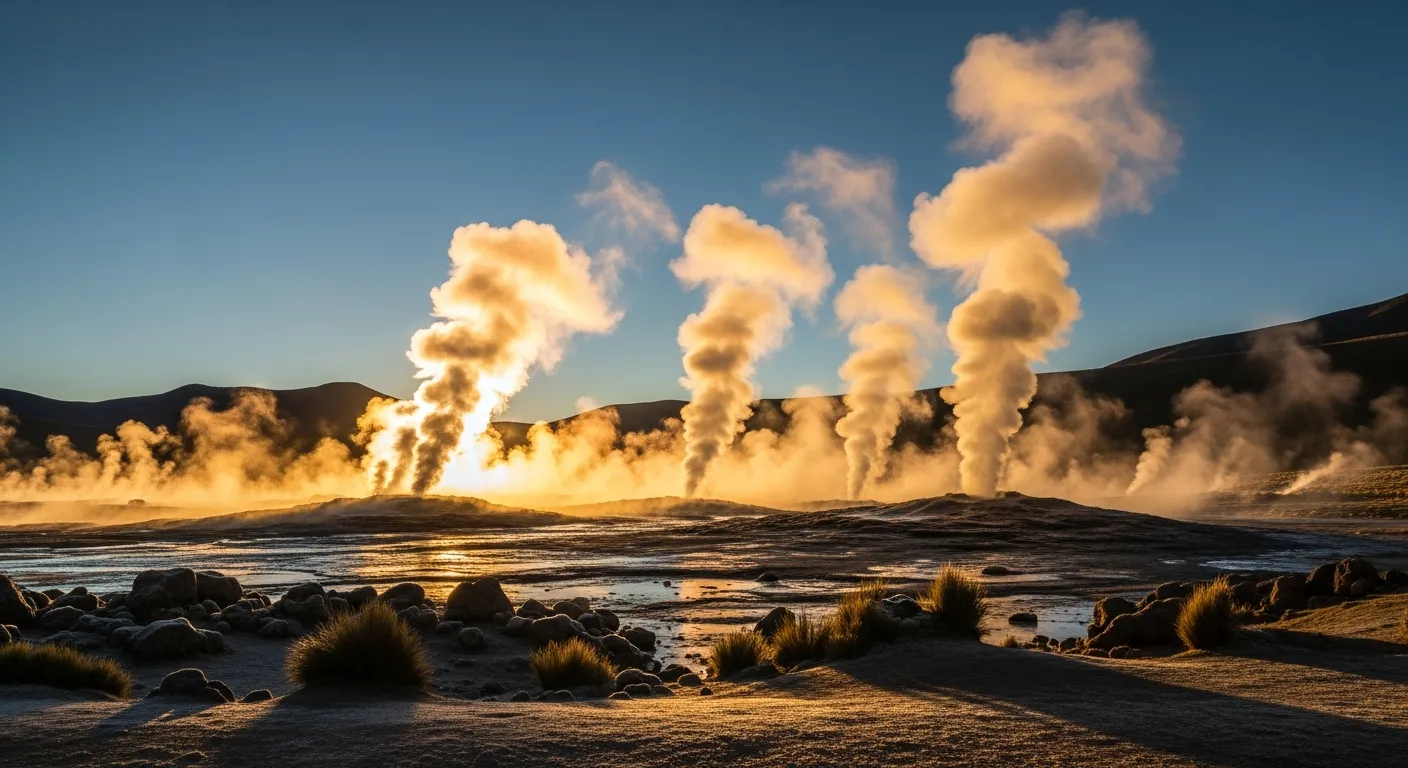
El Tatio, the world’s highest geyser field at 4,300 meters, requires a pre-dawn departure. You drive up in darkness, arrive as the first light hits the steam columns, and stand among eighty geysers erupting against a sky that’s transitioning from black to pink to blue. The steam rises forty feet. The ground shakes gently. The cold is brutal — minus ten Celsius at that altitude before sunrise — and the altitude headache is real. But the spectacle of geothermal fury at the top of the world, with condors circling above and the Andes stretching in every direction, is one of the most extraordinary natural experiences I’ve had anywhere.
The Valley of the Moon delivers surreal salt formations and erosion landscapes that look like a Dalí painting rendered in three dimensions. The Salar de Atacama — a vast salt flat with flamingo-filled lagoons — produces the kind of scale-distorted, horizon-eliminating vastness that resets your sense of what “big” means. The high-altitude lagoons, at 4,000 meters, are impossibly blue and ringed by flamingos that seem almost hallucinatory in this monochromatic landscape.
Puritama Hot Springs — natural thermal pools in a desert canyon, managed by Explora’s own conservation reserve — is the excursion you’ll dream about afterward. Eight geothermal pools, wooden walkways, mineral water rich in calcium and magnesium, and the surreal experience of soaking in hot water while staring at the walls of a desert canyon that hasn’t seen rain in months. This is included as a standard exploration, and it alone justifies the Explora premium over competitors without access.
The horseback riding program is unique among Atacama lodges — Explora maintains its own stable, with routes from ninety-minute beginner rides to six-hour gallops through the desert. You’ll need at least two lessons before joining the advanced rides, which is both a safety precaution and a quality filter that keeps the experience authentic.
The observatory sessions happen nearly every clear night. Matías and his team use a Meade 16-inch telescope with 700x magnification plus a newer SmartScope for real-time astrophotography. Jupiter’s moons. Saturn’s rings. The Southern Cross. The Magellanic Clouds — satellite galaxies of the Milky Way, visible to the naked eye from here and essentially invisible from any city on earth. If you care about the night sky, the Atacama is the greatest natural observatory accessible to civilians, and Explora’s setup is the best available without booking time at an actual research facility.
The Pools — Let’s Be Honest
Four outdoor pools surrounded by pampas grass and native Atacama flora. This sounds generous. The reality: only one pool is heated. The other three are essentially cold plunge pools in a desert where morning temperatures can drop near freezing and afternoon sun doesn’t always compensate.
This is the single most consistent complaint in Explora Atacama reviews, and it’s valid. At $1,500 per night, guests reasonably expect to swim in a heated pool after a day at 4,000 meters. What they get is one modestly heated pool and three pools that require the kind of cold tolerance usually associated with Nordic wellness rituals rather than Chilean luxury lodges. The hot tubs partially compensate, but they’re not a substitute for proper pool facilities.
Nayara Alto Atacama — Explora’s most direct competitor, ranked number one on TripAdvisor for San Pedro de Atacama — has a significantly superior pool complex at roughly half the price. If pool lounging is an important part of your trip, this comparison is not flattering.
The Competition
Nayara Alto Atacama (from ~$500/night) is ranked number one in San Pedro on TripAdvisor, and the reasons are straightforward: better spa, better pools, a more relaxation-focused experience, and significantly lower prices. The excursion program is good but not as deep as Explora’s forty-nine-exploration catalog. If you want the best physical property and the best relaxation experience, Nayara wins. If you want the deepest exploration program, Explora wins.
Tierra Atacama (from ~$800/night) is widely regarded as the best value in the luxury tier — better food-to-price ratio, a newer feel, and an excursion program that covers the essentials well. Several travel advisors now recommend Tierra over Explora for guests who don’t specifically need Explora’s exploration depth.
Awasi Atacama (from ~$1,800/night) is the true ultra-luxury option — ten rooms, a private guide and private 4×4 vehicle per booking, completely bespoke itineraries. If budget isn’t the constraint, Awasi delivers the most exclusive and personalized experience. Explora offers more variety; Awasi offers more intimacy.
The honest assessment from travel forums: Explora Atacama “has gotten a bit dated” while the company focuses investment on its Patagonia and Easter Island properties. The lodge that was once the undisputed leader in the Atacama now faces competitors that deliver more polish for less money, and the exploration program — while still the deepest — is the only remaining differentiator that justifies the premium.
The Atacama-Uyuni Crossing
I can’t write about Explora Atacama without mentioning the Travesía — a six-to-eleven-night overland crossing from the Atacama into Bolivia’s Salar de Uyuni, staying at Explora’s three minimalist mountain lodges along the way. Over three hundred miles through the Altiplano, crossing some of the most remote and visually extraordinary terrain on earth. This is a separate program from the standard lodge stay, and it is, by every account, a once-in-a-lifetime journey that no competitor offers. If the crossing interests you, it alone justifies choosing Explora over the alternatives.
The Verdict
Explora Atacama is an exploration company that happens to operate a lodge, and once you understand that hierarchy, the experience makes sense. The forty-nine guided explorations are the deepest, most varied, and most expertly led encounter with the Atacama available at any price. The guides are exceptional. The included excursion structure — two per day, small groups, all logistics handled — removes every barrier between you and the desert. El Tatio at sunrise, Puritama Hot Springs at midday, Saturn’s rings at midnight: these are experiences that justify the entire trip.
The lodge itself is where the value proposition strains. Rooms are modest for the price. The pools are a genuine disappointment. The food is interesting but inconsistent. The service has rough edges that competitors have smoothed. At $1,500 per night, you’re paying for the explorations and the guides, not the thread count — and that trade-off is either perfectly acceptable or deeply frustrating depending on what “luxury” means to you.
My recommendation: if the explorations are your priority and you want the deepest possible encounter with the Atacama, Explora is the right choice, full stop. No competitor matches the forty-nine-exploration catalog, the horseback program, the observatory, the Puritama reserve, or the Uyuni crossing option. But if you want a luxury lodge that feels luxurious when you’re back in your room at night — if the property matters as much as the program — Nayara Alto Atacama or Tierra Atacama deliver more polish for less money.
Go in April or September for the best balance of weather, pricing, and stargazing. Take the altitude seriously — lighter activities for the first two days, El Tatio on day three or later. Bring warm layers for pre-dawn excursions. Skip the pool expectations. And spend every clear night on that observation deck with Matías, because the sky above the Atacama is the most extraordinary natural phenomenon I’ve witnessed, and it costs nothing but the willingness to look up.
The bottom line: The deepest exploration program in the Atacama, with world-class guides, an unmatched observatory, and private hot springs access — housed in a lodge that hasn’t kept pace with its competitors’ comfort, pools, or food quality. You’re buying the desert, not the room.
Book if: Exploration is your priority. You want the deepest encounter with the Atacama. You value guides over thread count. The Uyuni crossing interests you. April or September for ideal conditions.
Skip if: Pool lounging matters. You expect luxury-tier rooms at luxury-tier prices. Altitude sickness is a known issue for you. You’d rather spend less at Nayara or Tierra for a more polished property.
Don’t miss: El Tatio at sunrise (day three or later). Puritama Hot Springs. The observatory every clear night. The horseback program if you ride.
Skip: The cold pools — use the hot tubs instead. High-altitude excursions on your first day. The expectation that Virgilio Martínez’s name means Virgilio Martínez is cooking your dinner.
Worth reading next
More stories worth your time.

The Maldives Question: Is $2,000 a Night Worth It? (An Honest Answer)
I've stayed at four Maldivian resorts across three trips and two budgets. Here's the honest answer to whether those overwater villas are worth what they charge — and what nobody tells you about paradise before you book.

The White Lotus Hotels Are Real. The Experience Isn’t What You Think.
The White Lotus hotels are real, but staying at them now is a different experience than the fantasy the show sells.

St. Regis Bora Bora: Waking Up Above Water Is Not a Spiritual Experience
The brochure for the St. Regis Bora Bora promises a “transformative overwater experience.” The website uses words like “transcendent” and “soul-stirring.” Three different people told me, before I went, that waking up in an overwater villa would “change the way I see the world.” It didn’t change the way I see the world. It changed […]
About Kaira
Explore With Kaira is built for readers who want the atmosphere of a luxury travel magazine without the emptiness of sponsored copy.
About Kaira