Three Days on the Amalfi Coast: Cliffside Dreams Meet Lemon-Scented Reality
The Kind of Place That Rearranges You I want to tell you something honest about the Amalfi Coast: I did not expect it to undo me the way it did. I had seen the photographs. I had scrolled through a thousand sunset reels. I thought I was prepared. But there is a difference between knowing […]

The Kind of Place That Rearranges You
I want to tell you something honest about the Amalfi Coast: I did not expect it to undo me the way it did. I had seen the photographs. I had scrolled through a thousand sunset reels. I thought I was prepared. But there is a difference between knowing that a town clings to a cliff and standing at the bottom of Positano at dusk, tilting your head back, watching the last light turn a thousand windows into molten gold while a waiter slides a glass of limoncello across a marble table and says, simply, benvenuta.
Three days is what I gave the Amalfi Coast, and three days is what I would tell you to give it. Long enough to stop gasping at every view and start actually seeing. Short enough that the wonder never becomes routine — every espresso still tastes like a small revelation, every sunset still feels like it was arranged specifically for you. The best time to come is May through June or September into October, when the coast belongs to itself again — the temperature hovers around 70 to 80 degrees, the shoulder-season rates are forgiving, and you can actually hear the sea instead of a hundred tour guides. Avoid August entirely. The Italians are all on holiday, every hotel is at peak pricing, and it is simply too hot, too crowded, and too expensive to enjoy properly.
Here is how my three days went, and how yours should too.
Before You Arrive: The Art of Getting There
You will fly into Naples — Napoli Capodichino, code NAP — which sits about fifty kilometers from the start of the coast. Now, the question of how you get from Naples to the cliffs is the first real decision you will make, and I need you to make it wisely.
I booked a private transfer, which ran about EUR 150 — roughly $175 — and took just over an hour. The driver met me at arrivals, loaded my single bag into a black Mercedes, and we were on the highway within minutes. If you are arriving after a transatlantic flight and your soul is slightly crumpled, this is worth every euro. But if you are feeling adventurous and your budget is leaner, the SITA bus runs hourly from Naples through Sorrento and along the SS163 coastal road for just EUR 2 to 3. Sit on the right side heading south. Trust me on this — the left side gives you rock face, but the right side gives you the entire Tyrrhenian Sea dropping away below hairpin turns while the driver navigates with a calm that borders on spiritual transcendence.
There is also the ferry, which operates from April through October. Naples to Positano takes about eighty minutes and costs EUR 18 to 22, and arriving by water means the coast reveals itself to you gradually, village by village, like someone slowly pulling back a curtain.
One thing I will say with the full force of my conviction: do not rent a car. The roads are cliff-carved, barely wide enough for a single vehicle, there is genuinely nowhere to park, and the local bus drivers navigate them with a terrifying expertise that suggests a pact with forces beyond our understanding. Let them do the driving.
Day One: Where the Sea Learns to Climb
Positano is vertical. I do not mean this poetically — I mean there are over fifteen hundred steps between the top of the town and the beach, and your calves will know every single one of them by nightfall. But this is also what makes Positano extraordinary. Every narrow alley you take leads somewhere you did not expect: a hidden courtyard where bougainvillea cascades in impossible fuchsia, a ceramics shop where an old man paints lemons onto tiles without looking up, a gap between two buildings that frames the sea so perfectly it looks staged.
I dropped my bag at the hotel and went straight down to Spiaggia Grande, the main beach, where rows of orange and white sunbeds line the shore like a Slim Aarons photograph come to life. A sunbed at one of the beach clubs runs EUR 15 to 25 for the day depending on proximity to the water and how much shade you require. I required very little. I required the sun and the sound of Italian being spoken around me and the knowledge that lunch was going to be extraordinary.
And it was. Da Adolfo is the kind of restaurant that could only exist in a place like this — you reach it by boat, a free shuttle that departs from the main pier, and you disembark onto a rocky beach where mismatched tables sit under faded umbrellas. The menu is whatever the sea provided that morning, but the thing you must order is the grilled mozzarella wrapped in lemon leaves. The cheese goes soft and slightly smoky inside the leaf, and when you bite through, the lemon perfume hits you before the salt does. Lunch for two with wine came to about EUR 40 each, and I would have paid twice that for the memory alone.
After lunch I wandered up Via dei Mulini, where artisan shops sell handmade leather sandals — real ones, cut and stitched to your foot while you wait, starting around EUR 50. I spent an hour being fitted for a pair of gold-strapped sandals by a woman who has been making them for thirty years, and she told me that Positano used to be a poor fishing village until Steinbeck wrote about it in 1953 and the world arrived. “We are still recovering,” she said, and laughed.
Late afternoon belongs to the water. I booked a private gozzo — a traditional wooden fishing boat, the kind with a curved prow and sun-bleached cushions — for a sunset cruise. It cost EUR 300 for two and a half hours, which sounds extravagant until you are drifting past sea grottos where the water glows emerald, rounding hidden coves that have no name, and watching the entire coastline turn to amber from a vantage point that no terrace can match. The captain poured prosecco and pointed out the villa where Sophia Loren once spent her summers, and I thought: this is what money is actually for.
For dinner, I walked to Chez Black on the beachfront, an institution since the 1950s that manages to be both iconic and unpretentious. The seafood pasta — I had the scialatielli ai frutti di mare — was EUR 24 and tasted like the ocean had been gently persuaded into noodle form. Afterward, I climbed up to Franco’s Bar at Le Sirenuse for a nightcap. The cocktails run EUR 18 to 25 and are, frankly, beside the point. You are paying for the view — Positano cascading below you in a constellation of terrace lights, the sea black and infinite beyond — and it is the finest EUR 20 you will spend on this coast.
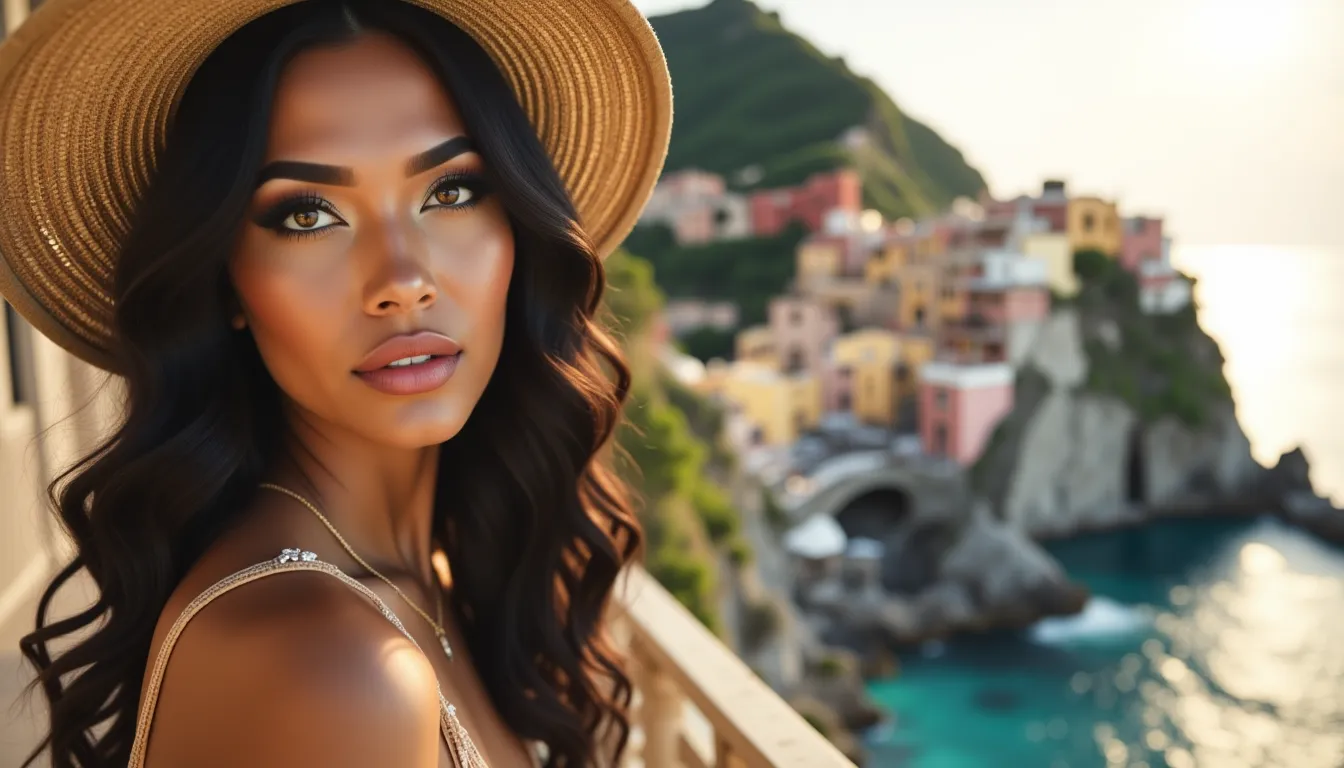
Day Two: The Town That Floats Above Everything
Ravello sits three hundred and fifty meters above the sea, and the road up to it is the kind of road that makes you grip the edge of your seat and then forget your fear entirely because the view from each switchback is more absurd than the last. The SITA bus will take you from the coast road and deposit you in a piazza so quiet you can hear church bells from three villages below. After the kaleidoscopic energy of Positano, Ravello feels like slipping into a deep, cool pool.
I went first to Villa Cimbrone, which costs EUR 7 to enter and is worth approximately one million times that. You walk through medieval gardens heavy with wisteria and rose, past stone arcades and crumbling statuary, and then you reach the Terrace of Infinity — a long, marble-balustraded overlook where the entire coast drops away below you and the sea and sky merge into a single blue that has no name. Gore Vidal, who lived in Ravello for decades, called it “the most beautiful view in the world,” and for once a writer was not exaggerating. Greta Garbo hid here with the conductor Leopold Stokowski during their affair in the 1930s, and standing on that terrace, I understood the impulse to disappear into beauty and never come back.
From Cimbrone I walked to Villa Rufolo — EUR 8 — whose thirteenth-century gardens are where Wagner sat in 1880 and was so overwhelmed that he found the inspiration to complete Parsifal. The Ravello Festival still holds concerts in these gardens from June through September, and tickets start around EUR 30. I did not attend a concert, but I sat on a bench where Wagner might have sat and listened to the wind in the umbrella pines and felt that perhaps this coast has always been in the business of making artists out of ordinary people.
Lunch was at Rossellinis, the Michelin-starred restaurant inside Palazzo Avino, where Chef Pino Lavarra serves a tasting menu that runs EUR 150 to 180 and deserves every euro. Each course arrived like a small sculpture — local fish with citrus foam, handmade pasta with sea urchin, a deconstructed sfogliatella that made me close my eyes. The dining room opens onto a terrace where you eat suspended above the coast, and the combination of extraordinary food and that specific quality of Ravello light — soft, golden, slightly unreal — made this the single best meal of my trip.
If Rossellinis feels like too much of a commitment, the Belvedere restaurant at the Belmond Hotel Caruso offers a more casual but equally spectacular lunch from the infinity pool terrace. A day pass that includes lunch runs roughly EUR 100 to 150, and the experience of eating burrata while gazing at the same view that has driven poets to madness is, by any measure, a bargain.
In the afternoon I wandered into Ceramiche d’Arte Carmela, a workshop where artisans hand-paint traditional Vietri ceramics in patterns that have not changed in centuries — lemons, donkeys, geometric Moorish designs in cobalt and yellow. I watched a woman paint a plate with such steady, practiced grace that I held my breath. Pieces start at EUR 15, and I left with a set of lemon-patterned espresso cups that I now use every morning and that transport me, with the first sip, directly back to this terrace.
Before heading back down to the coast, I made a detour to Atrani — Italy’s smallest municipality, a mere 0.12 square kilometers with about nine hundred residents. It connects to Amalfi through a short tunnel, but it feels like a different century. Piazza Umberto I is a tiny square where old men play cards and a single cafe serves espresso for EUR 1.50 — the Italian law that makes coffee cheaper when you drink it standing at the bar is one of civilization’s great achievements — and I stood there with my cup and watched the light change on the buildings and felt the kind of peace that only comes from very small, very old places.
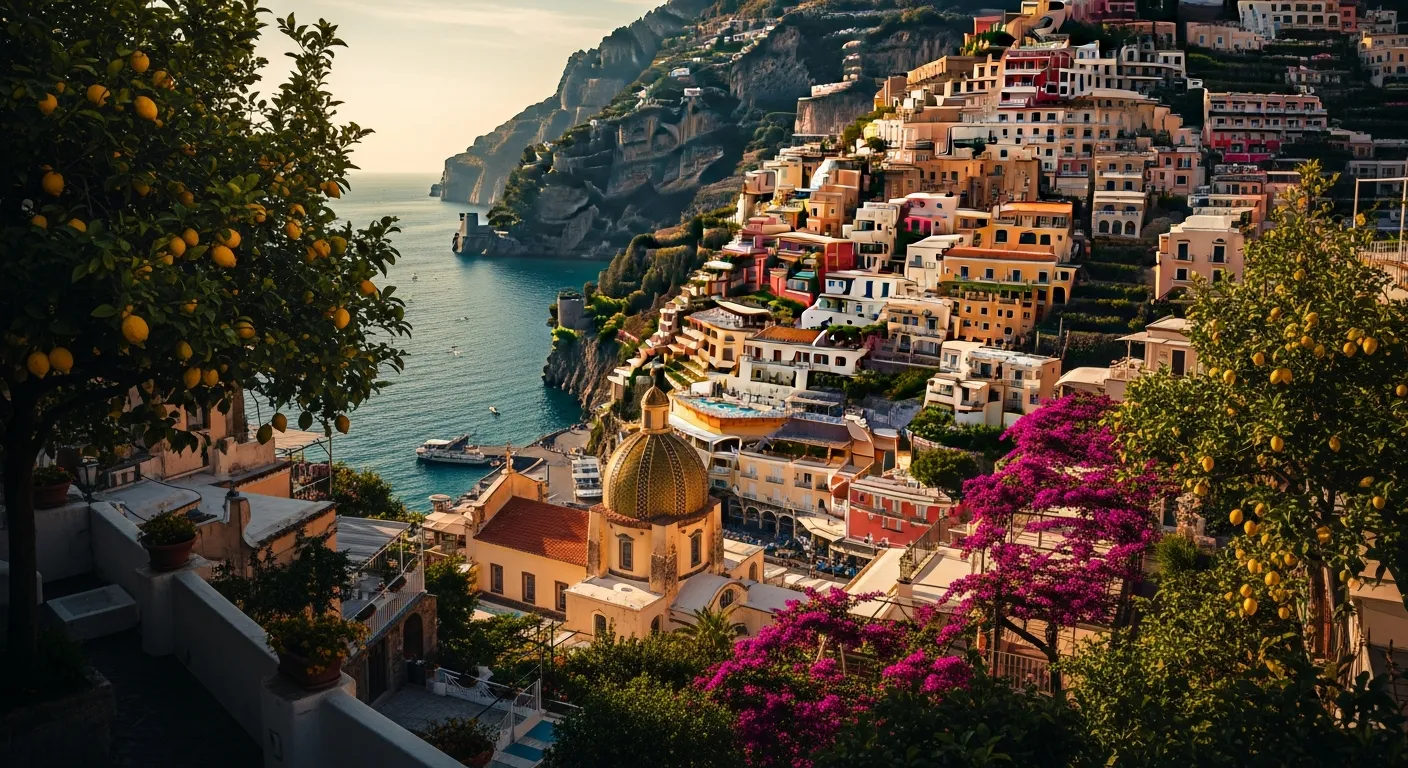
Day Three: The Cathedral, the Lemons, and the Long Goodbye
My last day began in Amalfi town itself, standing at the base of the Duomo di Sant’Andrea and looking up its sixty-two steps at a facade that is part Arab-Norman, part Gothic, part something that defies architectural vocabulary entirely. It costs EUR 3 to enter, and inside you will find the Chiostro del Paradiso — the Cloister of Paradise — a thirteenth-century arcade of interlocking arches that filters the light into something holy. The cathedral dates to the ninth century, and standing in that cloister, surrounded by silence and stone, I felt the particular weight of a place that has been sacred for over a thousand years.
From the cathedral I climbed into the hills behind town to walk through the lemon groves. The Sfusato Amalfitano lemon grows nowhere else on earth — it is enormous, thick-skinned, impossibly fragrant, and it is the reason the limoncello on this coast tastes nothing like the syrupy imitation you have had elsewhere. A lemon grove tour costs EUR 10 to 15 and ends with a tasting of limoncello made from fruit that was on the tree that morning, and I am telling you, the difference is so vast it is almost a different drink. The groves themselves are beautiful — terraced into the hillsides on ancient stone walls, shaded by chestnut-pole pergolas draped in netting, the air so thick with citrus scent it feels like breathing perfume.
I continued up the valley to the Valle dei Mulini — the Valley of the Mills — where the ruins of medieval paper mills crumble into the undergrowth. Most visitors do not know this, but Amalfi was once one of the Mediterranean’s great paper-making centers, and these mills, abandoned and half-swallowed by vegetation, tell the story of a coast that was once famous for industry and innovation, not just beauty. The walk takes less than an hour and ends at a waterfall where I had the ancient stones entirely to myself.
For my final lunch I went to Da Gemma, which has been run by the same family for four generations and serves the kind of food that makes you want to weep with gratitude. The soufflé al limone — a trembling, golden dome of Amalfi lemon and sugar and air — arrived at my table and I ate it slowly, deliberately, knowing it was the last perfect thing I would taste on this coast. The ferry from Positano to Amalfi runs about EUR 10 and takes twenty-five minutes — twenty-five minutes during which the entire coast unfolds beside you like a watercolor being painted in real time — and I took it back that afternoon, not because I needed to be in Positano, but because I wanted one more look at everything from the water.
A Detour for the Curious: Cetara
If your third day allows for it — and mine barely did, but I am glad I pushed — drive or bus fifteen minutes east of Amalfi to Cetara, a fishing village that has not yet learned to perform for tourists. Cetara is famous for colatura di alici, an anchovy fish sauce that is a direct descendant of the garum that ancient Romans prized above almost everything. At Al Convento, they drizzle it over pasta and the taste is deep and oceanic and unlike anything else I have ever eaten. This is the Amalfi Coast before the world discovered it — nets drying on the pier, cats sleeping on warm stone, the sound of boat engines in the morning.
The Numbers, Because You Will Want Them
I do not like reducing a place to its prices, but I know you will want to plan, so here is the truth of it: a mid-range day on the Amalfi Coast — a decent hotel, ferries between towns, two good meals and a glass of wine on a terrace — runs about EUR 200 to 350, which is roughly $235 to $410. A luxury day — a suite at Le Sirenuse or the Belmond, a private boat, dinner at Rossellinis — can run EUR 500 to well over 2,000. Most days I landed somewhere in between, splurging on the experiences that mattered most to me (the private boat, the Michelin tasting menu) and happily eating a EUR 3 slice of pizza al taglio for the meals in between. Water at restaurants is EUR 2 to 3 whether you take it naturale or frizzante, and espresso is EUR 1 to 1.50 if you drink it standing at the bar like a civilized person.
The coast is not cheap. But it is — and I mean this — worth every single euro. There are places in the world that are beautiful and places that are delicious and places that rearrange something fundamental in the way you experience being alive. The Amalfi Coast is all three at once.
The Last Light
On my final evening, I sat on a terrace — it does not matter which one, because every terrace on this coast faces the same impossible sea — with a glass of limoncello made from lemons that grew on the hill behind me. The sun was doing what it does here, which is to say it was turning the entire world into honey. Somewhere below, a church bell rang. Somewhere above, someone was laughing. The coast was doing what it has done for centuries: being so beautiful that it stops you mid-thought and makes you forget what you were going to say.
I had arrived three days earlier thinking I knew what to expect. I left knowing that the Amalfi Coast is not a destination you visit. It is a feeling you carry home with you, tucked between the lemon-scented sandals in your suitcase, and it stays with you — in the way you pour your morning espresso, in the way you tilt your face toward the afternoon sun, in the way you close your eyes sometimes and see, printed on the inside of your lids, that infinite terrace and that infinite sea and that golden, golden light.
Worth reading next
More stories worth your time.

Where to Stay in Tokyo: A Luxury Neighborhood Guide
An honest guide to where to stay in Tokyo, with the neighborhoods, hotel styles, and tradeoffs that matter before you book.

The Winter Alps: Where Luxury Means Wood Fires, Not Gold Leaf
Four Alpine towns, four different ideas of what winter luxury means. From Zermatt's car-free quiet to Courchevel's fur-coat chaos, a guide to the Alps for people who care about the fire in the lobby.

Where to Eat in Tokyo: A Guide for People Who Take Food Personally
Two weeks in Tokyo, eating three meals a day plus snacks, convenience store runs at midnight, and one life-altering omakase. A neighborhood-by-neighborhood guide for people who consider food a personality trait.
About Kaira
Explore With Kaira is built for readers who want the atmosphere of a luxury travel magazine without the emptiness of sponsored copy.
About Kaira