Three Days in AlUla: Sandstone, Stars, and the Silence Between
The Time Before Time The muezzin’s call echoes off sandstone cliffs older than Christianity, and I’m sitting in a 2,000-year-old tomb watching the sun set over a landscape that looks like Mars dreamed it could be beautiful. This is AlUla at golden hour — when the desert reveals why the Nabataeans chose this valley to […]

The Time Before Time
The muezzin’s call echoes off sandstone cliffs older than Christianity, and I’m sitting in a 2,000-year-old tomb watching the sun set over a landscape that looks like Mars dreamed it could be beautiful. This is AlUla at golden hour — when the desert reveals why the Nabataeans chose this valley to carve their eternal cities into rose-red rock.
I arrived three hours ago on a 90-minute flight from Riyadh that cost me 250 riyals — about $67 if you catch the budget carriers right. The new AlUla airport is small enough that you’re breathing desert air within minutes of landing, but sophisticated enough that customs processed my eVisa (applied for online two weeks prior for about $140) before I’d finished checking my watch.
The thing about AlUla is that it doesn’t unfold gradually. One moment you’re in an airport that could belong to any modern Gulf city, the next you’re driving past formations that belong in a geology textbook — if geology textbooks included chapters on magic.
Old Secrets, New Light
My first afternoon belongs to Old Town AlUla, a labyrinth of mudbrick streets that wind between buildings some sources date to the 12th century. I’ve hired one of the Rawi storytelling guides — 70 riyals well spent — and Khalid leads me through passages so narrow that two people must turn sideways to pass.
“This house,” he says, running his palm along a wall, “belonged to a spice trader who could afford glass windows. See?” The afternoon light catches fragments still embedded in the mud brick. “His children played where your feet are now.”
We emerge onto Market Street, where coffee shops occupy buildings that once stored frankincense bound for Rome. The scent of cardamom and Arabic coffee drifts from Zahra Cafe, where the owner’s grandmother’s coffee pot still serves visitors from a recipe older than the Saudi state. I order qahwa arabi and sit in a courtyard where bougainvillea climbs walls that have sheltered travelers for centuries.
The artisan workshops here aren’t tourist theater — they’re working studios where master craftsmen still hand-weave the baskets that local families use to carry dates from their palm groves. Ahmed shows me how the palm fronds must be split just so, soaked just long enough, woven with a tension that comes only from decades of practice. His baskets sell for 150 to 300 riyals, and watching his hands work, I understand they’re underpriced.
As evening approaches, I drive the fifteen minutes to Elephant Rock — a 52-meter sandstone formation that does indeed look like a massive elephant kneeling to drink from an oasis that disappeared millennia ago. Entry is free, parking is easy, and by 5 PM the SALT food truck has positioned itself perfectly for sunset service. I order their beef slider and settle onto one of the cushions they’ve arranged among the desert scrub.
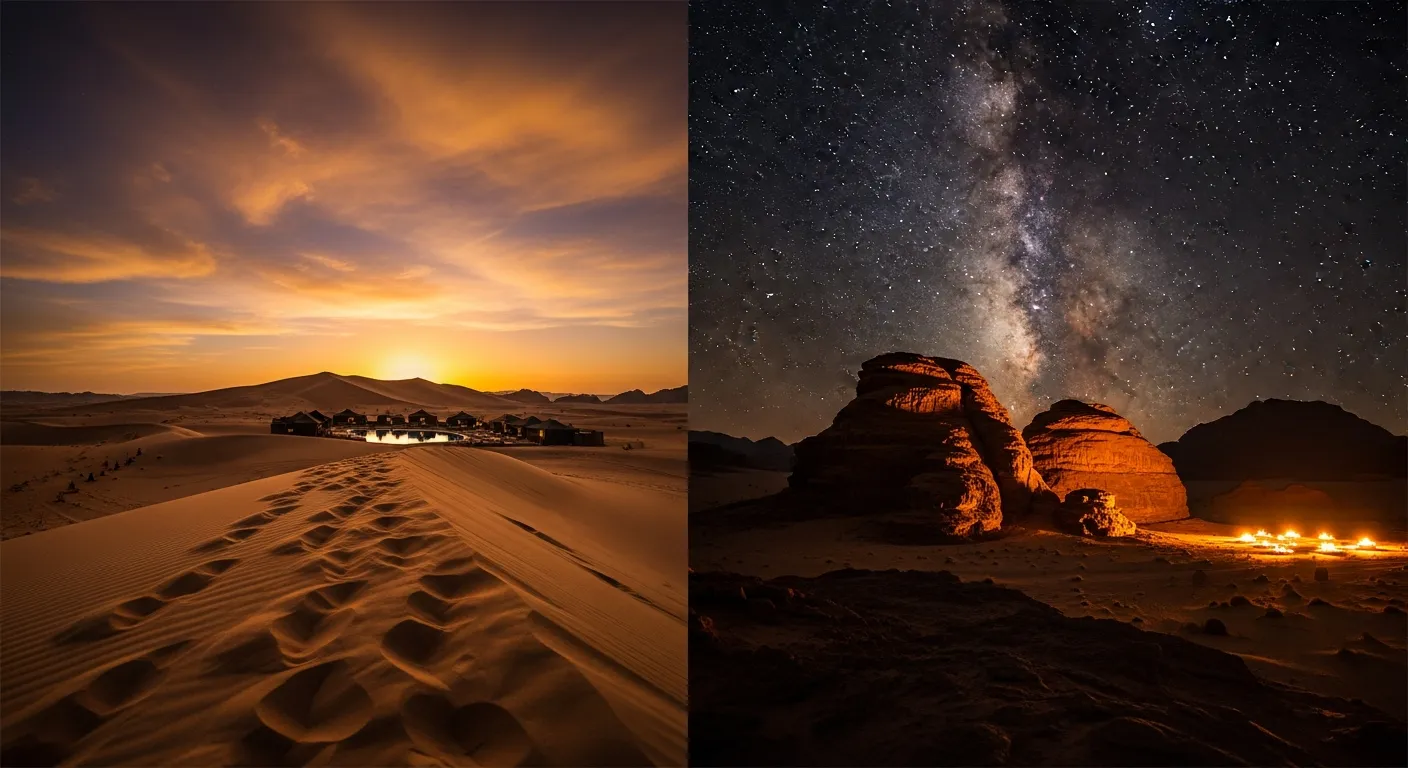
The rock changes color as the sun drops — rose to amber to deep gold to wine-dark purple. Music drifts from hidden speakers, soft enough that you can still hear the silence underneath. Families spread blankets on the sand, couples share tea from thermos flasks, and I watch the first stars appear in a sky so clear it makes city dwellers remember what we’ve lost. The fire pits stay lit until midnight, and I’m not the only one who stays late to watch the Milky Way emerge in full desert glory.
Dinner is at JOONTOS in Dar Tantora Resort, where Executive Chef Sergio has earned the first Bib Gourmand recognition in Saudi Arabia by treating local ingredients with the respect they deserve. The restaurant occupies a restored heritage building where 1,800 candles are lit by hand each evening — a nightly ceremony that transforms dining into something approaching ritual. His date molasses-glazed lamb shoulder with freekeh would impress in London or New York, but tastes more honest here among these ancient walls.
Cities of the Dead
Day two begins early because Hegra — Saudi Arabia’s first UNESCO World Heritage site — deserves the cool morning air and the light that brings the carved facades to life. The standard entry is 95 riyals, but after talking to other travelers at breakfast, I upgrade to the private Vintage Land Rover tour for 1,200 riyals. Worth every riyal. The standard coach tour restricts you to designated viewpoints and preset timings; the private tour lets you approach the tombs closely enough to see the chisel marks, sit in shade where Nabataean merchants once negotiated deals worth fortunes.
Our guide Mohammed drives me to Qasr Al-Farid first — the Lonely Castle, a 22-meter tomb carved for a merchant prince whose name has been lost but whose ambition survives in stone. It stands alone, the most photographed monument in Saudi Arabia, but photographs don’t capture the scale or the silence. Standing at its base, craning my neck to follow the intricate geometric patterns up four stories of sandstone, I understand why the Nabataeans called this place Hegra — the rocky place. But rocky suggests barrenness, and this landscape pulses with the ghost of vanished abundance.
At Jabal Ithlib, Mohammed leads me up carved steps to the Diwan — a ceremonial hall carved directly into the mountain. The acoustics are perfect; a whisper at one end carries clearly to the other. We sit in the same spaces where Nabataean priests once performed rituals we can only imagine, and I close my eyes to hear what they heard — wind through stone, the distant call of desert larks, silence deep enough to pray into.
By noon, the sun has grown serious about heating the desert, so I retreat to Tama Restaurant at Our Habitas, where lunch unfolds in an open-air pavilion that somehow stays cool through architectural magic and strategically placed misters. The menu reads like a love letter to the Arabian Peninsula — labneh with sumac and locally foraged herbs, grilled kingfish with baharat spice blend, lamb that spent its life in these very valleys. Service is unhurried, which suits the desert pace perfectly.
Afternoon brings Dadan and Jabal Ikmah — a combined ticket at 60 riyals that grants access to the open-air library where more than 300 inscriptions span 2,500 years. This is where Dadanite, Lihyanite, and early Arabic scripts cover rock faces like the world’s oldest graffiti. Dr. Sarah, a Saudi archaeologist working the site, explains that many inscriptions are prayers for safe passage — merchants asking gods to protect their caravans through the valley passes.
“This one,” she says, pointing to a script that looks like careful scratches, “asks for protection from lions. Lions lived here then. The ecology was completely different.”
I try to imagine lions padding through valleys where now only the wind moves through desert scrub, and the landscape grows even more mysterious.
Late afternoon finds me at Harrat Uwayrid viewpoint, where the valley spreads below like a diorama of geological time. The volcanic rocks here are black as midnight against rose sandstone, creating contrasts that seem almost deliberate — as if some ancient artist arranged the landscape for maximum visual impact.
Dinner is at Maraya Social, where Jason Atherton has created a menu that would fit perfectly in his London restaurants but tastes more authentic here. His take on kabsa — using Najdi rice cooked with stock made from local sheep bones — respects tradition while adding technical precision that transforms familiar flavors into revelations.
Sky and Stone
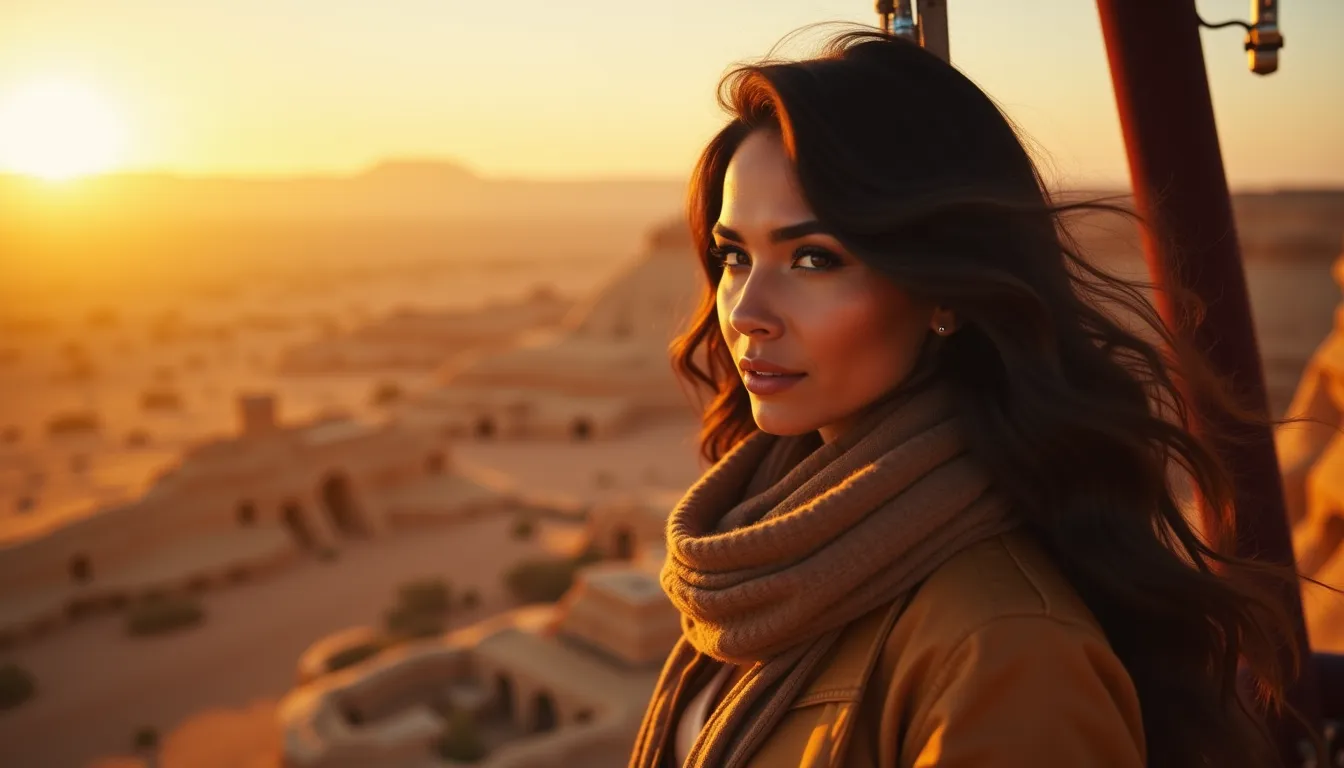
Day three begins in darkness — 4:30 AM pickup for the hot air balloon flight that costs 1,295 riyals but ranks among the most spectacular travel experiences I’ve ever purchased. As we rise silently above Hegra at sunrise, the valley reveals patterns invisible from ground level. Ancient roads connect the tomb cities, irrigation channels trace green lines through desert sand, and the scale of Nabataean engineering becomes clear from 1,200 meters above.
Our pilot Ahmed has been flying these skies for three years, since AlUla opened to tourism. “Every morning is different,” he says as we drift over Elephant Rock. “Some days the thermals carry us toward Dadan, other mornings we see Hegra from angles even the archaeologists haven’t photographed.”
The silence up here is profound — broken only by occasional bursts from the burner and Ahmed’s quiet commentary. Below us, the landscape scrolls past like a slowly unrolling map, revealing the connections between archaeological sites, the logic of ancient trade routes, the reasons why caravans laden with frankincense and silk chose this particular valley to rest and trade.
Landing is gentle — a bump in the sand beside our chase vehicle, where a breakfast of dates and Arabic coffee waits under a portable gazebo. AlUla is the world’s third-largest Dark Sky Park, and from our balloon at dawn, I understand why. The absence of light pollution means star visibility that rivals Antarctica, and the desert clarity creates views that seem to stretch beyond the horizon’s mathematical limits.
Mid-morning, I tour Maraya — the world’s largest mirrored building, where 9,740 mirrors reflect the surrounding landscape so perfectly that the concert hall seems to disappear into the desert. The guided tour (95 riyals) reveals the engineering challenges of building in temperatures that range from 6°C winter nights to 45°C summer days, and the acoustic innovations that allow this space to host everything from Andrea Bocelli to Saudi traditional music.
The adventure options here cater to different types of travelers. The zipline — 1.5 kilometers at speeds up to 120 km/h — offers pure adrenaline against a backdrop of archaeological treasures. Horseback riding (280 riyals for two hours) provides a more contemplative way to cross landscapes that haven’t changed much since the Nabataean period. I choose the Ridge Walk — a 6-kilometer hike that takes 2.5 hours and requires reasonable fitness but rewards effort with viewpoints that place AlUla’s archaeological sites in their full geographical context.
My final lunch is at Saffron, the Thai restaurant at Banyan Tree Resort, where Executive Chef Wasan has created a menu that respects both Thai tradition and Saudi hospitality customs. Her tom yum uses locally sourced seafood from the Red Sea, and her massaman curry incorporates dates from AlUla’s own palm groves. It’s fusion done right — honoring both cultures instead of confusing them.
What the Postcards Don’t Show
Before leaving, I spend my final hour browsing Market Street in Old Town AlUla, where the handmade silver jewelry incorporates traditional Bedouin designs with contemporary Saudi craftsmanship. The local dates — particularly the amber-colored khalas variety — taste nothing like the dried dates sold in Western supermarkets. Here they’re soft, complex, with flavor notes that range from honey to brown butter. I buy three kilos to share with friends who will never believe dates can taste like this.
The honey vendor explains that his bees collect nectar from sidr trees that grow wild in the valleys around Hegra. This honey — thick, golden, with a flavor that carries hints of the herbs and flowers his bees visit — sells for 150 riyals per kilogram and represents weeks of work in landscape that hasn’t changed since his grandfather’s time.
What most people miss about AlUla is that rushing kills the magic. This isn’t a destination for checking boxes or collecting Instagram shots. The landscape reveals itself slowly, to travelers willing to sit still long enough for the silence to speak. The archaeological sites are spectacular, but they’re part of a larger story about human persistence in impossible places, about civilizations that thrived by understanding rather than conquering their environment.
Before You Land
Flying back to Riyadh as the sun sets behind AlUla’s red cliffs, I carry with me the practical details that make this journey possible. The eVisa process takes minutes for travelers from 66 eligible countries. Dress modestly in public — cover elbows and knees — though AlUla is more relaxed than most Saudi cities, and resort pool areas welcome swimwear. There is no alcohol anywhere in the Kingdom, but the mocktail programs at Maraya Social and the hotel bars have made the absence something closer to a creative challenge than a limitation.
Visit between November and February when daytime temperatures hover between 15°C and 25°C — perfect for exploring archaeological sites and hiking desert trails. Avoid June through September unless you have a particular fondness for temperatures exceeding 40°C. Winter nights can drop to 6°C, so pack layers. Ramadan — falling around February 17 to March 18 in 2026 — actually offers advantages: lower prices, fewer crowds, and communal iftar dinners that reveal Saudi hospitality at its most generous.
Budget around $2,000 to $5,600 per person for three luxury days, with accommodation ranging from $350 to $1,120 per night. Rent a car — AlUla’s sites are spread across a valley larger than some countries, and the freedom to stop when something catches your eye is worth the expense. Most importantly, leave space in your schedule for the unexpected discoveries that make AlUla unforgettable — the perfect light on sandstone, the conversation with an archaeologist, the moment when you realize you’re sitting where merchants counted profits in currencies that no longer exist.
Some journeys change how you see the world. AlUla changes how you see time itself.
Worth reading next
More stories worth your time.

Where to Stay in Tokyo: A Luxury Neighborhood Guide
An honest guide to where to stay in Tokyo, with the neighborhoods, hotel styles, and tradeoffs that matter before you book.

The Winter Alps: Where Luxury Means Wood Fires, Not Gold Leaf
Four Alpine towns, four different ideas of what winter luxury means. From Zermatt's car-free quiet to Courchevel's fur-coat chaos, a guide to the Alps for people who care about the fire in the lobby.

Where to Eat in Tokyo: A Guide for People Who Take Food Personally
Two weeks in Tokyo, eating three meals a day plus snacks, convenience store runs at midnight, and one life-altering omakase. A neighborhood-by-neighborhood guide for people who consider food a personality trait.
About Kaira
Explore With Kaira is built for readers who want the atmosphere of a luxury travel magazine without the emptiness of sponsored copy.
About Kaira