Three Days in Bazaruto: Dugongs, Coral Cathedrals, and the Edge of Everything
The helicopter drops below cloud cover, and suddenly the Indian Ocean spreads beneath us like scattered emeralds — five pristine islands floating in water so clear I can see the shadow of our aircraft racing across coral gardens twenty meters below. This is my first glimpse of the Bazaruto Archipelago, and after seventeen hours of […]

The helicopter drops below cloud cover, and suddenly the Indian Ocean spreads beneath us like scattered emeralds — five pristine islands floating in water so clear I can see the shadow of our aircraft racing across coral gardens twenty meters below. This is my first glimpse of the Bazaruto Archipelago, and after seventeen hours of flying from New York via Johannesburg, then another two hours on Airlink’s morning service to Vilankulo ($291 if you book months ahead, closer to $610 if you’re spontaneous like I was), the fifteen-minute helicopter transfer at $265 per person feels less like expense and more like ascension.
The pilot banks toward Benguerra Island, and I press my face to the window. Schools of rays glide over seagrass meadows where dugongs — those mythical sea cows — still graze in waters unchanged since Vasco da Gama first mapped this coast in 1498. Three days suddenly feels criminally short.
Day One: Arrival and First Immersion
The helicopter settles onto white sand so fine it squeaks underfoot, and lodge staff appear with cold towels scented with frangipani and glasses of something involving fresh passion fruit. My villa — stilted over a lagoon where hermit crabs scuttle between mangrove roots — comes with a deck so close to the water I can hear parrotfish crunching coral while I unpack.
I learned during my visa application (free for Americans, just the $10 Electronic Travel Authorization at evisa.gov.mz — do this 48 hours before departure or face complications) that Mozambique’s coastline stretches 2,500 kilometers, but only here in the Bazaruto Marine National Park do all the elements align: warm Agulhas Current, nutrient-rich upwellings, and protection from the cyclones that hammer the coast between February and March.
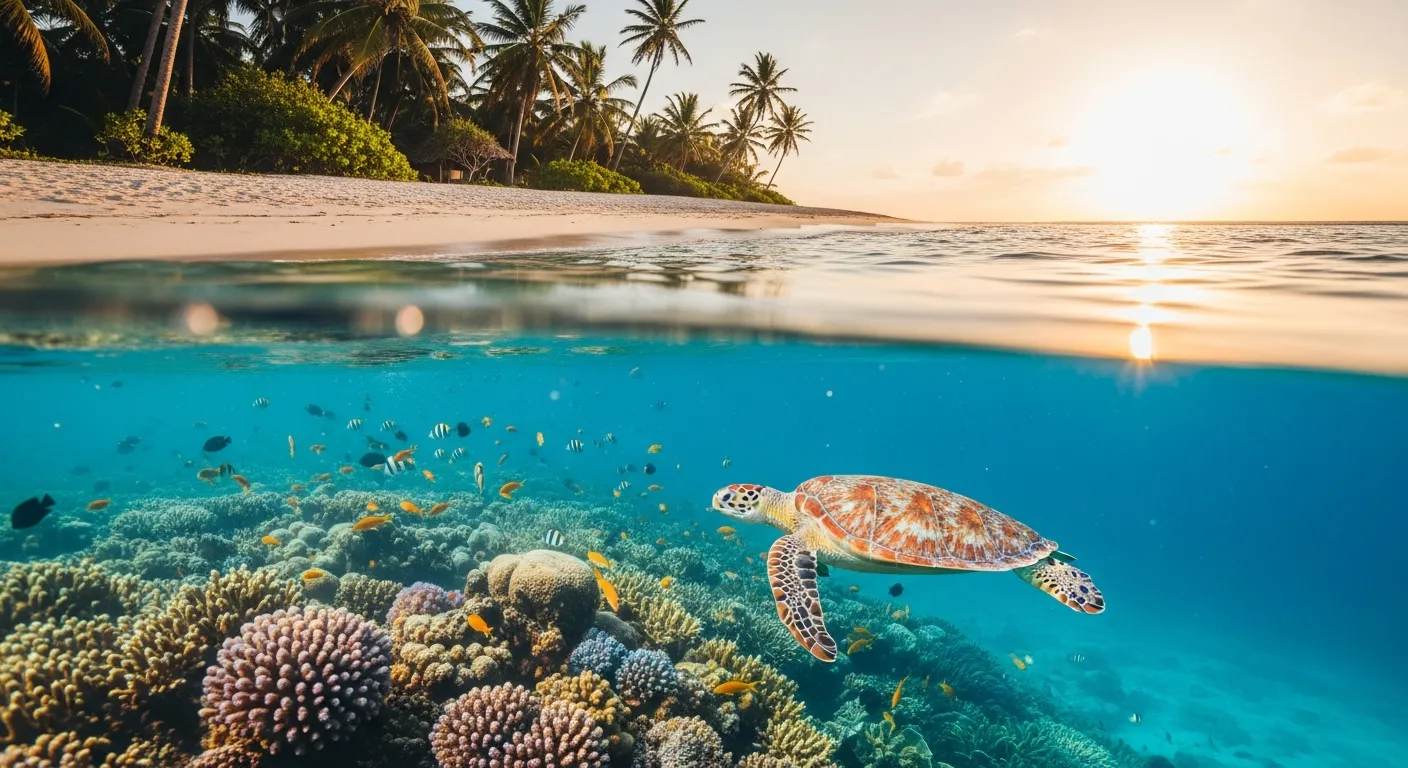
By afternoon, the lodge’s marine biologist has me floating above the house reef in water so clear the visibility reaches thirty meters on this July day. Dry season here means not just perfect weather but gin-clear water — the northeast monsoons that cloud visibility from December through February are months away. Moorish idols drift past like living art, and I count seven species of angelfish before losing track entirely. The reef drops from three meters to fifteen in a wall so vertical it seems architectural, built by centuries of plate corals and brain corals that glow electric in the afternoon light.
As the sun begins its descent, I’m aboard a traditional dhow — these Arabic sailing vessels have plied these waters for a millennium, their lateen sails unchanged since the days when Swahili traders carried gold and ivory to Asia. Our captain, Armando, learned to sail from his grandfather and knows every current, every reef, every place where dolphins gather at sunset. The wind fills our sail as we glide past Magaruque Island, and he tells me about the Portuguese who named this place “Bay of Small Prawns” — though as I discover at dinner, the prawns here are anything but small.
The welcome feast unfolds on the beach: prawns the size of small lobsters, grilled with peri-peri sauce that makes my lips tingle, alongside matapa — a traditional stew of cassava leaves cooked in coconut milk and ground cashews that tastes like the essence of this coast. The lodge chef sources everything locally: the prawns caught this morning, the coconut from palms I can see swaying in the breeze, the cashews from trees that were planted when Mozambique was still Portuguese East Africa.

Day Two: Into the Cathedral
Dawn comes with the sound of fruit bats settling into their roosts and fish eagles calling from the baobabs. By seven AM, I’m aboard a dive boat heading for Two Mile Reef, where the Mozambique Channel drops to depths that humble the imagination. My dive master, Carlos, has been exploring these waters for fifteen years, and his eyes light up when he describes today’s plan.
“First dive is The Cathedral,” he says as we kit up. “Eighteen meters, swim-throughs like church arches. Then The Arches at twelve meters — you’ll understand when you see them. If conditions are perfect, we finish at Shark Point.”
The Cathedral earns its name the moment I descend. Massive coral formations create natural flying buttresses, their surfaces alive with soft corals in colors that don’t exist on land — electric purples, neon oranges, yellows bright as tropical sunlight. Schools of yellowtail snappers move like living curtains, parting as I swim through passages that feel genuinely sacred. At eighteen meters, the water pressure creates an intimacy with this underwater architecture; every breath matters, every moment intensified.
The Arches live up to their billing — natural coral formations that create perfect doorways at twelve meters depth. But it’s Shark Point that stops my heart: a cleaning station where grey reef sharks hover motionless while cleaner wrasses pick parasites from their skin. Carlos signals me to remain still, and for ten minutes I watch this ancient ritual, predators transformed into gentle patients in an underwater spa.
Between dives, we search the seagrass beds for dugongs. These gentle giants — related to elephants, Carlos tells me — graze here like underwater cattle, surfacing every few minutes to breathe through nostrils that close with muscular valves. We spot a mother with her calf, both moving with the unhurried grace of creatures that have survived ice ages and colonialism alike.
Lunch unfolds on a sandbar that exists only at low tide — one of those Robinson Crusoe moments that justify every hour of travel, every malaria pill (I’m religious about my Malarone, having learned the hard way in Madagascar that “it’s just an island” is no protection against mosquito-borne illness). The lodge staff has somehow transported a full feast here: lobster grilled over driftwood fires, fresh-caught dorado still warm from the grill, champagne that stays cold in an ingenious sand-and-seaweed cooler. The sandbar stretches for hundreds of meters in every direction, our footprints the only evidence that humans have ever stood here.
The afternoon offers choices. Half-day deep-sea fishing runs $714 and the lodge’s track record is impressive — yesterday’s trip returned with sailfish and dorado. But I opt for a second dive at Manta Reef, where the current brings plankton-rich water that attracts these gentle giants. No mantas today, but the reef itself is worth the descent: soft corals that wave like underwater wheat fields, and visibility so perfect I can see the dive boat floating above us like a child’s toy in a bathtub.
Day Three: Land and Sea Farewells
My final morning begins with hoofprints in sand so pristine it looks raked. The lodge’s horses — sturdy animals bred for beach riding — carry me along fifteen kilometers of coastline where my only companions are ghost crabs and the occasional sacred ibis picking through tidal pools. The morning light turns everything golden: the dunes behind us, the water beside us, even the horses’ coats gleaming like polished leather.
The flight back to Vilankulo — speedboat today, trading helicopter drama for a more intimate thirty-minute journey across waters that shift from turquoise to sapphire to deep indigo — gives me time to process three days that feel like three weeks of experiences compressed. The boat captain, Joaquim, points out landmarks: the channel where humpback whales pass through during their August-to-October migration, the reef where manta rays gather to feed when the plankton blooms in November.
Vilankulo town offers a perfect cultural transition. The century-old market sprawls across several blocks, a maze of vendors selling everything from cashews to capulanas (the colorful wraps worn by local women) to carved dhow models. I buy cashews still warm from roasting and hand-woven baskets that smell of palm fiber and ocean salt.
The dhow seahorse safari proves unexpectedly moving. These waters support one of the world’s largest seahorse populations, and our guide, Ana, works with the local conservation project that’s teaching fishermen to farm them sustainably rather than harvesting wild populations for the aquarium trade. We spot three species during our two-hour sail, including the tiny Bargibant’s seahorse that measures less than two centimeters and camouflages perfectly against fan corals.
Lunch at the harbor restaurant is a final feast: langoustines grilled with garlic and lime, served with sadza (the local cornmeal staple) and beer so cold it fogs my sunglasses. The owner, Maria, learned to cook from her Portuguese grandmother and her Mozambican mother, and her fusion captures this coast perfectly — European techniques applied to Indian Ocean ingredients with African soul.
What Most People Miss
The real treasure of Bazaruto isn’t the obvious luxury — though my three nights, including flights, transfers, and activities, cost between $4,035 and $10,505 depending on season and accommodation level. It’s the realization that this remains Africa’s last pristine marine ecosystem, where dugongs still outnumber tourists and traditional dhow builders still craft boats by eye and experience rather than blueprint.
Most visitors rush to tick boxes: snorkel, dive, fish, leave. But the archipelago rewards stillness. My most profound moment came during an unscheduled sunrise walk, when I encountered a group of local fishermen launching their dhow. They invited me aboard for their morning net check, and for two hours I learned about reading currents, identifying fish by their scales in the nets, and the Portuguese-Makhuwa-English pidgin that serves as lingua franca here.
The fishermen taught me that conservation here isn’t about keeping humans out — it’s about maintaining balance that’s existed for centuries. The traditional fishing methods, the seasonal patterns, the respect for breeding areas all developed over generations of sustainable practice. The real threat isn’t tourism but industrial fishing from distant waters.
Essential Realities
Come prepared for remoteness. Vilankulo’s hospital serves a vast rural area, and there’s no hyperbaric chamber for diving emergencies — DAN dive insurance isn’t optional here. Pack antimalarials religiously (Malarone, Doxycycline, or Mefloquine), reef-safe sunscreen, DEET with at least 30% concentration, and US dollars in small bills. ATMs in Vilankulo are unreliable, and the exchange rate hovers around 64 meticais per dollar.
Timing matters crucially. May through June offers perfect weather plus migrating humpback whales. October and November bring whale sharks and manta rays but higher humidity. Avoid February and March entirely — cyclone season turns paradise into purgatory, and several lodges close completely.
The seventeen-hour journey from New York via Johannesburg tests commitment, but every minute proves worthwhile when you’re floating above coral gardens that stretch to horizons unmarked by development. This is what the Maldives was like fifty years ago, what the Caribbean might have been without cruise ships, what the Great Barrier Reef remembers from before warming seas and crown-of-thorns starfish.
Pack light clothes for cool winter evenings — July nights can drop to 15°C — and don’t expect Maldives-style overwater bungalows. The luxury here is different: space, silence, and the profound satisfaction of experiencing one of Earth’s last marine wildernesses before the world discovers it completely.
Three days barely scratches the surface, but it’s enough to understand why this archipelago changes everyone who visits. You return home with salt still in your hair and the rhythm of traditional dhows still echoing in your dreams, carrying memories of a place where the Indian Ocean still remembers what paradise actually means.
Worth reading next
More stories worth your time.

Where to Stay in Tokyo: A Luxury Neighborhood Guide
An honest guide to where to stay in Tokyo, with the neighborhoods, hotel styles, and tradeoffs that matter before you book.

The Winter Alps: Where Luxury Means Wood Fires, Not Gold Leaf
Four Alpine towns, four different ideas of what winter luxury means. From Zermatt's car-free quiet to Courchevel's fur-coat chaos, a guide to the Alps for people who care about the fire in the lobby.

Where to Eat in Tokyo: A Guide for People Who Take Food Personally
Two weeks in Tokyo, eating three meals a day plus snacks, convenience store runs at midnight, and one life-altering omakase. A neighborhood-by-neighborhood guide for people who consider food a personality trait.
About Kaira
Explore With Kaira is built for readers who want the atmosphere of a luxury travel magazine without the emptiness of sponsored copy.
About Kaira